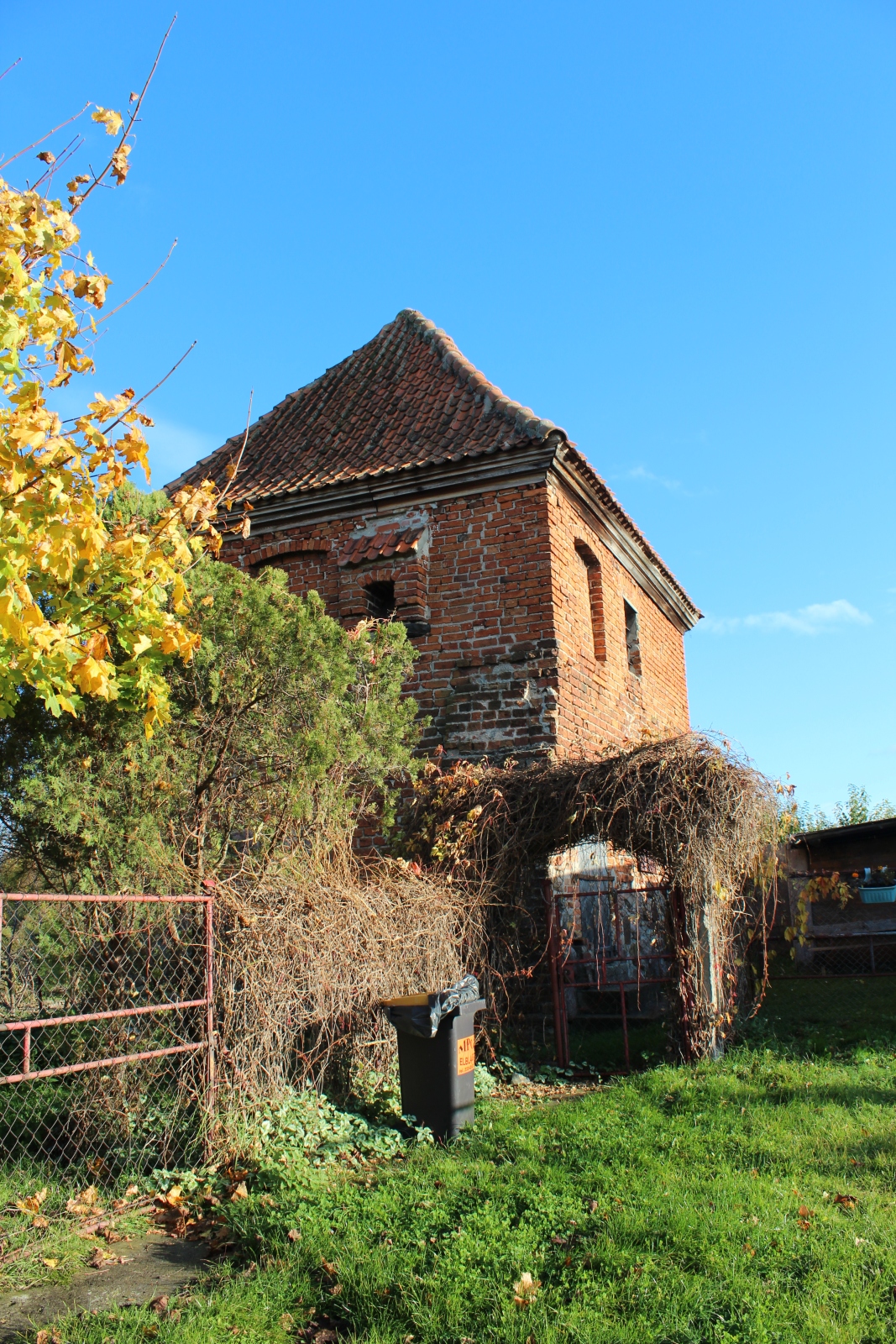
Defensive Tower in Tolkmicko
General Information
The defensive tower in Tolkmicko is a Gothic structure constituting a surviving fragment of the town’s former defensive walls. The monument has been entered in the register of historic monuments of the Warmian-Masurian Voivodeship.
Location / Geographical Setting
The tower is located within the historic centre of Tolkmicko, on private property at 3 Basztowa Street. It can be reached most easily by walking from the Church of St James the Apostle in the direction of the cemetery.
History
Probably during the rule of Grand Master Winrich von Kniprode (c. 1310-1382), who governed in the second half of the fourteenth century, the wooden palisade surrounding the town was replaced by a permanent brick defensive wall. The wall reached a height of approximately 5-6 metres and was strengthened by several towers. Two main gates led into the town: the Frombork Gate to the north and the Elbląg Gate to the south. In addition, there were probably smaller postern gates facilitating communication with the fishing harbour located on the shore of the Vistula Lagoon. The town was further protected by a moat supplied with water from a nearby stream. In later times, the Mill Canal and artificial ponds were created on the western side.
The tower, whose remains have survived to the present day, was erected of brick on a rectangular plan at the end of the fourteenth century. The structure is evidence of the typical urban fortification system of the period, in which towers reinforced the line of the defensive walls and served as guard posts. Its position and function indicate that it controlled access to the town and protected one of the more vulnerable stretches of the fortifications.
During the Polish-Teutonic wars, Tolkmicko played an important role in the conflicts between the Teutonic Order and the Polish Crown. In 1440, the town joined the Prussian Confederation. During the Thirteen Years’ War (1454-1466), the inhabitants captured and demolished the seat of the Teutonic officials. In retaliation, Teutonic troops forced their way within the town walls on 22 July 1456 and, while withdrawing, set the town buildings on fire. After Tolkmicko was incorporated into Royal Prussia, it became the seat of a starosty. Its first starost was Jan Bażyński (c. 1390-1459), appointed in 1457.
After the First Partition of Poland, Tolkmicko found itself within the Kingdom of Prussia. In the Prussian period, the damaged and weakened Gothic defensive walls were gradually dismantled, and their material was reused in the construction of new town houses and municipal facilities. Only this single tower has survived to the present day.
Architectural Characteristics
The tower is an example of Brick Gothic defensive architecture, typical of the former Prussian territories and the southern Baltic coast. Built of brick, it has a simple massing based on a rectangular plan. The building has two storeys, which made it possible to station guards and store supplies of ammunition and food. Its upper part is crowned by a tent roof covered with roof tiles, protecting the interior from weather conditions.
The layout of the tower indicates numerous alterations and repairs carried out over the centuries. Its construction reflects the practical approach characteristic of military building – solid brick walls provided the main protection, while the rectangular plan offered good visibility over the foreground and enabled effective observation. Towers of this kind were a typical element of medieval urban defence systems, forming important nodes within the fortification structure.
Current Condition
Today, the tower remains a valuable document of medieval military architecture and a testimony to the significance of Tolkmicko in the former defensive system of the region. The monument, entered in the register of historic monuments, is not open to visitors because it stands on private property. However, its façade, visible from the street, allows observers to appreciate its form and its construction characteristic of Brick Gothic architecture.
Bibliography
- "Baszta", https://zabytek.pl/pl/obiekty/tolkmicko-baszta, [accessed: 12.11.2025].
- "Baszta obronna", https://polska-org.pl/11083617,Tolkmicko,Baszta_obronna.html, [accessed: 12.11.2025].
- "Tolkmicko", https://encyklopedia.warmia.mazury.pl/index.php/Tolkmicko, [accessed: 12.11.2025].
- "Średniowieczna baszta gotycka oraz pozostałości dawnych murów obronnych miasta", http://lanzania.pl/turystyka/ciekawe-miejsca/, [accessed: 12.11.2025].
- "Zabytkowa baszta w Tolkmicku", https://www.portel.pl/dawny-elblag/zabytkowa-baszta-w-tolkmicku/92142, [accessed: 12.11.2025].
- "Tolkmicko – miejskie mury obronne", https://zamkiobronne.pl/mury-miejskie/tolkmicko/, [accessed: 12.11.2025].