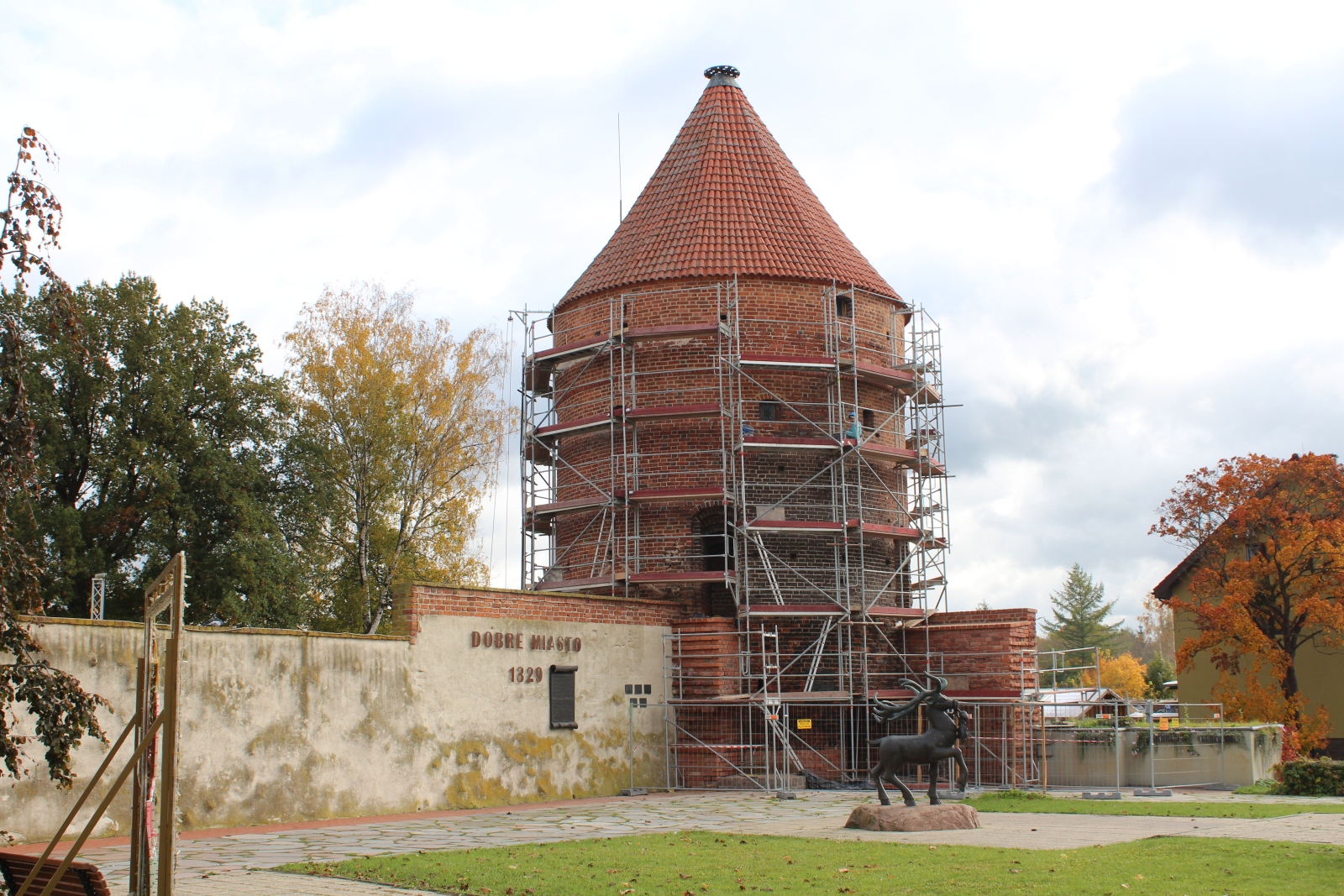
Stork Tower in Dobre Miasto
General Information
The Stork Tower is located in Dobre Miasto (until 1945: Guttstadt) in Warmia, in the former Prussian province of Pogezania. It lies in the central part of the Warmian-Masurian Voivodeship, within the Olsztyn Lake District, in the picturesque valley of the Łyna River, which surrounds the old town from the east and south. The locality was historically associated with the functioning of the Warmian collegiate chapter. The name of the town evolved from the Prussian Guddamistan, through the German Guttstadt and the Latin Bona Civitas, to the Polish Dobre Miasto. Today, the town serves as the seat of an urban-rural municipality. According to data from the Central Statistical Office of 1 January 2024, the population of Dobre Miasto amounted to 9,255 inhabitants.
The Stork Tower (German: "Storchenturm") is one of the most recognisable symbols of the town and a valuable monument of medieval defensive architecture. The structure is under conservation protection and currently serves museum and cultural functions as the seat of the Museum of Dobre Miasto, operated by the “Pojezierze” Socio-Cultural Association.
Location
The Stork Tower is situated in the north-eastern part of the historic urban layout, on Józefa Sowińskiego Street, in close proximity to the former collegiate church of the Most Holy Saviour and All Saints. It is the only fully preserved element of the former defensive walls that once encircled the town.
History
The construction of the tower is dated to the 14th or 15th century (most often to the period after 1356, when, following a Lithuanian raid, the construction of masonry fortifications began). It formed an integral part of the town’s defensive system, laid out on a plan approximating a rectangle. In the Middle Ages and early modern period, the tower served strictly military functions, flanking the north-eastern corner of the town walls, while its lower storeys were used as a prison (dungeon).
After the First Partition of Poland and the incorporation of Warmia into Prussia in 1772, and later during the 19th-century urban transformations, the town walls were gradually dismantled. The tower escaped this fate, although it lost its military significance. In 1945, during the Red Army offensive, the structure itself was not destroyed, although the town was largely burned. Immediately after the war, the tower was used, among other purposes, as temporary accommodation for Soviet soldiers. The name “Stork Tower” is not accidental and is related to the fact that for generations storks have nested on the top of its مخروط-shaped roof. These birds became an inseparable element of the town’s landscape, and their nest on the tower was frequently depicted in engravings and pre-war postcards.
In the years 1952–1958, the first post-war conservation works were carried out on the tower and the adjacent section of the defensive wall. Unfortunately, some of the works were conducted improperly (including during winter), which resulted in technical errors and the need for later corrections. During renovation works in the 1950s, a mistake was made when the original entrance to the walls was bricked up, temporarily obscuring the legibility of the former communication system of the fortifications. Only later research allowed a full recognition of the structure of the monument.
A thorough restoration of the building took place in the years 1970–1973, when the tower was adapted for museum purposes. At that time, it was entrusted to the “Pojezierze” Association, which continues to care for the monument, organising historical exhibitions and art displays.
Architecture
The Stork Tower is a Gothic structure built on a circular plan, which distinguishes it from the originally quadrilateral towers in the defensive system of Dobre Miasto. It was constructed of red ceramic brick laid in the characteristic medieval pattern (the so-called Gothic bond), on a solid foundation made of fieldstone.
The building has a compact cylindrical form crowned with a high conical roof covered with ceramic tiles. At the top of the roof there is traditionally a nesting platform for storks. The façade of the tower is austere, devoid of rich ornamentation, diversified only by the rhythm of small window openings and arrow slits distributed across five storeys. These openings formerly enabled the use of firearms and crossbows in various directions. Today, access to the interior is provided at ground level, although originally communication took place from the level of the wall-walk, which increased the defensive capabilities of the structure. A prison dungeon has been preserved in the ground floor of the tower. Adjacent to the tower is a reconstructed section of the defensive wall, illustrating the former scale of the fortifications of Dobre Miasto.
Bibliography
- Achremczyk Stanisław, "Dobre Miasto. A Monograph of the Town and Municipality" (Dobre Miasto. Monografia miasta i gminy), Olsztyn 2009, pp. 45–48, 120–122.
- "Stork Tower in Dobre Miasto" (Baszta Bociania w Dobrym Mieście), in: "Lexicon of the Culture of Warmia and Mazury", http://leksykonkultury.ceik.eu/index.php/Baszta_Bociania_w_Dobrym_Mieście [accessed: 12.08.2025].
- Czubiel Lucjan, "Conservation Issues of Dobre Miasto" (Zagadnienia konserwatorskie Dobrego Miasta), “Ochrona Zabytków”, 1964, no. 3, pp. 46–56.
- "Dobre Miasto – Town Defensive Walls", in: "Medieval Heritage", https://medievalheritage.eu/pl/?s=dobre+miasto [accessed: 12.08.2025].
- Orłowicz Mieczysław, "Illustrated Guide to Masuria and Warmia" (Ilustrowany przewodnik po Mazurach Pruskich i Warmii), Olsztyn 1991.
- Rzempołuch Andrzej, "Guide to Monuments of Art of Former East Prussia" (Przewodnik po zabytkach sztuki dawnych Prus Wschodnich), Olsztyn 1993, pp. 165–167.
- Skurzyński Piotr, "Warmia and Polish Lower Prussia: A Tourist Guide" (Warmia i polskie Dolne Prusy. Przewodnik turystyczny), Gdynia 2012.
- Wakar Andrzej, "Dobre Miasto", Olsztyn 1968.