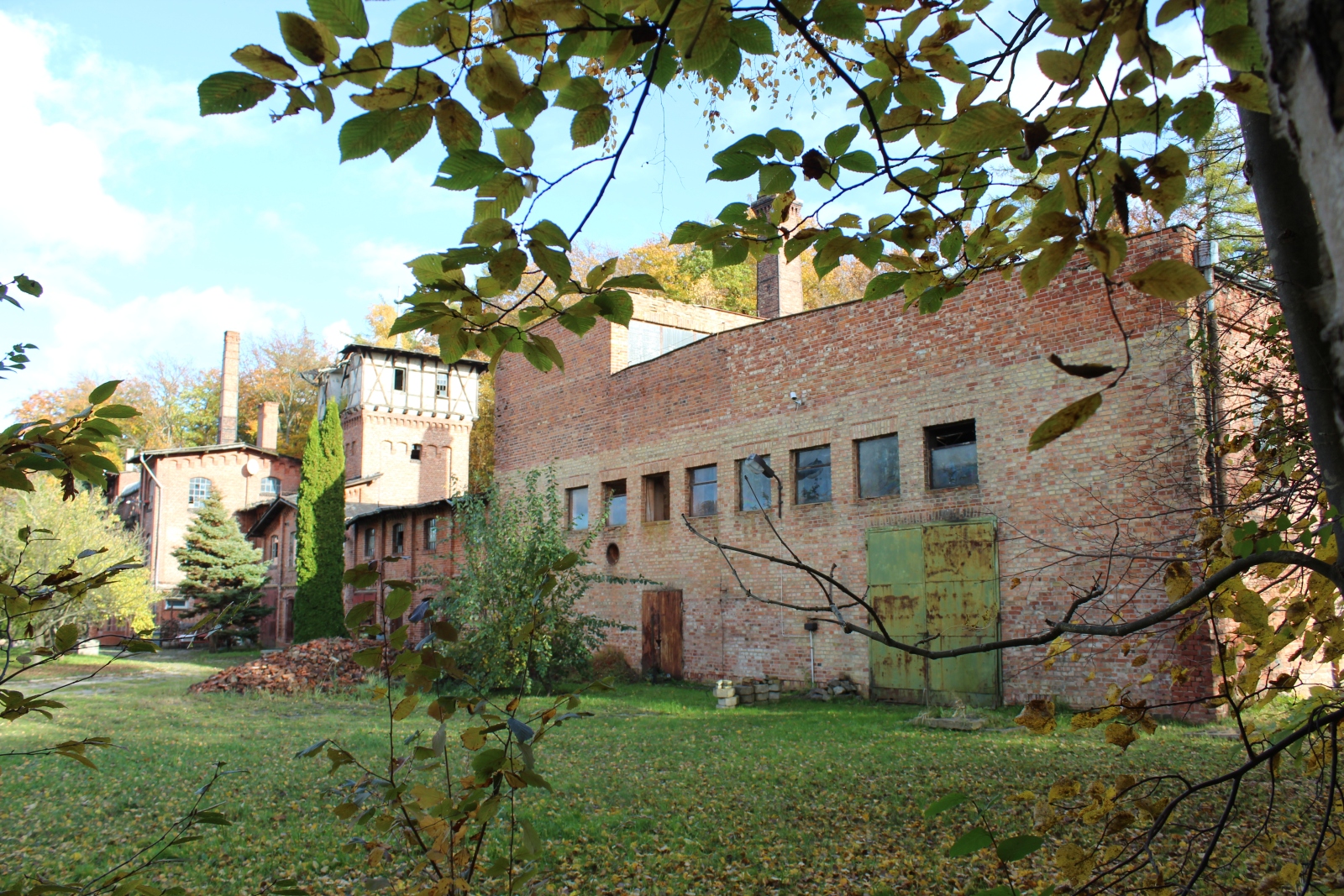
Majolica Factory in Kadyny
General Information
The Majolica Factory in Kadyny (German: "Königliche Majolika und Terrakotta-Werkstatt Cadinen" – Royal Majolica and Terracotta Workshop in Kadyny) is a historic ceramic plant founded at the beginning of the twentieth century by the German Emperor Wilhelm II. The site formed part of the imperial summer residence and the manorial-farm complex in the village of Kadyny (German: "Cadinen"). The manufactory, being the private property of the monarch, became renowned for the production of high-class artistic ceramics, initially referring to antique and Renaissance models, and in a later period producing unique works in the so-called Kadyny style. The palace and farm complex in Kadyny is entered in the register of monuments.
Location / Geographical Setting
The former factory buildings are situated by voivodeship road no. 503, connecting Elbląg with Tolkmicko, and are located within the historic landed estate, which also included the palace, park, stud farm, and utility buildings. The specific location at the foot of forested hills and access to rich deposits of ceramic clay in the vicinity (the so-called Kadyny clay) determined the location of the plant in this place.
History
The establishment of the manufactory is directly connected with Emperor Wilhelm II, who in 1898 purchased the estate in Kadyny for use as his summer residence. The ruler, wishing to stimulate the economy of the agricultural areas of East Prussia and to pursue his artistic passions, decided to make use of the local natural resources. At the urging of the sculptor Ludwig Manzel (1858-1936), in 1904 (some sources give 1905 as the beginning of operations), the Royal Majolica and Terracotta Workshop was opened. It initially employed 9 workers.
In the first period of activity (until 1918), production was subordinated to the conservative tastes of the emperor. Mainly copies and imitations of antique ceramics (Greek and Etruscan) and Italian Renaissance majolica were produced, including reliefs in the della Robbia style. These works, often monumental in character, were destined for imperial residences and public utility buildings. Ludwig Manzel became the first artistic director, and the designs were personally approved by Wilhelm II. The World Exhibition in Turin in 1911 became an artistic and propagandistic success, where Kadyny ceramics won two gold medals, gaining international recognition.
After the First World War and the emperor’s abdication, the manufactory had to adapt to new market realities. Under the management of Wilhelm Dietrich in the 1920s, a new, characteristic style was developed, abandoning historicism in favour of simpler forms. The technique of unglazed, polished terracotta in red colour and ceramics decorated with cobalt and gold ("blau-rot-gold" style) were introduced. An important element of production at that time also became artistic figurines of animals, designed among others by Arthur Steiner (1877-1960), as well as copies of historic Gdańsk and Elbląg tile stoves. In the 1930s, innovative attempts were made to combine ceramics with amber in cooperation with the Amber Manufactory in Königsberg. The plant then employed approximately 50 workers. Company shops were located in Berlin, Elbląg, Hamburg, Krynica Morska, and Stuttgart. Part of the production was exported to England and the USA.
The factory operated until the end of the Second World War. In 1945, as a result of the entry of the Red Army and the incorporation of these lands into Poland, the plant ceased production under its former signboard. Part of the equipment and moulds was dispersed or destroyed. After the war, agricultural and breeding activity was continued in the farm buildings (Kadyny Stud Farm), while ceramic traditions were maintained to a lesser extent within craft workshops (among others the Historic Ceramics Workshop). Today, the former factory and farm buildings, partially restored, constitute a tourist attraction, and works bearing the “Cadinen” mark are valued collectors’ objects.
Architecture / Architecture and Spatial Layout
Characteristics and Architecture of the Site
The factory buildings formed part of a larger, deliberately conceived urban layout, designed in the so-called "ordensburg" style (referring to the architecture of the Teutonic Order) and in the rural style typical of East Prussia. The production buildings were erected in red brick, which harmonized with the rest of the farmstead. The site was equipped with kilns modern for those times and machines for clay processing, including, among others, narrow-gauge trains (lorries) for transporting raw material from nearby excavations.
A special feature of the Kadyny products, which brought fame to the factory, was the material – local clay, which after firing acquired a characteristic, intense reddish-brown colour (the so-called Kadyny red). It was used both for the production of small artistic items and for large-format architectural ceramics (architectural details, portals, fountains). An example of the use of Kadyny ceramics in architecture is the décor of the entrance hall and operating room in the building of today’s National Bank of Poland branch in Gdańsk, as well as numerous details on buildings in Tolkmicko and Elbląg.
In the manufactory’s offer, apart from vases, amphorae, and busts (including numerous images of the emperor), there were also coffee services, toilet sets, ashtrays, and inkwells. The factory mark changed over time, most often depicting the imperial crown with the inscription “Cadinen”.
Curiosities
Wilhelm II treated the factory very personally, not only as an investment, but as a “testing ground” for his artistic concepts. He often sketched vessel designs himself or corrected artists’ drawings, imposing his conservative taste on them, which more than once met with quiet criticism from artistic circles.
One of the best-known artists cooperating with Kadyny was Arthur Steiner, a sculptor from Königsberg, who became renowned for masterful figurines of animals. His realistic depictions of dogs, horses, or wild birds were so precise that they were referred to as “animal portraits”.
In the years of crisis after the First World War, in order to save the plant’s finances, objects atypical for a royal manufactory were produced there, such as simple kitchen vessels or commemorative tankards, which stood in contradiction to the plant’s original elite mission.
Kadyny clay was of such excellent quality that there were plans to use it for the production of substitute banknotes (ceramic coins) during inflation in Germany, although this project did not enter widespread circulation on a broad scale.
Bibliography
- Barford Jörn, "Des Kaisers Keramik, 100 Jahre Königliche Majolika-Werkstätten Cadinen", Husum 2003.
- Barfod Jörn, "Kadyny. Ceramics from the Royal Majolica Workshop (1904-1944)" ("Kadyny. Ceramika z królewskiego warsztatu majoliki (1904-1944)"), Malbork 1999.
- Kadyny Ceramics ("Ceramika kadyńska"), https://edukacja.muzeum.elblag.pl/ceramika-kadynska/ [accessed: 12.11.2025].
- Kadyny Ceramics – Classicism with the Simplicity of Early Modernism ("Ceramika kadyńska – klasyka z prostotą wczesnego modernizmu"), https://rynekisztuka.pl/2013/02/26/ceramika-kadynska-klasyka-z-prostota-wczesnego-modernizmu/, [accessed: 12.11.2025].
- History, https://kadyny.com.pl/history, [accessed: 12.11.2025].
- Kadyny, https://encyklopedia.warmia.mazury.pl/index.php/Kadyny, [accessed: 12.11.2025].
- "Kadyny. Ceramics from the Royal Majolica Workshop (1904–1944)" ("Kadyny. Ceramika z Królewskiego Warsztatu Majoliki (1904–1944)"), ed. M. Mierzwiński, Malbork 1999.
- Pospieszna Barbara, "Kadyny Ceramics in the Collection of Edward Parzych" ("Ceramika kadyńska w zbiorach Edwarda Parzycha"), Elbląg 2012.
- Pospieszna Barbara, "Kadyny Ceramics in the Collection of the Castle Museum in Malbork" ("Ceramika kadyńska w zbiorach Muzeum Zamkowego w Malborku"), Malbork 2002.
- Pospieszna Barbara, Wilhelmian Terracotta and Majolica Factory in Kadyny 1903/4-1945 ("Kadyny. Wilhelmińska fabryka terakoty i majoliki 1903/4-1945"), “Szkło i Ceramika”, 2004, vol. 55, pp. 36–40.
- Pospieszna Barbara, Kadyny Painters on Ceramics ("Kadyńscy malarze na ceramice"), “Szkło i Ceramika”, 2013, vol. 64, no. 4, pp. 18–21.
- Pospieszna Barbara, Kadyny Majolica ("Majolika kadyńska"), “Spotkania z Zabytkami”, 1994, no. 4, pp. 14-16.
- Nobody Fires in the Old Furnace (A Museum You Do Not Know, episode 2) ("W starym piecu nikt nie pali (Muzeum, jakiego nie znacie odc. 2)"), https://www.portel.pl/kultura/w-starym-piecu-nikt-nie-pali-muzeum-jakiego-nie-znacie-odc-2/139833, [accessed: 12.11.2025].