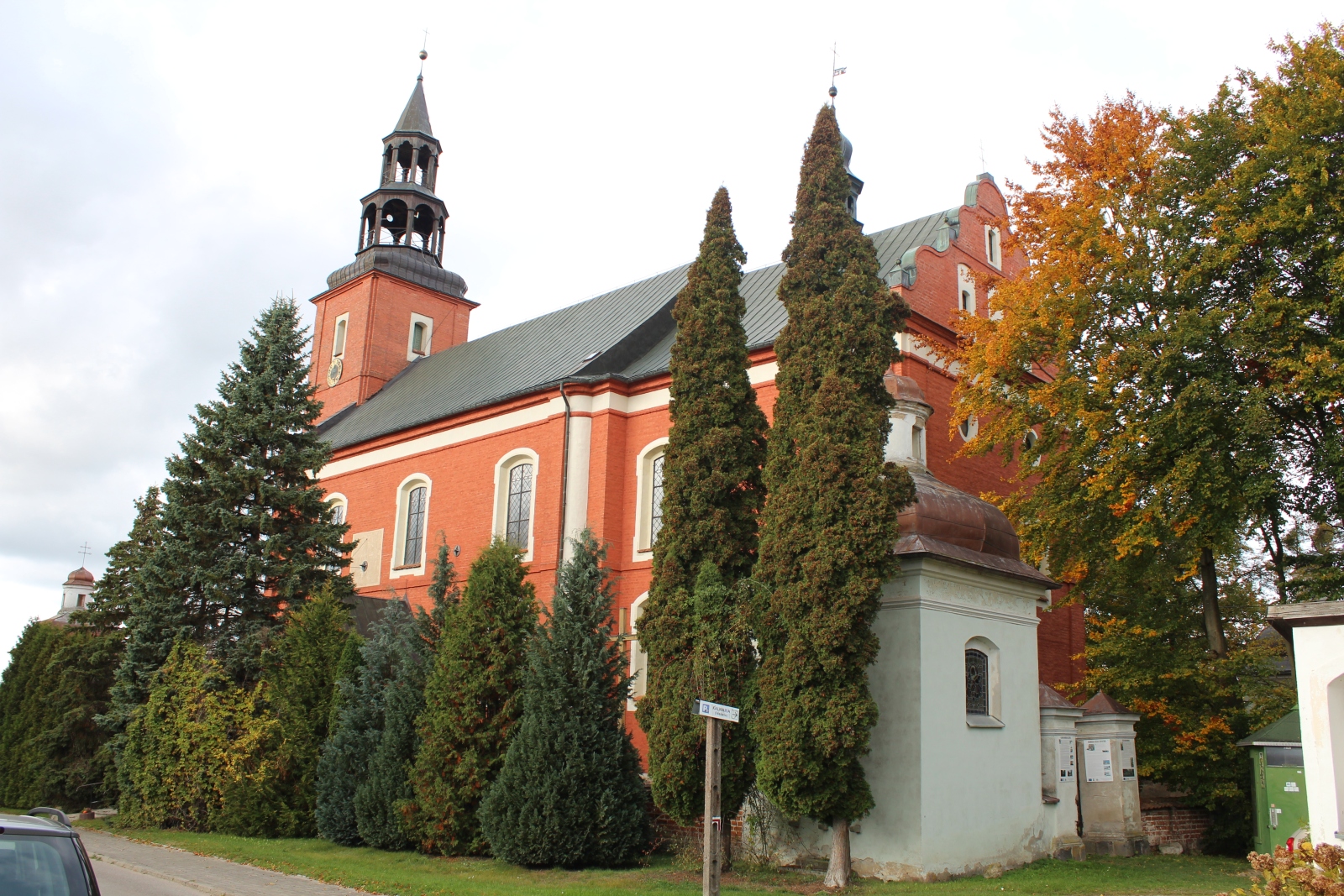
Warmian Calvary in Głotowo
General Information
The Warmian Calvary in Głotowo is a 19th-century architectural and landscape complex consisting of fourteen chapels of the Stations of the Cross, together with accompanying structures – the Grotto of Our Lady of Lourdes and the Chapel of the Agony of Christ in the Garden of Gethsemane – closely integrated spatially with the Baroque Sanctuary of the Blessed Sacrament and the Passion of Christ. The complex was established between 1878 and 1894 as a deliberate attempt to recreate the topography of the Jerusalem Via Dolorosa within the context of the Warmian landscape, imitating both the length of the route and the character of the terrain’s inclines. As the only calvary in Warmia, the site holds the status of a registered monument in the Warmian-Masurian Voivodeship.
Location
The Calvary is located in the village of Głotowo, approximately four kilometres south-west of Dobre Miasto, in the Warmian-Masurian Voivodeship, in the western part of the Masurian Lake District. It occupies around seven hectares in the centre of the settlement, within a picturesque ravine of the Kwiela River, partly shaped artificially, forming a kind of fork-like valley surrounding the church-calvary complex. To the north and south, it is bordered by agricultural fields and compact village development. A significant part of the complex lies within the Protected Landscape Area of the Middle Łyna Valley, which further emphasises the natural value of this sacred landscape.
History
The history of the Warmian Calvary is inseparably linked with the earlier development of the Eucharistic sanctuary in Głotowo. The village, founded in 1313 under Chełmno law, already possessed a wooden parish church dedicated to St Andrew in the 13th century, which was destroyed during a Lithuanian raid. A local legend is associated with this event: the inhabitants, seeking to protect the Blessed Sacrament from desecration, buried a chalice with the consecrated host in a field. Years later, during spring ploughing, a farmer allegedly discovered the chalice, while the oxen pulling the plough knelt at the site of the discovery. This was interpreted as a sign of divine will that a new church should be erected at that location. The host, temporarily transferred to the church in Dobre Miasto, was said to have miraculously “returned” twice to the place of its concealment. These events became the foundation of the local Eucharistic cult and the beginning of a pilgrimage tradition recorded in later pilgrims’ books.
In the mid-14th century, a sanctuary of the Blessed Sacrament developed at the site of the chalice’s discovery, which in subsequent centuries became one of the most important pilgrimage centres in Warmia. After the incorporation of Warmia into the Kingdom of Poland in 1466, pilgrimage traffic intensified, and accounts of miraculous healings and conversions, recorded in written sources, increased the prestige of the site. As the number of pilgrims grew, the existing church proved insufficient. In 1722, the foundation stone was laid for a new late Baroque church, consecrated in 1726 under the dedication of the Most Holy Saviour and St Florian. Its rich Baroque furnishings, with a clearly Eucharistic programme – especially the main altar by Jan Krüger of Königsberg – together with a system of external chapels, created an appropriate liturgical setting for the flourishing cult of Corpus Christi.
In the second half of the 19th century, the Eucharistic and pilgrimage tradition was further developed through the introduction of a monumental Way of the Cross in the form of a calvary. The impulse came from a pilgrimage to the Holy Land undertaken by a wealthy inhabitant of Głotowo, Jan (Johannes) Merten. After his return, around 1860, he purchased seven hectares of land in the Kwiela ravine and donated it to the parish for the construction of a calvary modelled on that of Jerusalem. From his pilgrimage, he brought small stones from the Via Dolorosa, regarded as relics, which were later placed in wooden crosses inside the chapels of individual stations.
The construction of the Warmian Calvary began ceremonially on 29 July 1878 and continued for sixteen years, until 1894. The Kwiela ravine was extensively reshaped by hand – deepened and formed so as to faithfully reproduce the terrain configuration known from the Jerusalem route to Golgotha; according to research, the difference in length compared to the original amounts to only about 20 metres. The works involved numerous faithful from across the Warmian diocese; local tradition speaks of tens of thousands of people who supported the construction both through physical labour in shaping the ravine and through financial contributions.
In European scholarship, the Warmian Calvary is classified among so-called topographical calvaries, which strive to recreate as faithfully as possible the spatial layout and length of the Jerusalem route. This places it among the most important Polish examples of this type of sacred landscape. After 1945, the calvary retained its pilgrimage function, becoming one of the key centres of Passion devotion in the Archdiocese of Warmia. At the same time, it underwent gradual naturalisation, including spontaneous vegetation growth and transformation of the tree stand.
In response to these processes, a detailed dendrological inventory of the calvary park was carried out in 2005. Researchers documented approximately seven hectares of greenery dominated by over one-hundred-year-old maples, lindens, and ashes, emphasising the need to balance spontaneous forest succession with the preservation of historical sightlines and the legibility of the original composition. They proposed principles of tree management combining the protection of natural values with the conservation of the historical spatial structure, forming the basis for plans for the comprehensive revitalisation of the Warmian Calvary as a “pilgrimage garden of memory.”
Today, the Warmian Calvary in Głotowo functions simultaneously as a place of living Passion devotion, an element of local identity, and an important subject of research on the sacred landscape of Warmia. Its significance extends beyond the regional scale, contributing to European studies on calvaries as a specific form of religious space in which the memory of salvific events is made present through a carefully designed relationship between landform, vegetation, and architecture.
Architecture and Spatial Layout
The calvary was designed as an integrated architectural and landscape composition. Along the main avenue running above the river and along the slopes of the ravine, fourteen station chapels were arranged in Neo-Romanesque and Neo-Gothic styles, varied in terms of massing, articulation of detail, and interior solutions. Their interiors contain ceramic and wooden sculptural groups characterised by a strongly realistic and expressive depiction of the Passion of Christ, associated in the literature with a Bavarian sculptural workshop and regarded as a model example of 19th-century Passion art in open space.
The Way of the Cross route runs through a varied ravine with numerous changes in elevation and viewpoints, intensifying the spatial experience of the pilgrim; the crossing of the Kwiela River at the first station has a clear symbolic reference to the biblical Cedron Brook.
Complementing the main route are the Grotto of Our Lady of Lourdes with a spring and the Chapel of the Agony in the Garden, which together with the stations are included in the contemporary register of monuments as integral elements of the calvary complex. The entire layout is compositionally linked with the Baroque church – the pilgrim begins the journey with liturgy in the church, then descends into the ravine and proceeds through the successive stations. As a result, the calvary is not an autonomous structure but an organically integrated part of the Sanctuary of the Blessed Sacrament and the Passion of Christ, as emphasised by both historical research and landscape analyses.
Bibliography
- Balcer Jerzy, "Sanctuary of the Blessed Sacrament and the Passion of Christ, Głotowo–Glotowo 1313–2023" (Sanktuarium Najświętszego Sakramentu i Męki Pańskiej, Głotowo-Glotowo 1313–2023), Lublin 2023.
- Bilska-Wodecka Elżbieta, "European Calvaries. Analysis of Structure, Types, and Origins" (Kalwarie europejskie. Analiza struktury, typów i genezy), Kraków 2003.
- Parish of the Most Holy Saviour in Głotowo (Parafia pw. Najświętszego Zbawiciela w Głotowie), available at: https://encyklopedia.warmia.mazury.pl/index.php/Parafia_pw._Naj%C5%9Bwi%C4%99tszego_Zbawiciela_w_G%C5%82otowie [accessed: 15.04.2025].
- Regulska Edyta, "“Warmian Jerusalem” – Głotowo" („Warmińska Jerozolima” – Głotowo), in: Marcin Wójcik (ed.), "Identity and “Place”. Awakening the Dormant Potential of Rural Areas" (Tożsamość i „miejsce”. Budzenie uśpionego potencjału wsi), Łódź 2017, pp. 45–52.
- Swaryczewska Magdalena, Antolak Mariusz, "Warmian Calvary in Głotowo – Dendrological Inventory and Tree Stand Management" (Kalwaria Warmińska w Głotowie – inwentaryzacja dendrologiczna i gospodarka drzewostanem), “Acta Scientiarum Polonorum. Administratio Locorum”, 2011, no. 1, pp. 101–110.