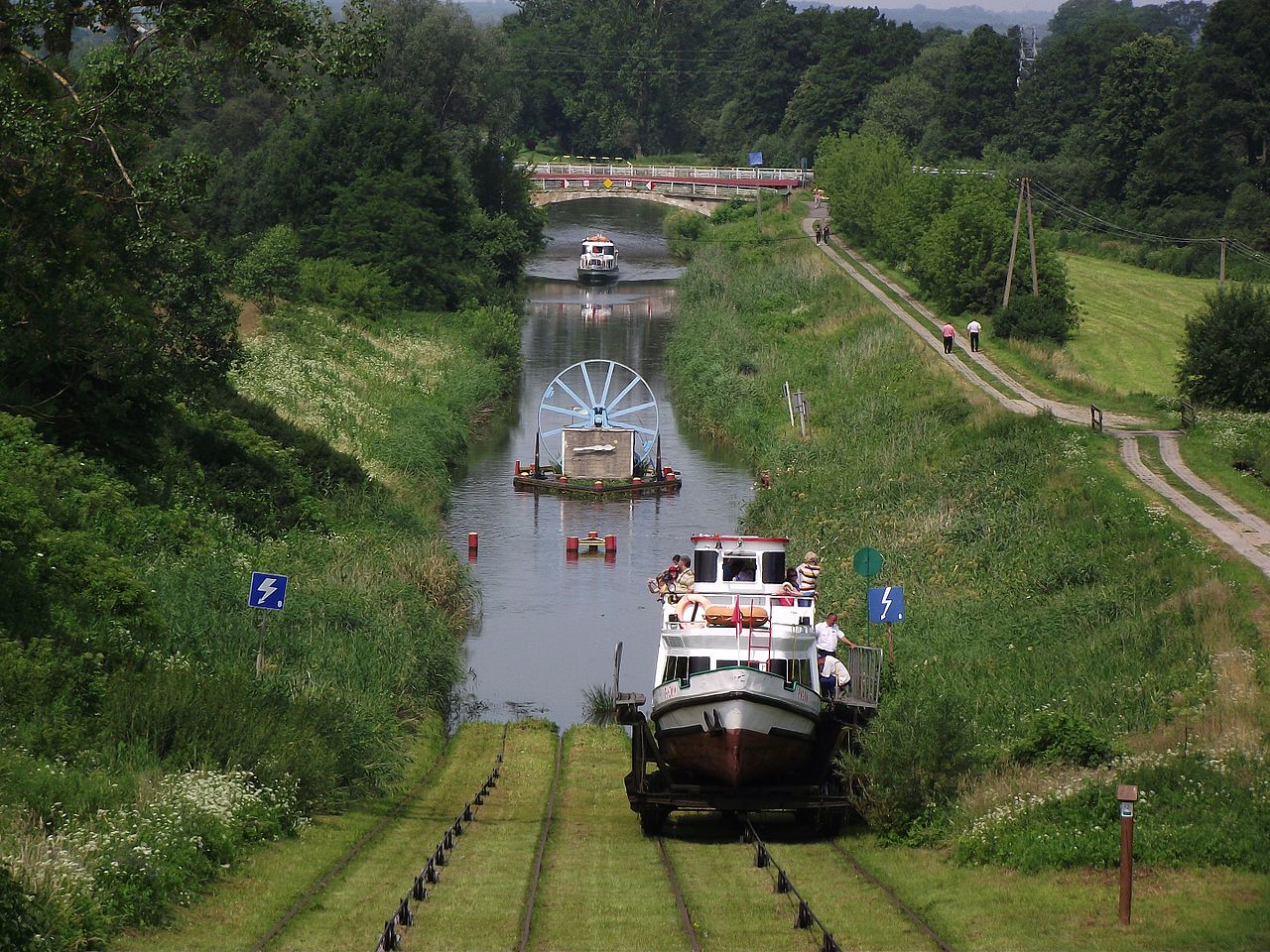
Elbląg Canal
General Information
The Elbląg Canal (also known by its historical name "Oberländischer Kanal" – the Oberland Canal) is a waterway constituting one of the greatest achievements of 19th-century hydraulic engineering. It is a system unique on a global scale, which in 2011 was recognised by a regulation of the President of the Republic of Poland as a Historic Monument, and efforts are currently being made to have it inscribed on the UNESCO World Heritage List. In the 2007 "Rzeczpospolita" poll, the site was recognised as one of the Seven Wonders of Poland. Management of the canal rests with the State Water Holding Polish Waters. The structure remains fully operational—all devices, such as water wheels, steel ropes, and rails, function in a system almost unchanged for more than 160 years, constituting the only “living laboratory” of 19th-century hydrotechnics in the world (its American counterpart, the Morris Canal, was closed in 1922).
Location
The Elbląg Canal is situated in the western part of the Warmian-Masurian Voivodeship, crossing the geographical regions of the Iława Lake District and the Vistula Delta. The route runs from Ostróda and Iława in the south, through a series of ribbon lakes, northwards to Elbląg. A connection with the sea is provided by the Elbląg River, which flows into the Vistula Lagoon. The route passes through areas of outstanding natural value, including the Protected Landscape Area of the Elbląg Canal, which serves as a refuge for hundreds of species of fauna and flora. The length of the main route is 76.5 km, while together with numerous side branches the total length of the canal system exceeds 151.7 km.
History
The need to build the canal arose in the 1820s within the administration of East Prussia. The aim was to connect the natural-resource-rich areas of Oberland (Upper Prussia) with the seaport of Elbląg and the Baltic Sea, bypassing the inefficient transport route along the Drwęca River. The initiative was officially proposed by Elbląg deputies at the session of the Provincial Diet of East Prussia in 1825.
The key figure in the creation of the canal was the Prussian engineer from Königsberg, Georg Jacob Steenke (1801–1884). He was the son of Johann Friedrich Steenke, the harbour master of Piława (creator of the first maritime rescue service). After his father’s death in 1818, young Georg apprenticed with a master carpenter and then studied at the Academy of Construction in Berlin. He gained experience, among other places, during the construction of the Seckenburg Canal on the Niemen. In 1833, he arrived in Elbląg as inspector of embankments and levees in the Vistula Delta. From 1837 onwards, he developed a revolutionary design for connecting the lakes, whose main principles he had already outlined in the years 1825–1837.
Before construction began, Steenke undertook crucial study journeys. In 1846, he visited engineering works in Bavaria, Belgium, and the Netherlands. The decisive journey, however, was his trip to the United States in the second half of 1850, where he studied the system of 23 inclined planes on the Morris Canal in New Jersey, as well as his visit to England, from which he brought back drawings of hydraulic devices. He ultimately developed his own solution, adapted to local conditions and considerably more economical in water consumption than foreign systems.
Construction was inaugurated by the turning of the first spade on 28 October 1844 in Miłomłyn, during the reign of King Frederick William IV. The works proceeded in stages:
- 1844–1850 – the lakes of the Iława Lake District were connected and their levels equalised, and two wooden locks (Miłomłyn and Zielona) were built;
- 1851 – navigation began: a steamboat of the company “Reederei Kardinal” operated from Iława, followed later by vessels of “Reederei Matzmor” (the screw steamers “Martha” and “Ernst”);
- 31 August 1860 – in the presence of the Prussian Minister of Trade August Freiherr von der Heydt (1801–1874), the trial operation of the Buczyniec inclined plane was carried out. The first timber vessels passed the inclined planes on 29 October 1860.
- April 1861 – the official opening of the navigation season and the issuance of the Canal Police Regulations.
- 1873–1876 – final completion of the system. The section from Ostróda through Lake Pauzeńskie to Stare Jabłonki was opened (1873), and the route towards Lake Szeląg was extended by the construction of the Ostróda and Mała Ruś locks.
Initially, the canal served an economic function, transporting mainly timber (especially the prized Tabór pine) and grain. Special “Oberland barges” with a carrying capacity of approx. 50 tons were designed specifically for the canal (the prototype, the barge "Vorwärts", was built in 1845 by the boatbuilder Riedel Liebnitzki junior). The design of the fleet involved the famous shipyard of Ferdinand Gottlieb Schichau in Elbląg. In the peak year of 1890, 487 vessels and 672 rafts passed through the canal. The development of the railway in East Prussia in the second half of the 19th century (the Ostróda–Elbląg line opened in 1872) reduced the canal’s economic significance, prompting operators to turn towards tourism. The breakthrough came in 1912, when the shipowner Adolf Tetzlaff (1888–1952) inaugurated regular tourist navigation with the motorboat "Seerose" ("Water Lily"). His company, "Schiffs-Reederei Adolf Tetzlaff", also operated the steamer "Herta" (launched in 1914), the boat "Heini" (1925), and the motor vessel "Konrad". After the destruction of the Second World War and a general overhaul in 1947, the canal has served almost exclusively tourism.
Architecture and Spatial Layout
The Elbląg Canal system constitutes a brilliant solution to the problem of levelling significant differences in terrain height (the total difference in water levels amounts to approx. 103.4 m). The main waterway is characterised by a minimum width of 7 m and allows navigation by vessels up to 24.5 m in length and 3 m in width.
Two groups of hydraulic structures operate along the route. The first consists of four chamber locks: Miłomłyn (from 1849, with the greatest level difference – approx. 2.8 m), Zielona (1849), Mała Ruś (1876), and Ostróda (1876). Originally timber-built, most were rebuilt in concrete during the interwar or post-war periods. The second, unique group is the set of five inclined planes on the so-called “dry section” (between Buczyniec and Całuny), which replaced traditional locks. These are, in sequence (from the upper level): Buczyniec (level difference 20.6 m), Kąty (18.9 m), Oleśnica (24.5 m), Jelenie (22.0 m), and Całuny (13.8 m). Altogether, these five inclined planes overcome approx. 99.5 m of water level difference along a section of approx. 9.5 km.
The whole is complemented by numerous auxiliary structures: weirs, safety gates (protecting against sudden emptying of the canal in the event of failure), culverts, aqueducts, as well as water supervision buildings and engine houses, maintained in the stylistic language of 19th-century industrial architecture.
Hydraulic Devices
At the heart of the system is the set of five inclined planes, which enable vessels to be transported “over land.” Their operating principle, unchanged for more than 160 years, is based on the use of the energy of falling water. Vessels enter special cradles moving on rails of 3.27 m gauge. Two parallel tracks allow simultaneous transport up and down—the cradle descending downhill, using gravitational force, helps pull up the cradle moving uphill, thereby optimising energy use.
The mechanism is powered by a water wheel (on the four older inclined planes) or by the more efficient Francis turbine (on the Całuny inclined plane, added in 1881–1883 in place of earlier locks). Water supplied from the upper canal sets in motion a wheel 8 m in diameter, which through a system of toothed gears drives a drum with a steel rope pulling the cradles. This is a unique solution—the twin Morris Canal in the USA was dismantled in 1924, making the Elbląg Canal the only operating monument of this type in the world.
Economic and Tourist Significance
In the 19th century, the canal played a key role in freight transport, enabling the floating of Tabór pine (valued in shipbuilding) and grain from inland areas to seaports. Today, the site serves as an outstanding tourist attraction. Cruises of the “White Fleet” of the Ostróda-Elbląg Navigation Company attract tens of thousands of tourists from all over the world every year, eager to experience the phenomenon of “ships sailing over grass.” The canal is also a popular route for individual tourism (kayaks, yachts, tourist barges). Its surroundings, rich in technical monuments and natural assets, constitute an important factor in regional development.
Bibliography
- "Elbląg Canal" (Kanał Elbląski), http://encyklopedia.warmia.mazury.pl/index.php/Kanał_Elbląski, [accessed: 12.11.2025].
- "Elbląg Canal" (Kanał Elbląski), https://zabytek.pl/pl/obiekty/elblag-kanal-elblaski-73, [accessed: 12.11.2025].
- Januszewski Stanisław (ed.), "The Ostróda–Elbląg Canal" (Kanał Ostródzko-Elbląski), series: "Industrial and Technical Monuments in Poland", vol. 5, Wrocław 2001, pp. 35–120.
- Kowalski Ryszard, Wawrzyński Cezary, "100 Years of Passenger Navigation. Ostróda–Iława–Elbląg 1912–2012" (100 lat żeglugi pasażerskiej. Ostróda-Iława-Elbląg 1912–2012), Olsztyn 2012.
- Kowalski Ryszard, Wawrzyński Cezary, "150 Years of the Ostróda–Elbląg Canal 1860–2010" (150 lat Kanału Ostróda-Elbląg 1860–2010), Olsztyn 2010.
- Kujawski Wojciech, "Elbląg Canal. The Route of Water and Rails" (Kanał Elbląski. Szlak wód i szyn), Olsztyn 2014.
- Machel Ryszard, "Elbląg Canal. 150 Years of Navigation" (Kanał Elbląski. 150 lat żeglugi), “Spotkania z Zabytkami”, 2010, nos. 7–8, pp. 4–9.
- Mierzwa Waldemar, Wawrzyński Cezary, "The Elbląg–Oberland Canal in One Hundred Illustrated Stories 1844–1945" (Kanał Elbląsko-Oberlandzki w stu ilustrowanych opowieściach 1844–1945), Dąbrówno 2025.
- Wawrzyński Cezary, "Navigation and Navigable Canals of the Former Polish-Lithuanian Commonwealth" (Żegluga i kanały żeglowne dawnej Rzeczypospolitej), Olsztyn 2019.
- Wawrzyński Cezary, "Navigation on the Elbląg Canal 1860–1945" (Żegluga na Kanale Elbląskim 1860–1945), Olsztyn 2011, pp. 20–55.