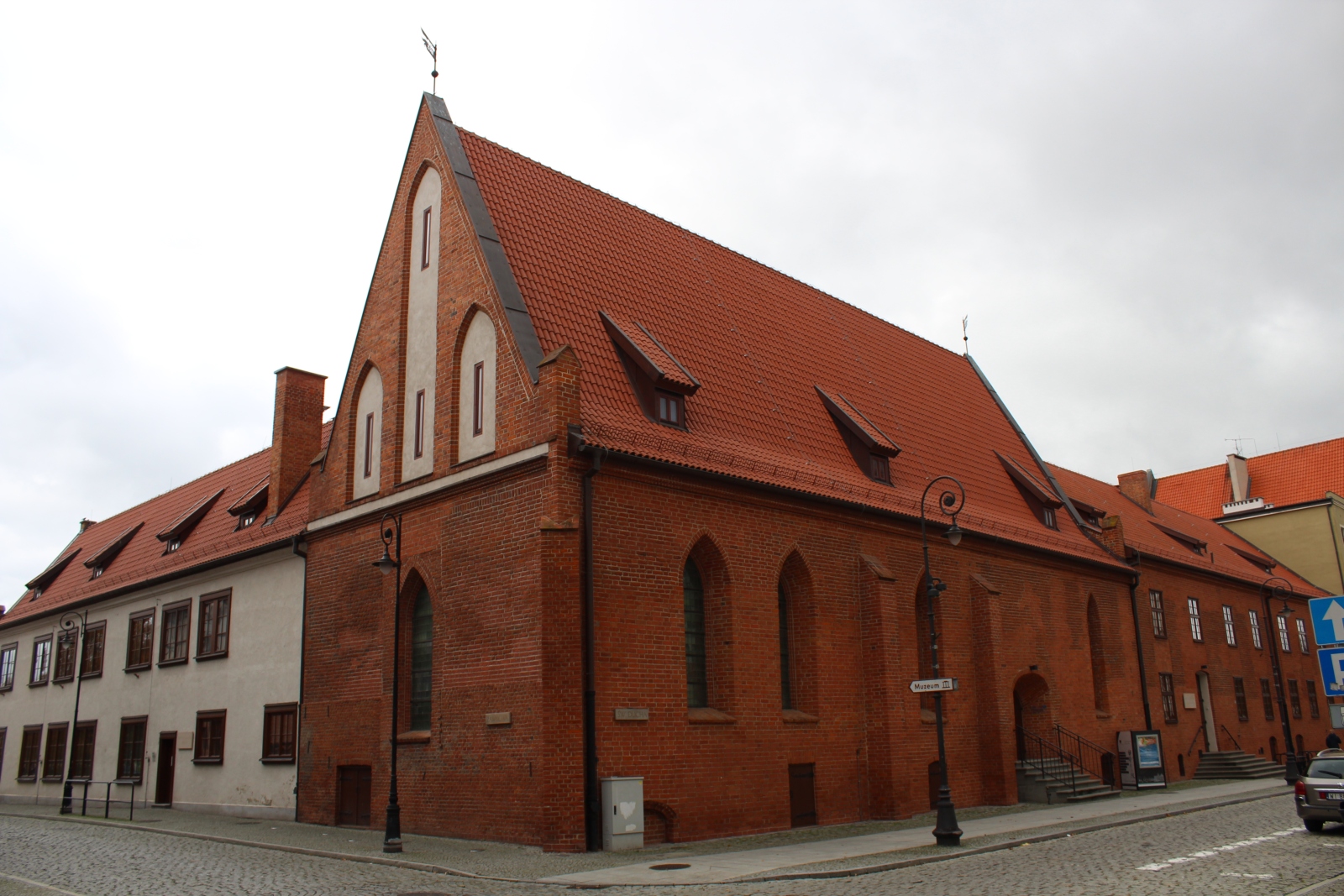
Church of the Holy Spirit in Elbląg
General Information
The Roman Catholic Church of the Holy Spirit belongs to the Gdańsk ecclesiastical province and the Diocese of Elbląg. The building constitutes an integral part of the historic hospital complex and is subject to conservation protection as a monument of exceptional architectural and historical value. The present-day user of the hospital complex is the Cyprian Norwid Elbląg Library.
Location / Geographical Setting
The Holy Spirit hospital complex is located in the southern part of the Old Town in Elbląg, near the former Teutonic castle, at the intersection of Świętego Ducha Street and Zamkowa Street.
History
Foundation of the Hospital and the Privilege of William of Modena (1242)
The Holy Spirit hospital complex was established on the basis of a privilege granted by the papal legate William of Modena on 15 February 1242. It is one of the oldest hospital institutions in Prussia. The papal privilege provided the foundation for the rapid and dynamic development of the institution, which was supported by the authorities of the Teutonic Order through generous endowments. Thanks to these donations, the hospital quickly attained the rank of the largest social welfare institution in the monastic state. The original purpose of the hospital was to offer free shelter and food to the sick, the poor, and travellers. This activity stemmed from the medieval concept of Christian mercy and the obligation of the community to support persons deprived of means of subsistence. The earliest archival sources date from 1277 and contain references to indulgences granted by the Archbishop of Riga for the benefactors of the hospital, which testifies to its significance for the community of Elbląg.
The Fire of 1288 and Reconstruction with the Use of More Durable Building Materials
The original buildings of the hospital complex were erected in wood. Unfortunately, in 1288 a fire completely destroyed the wooden structures of both the church and the hospital buildings. This event became a turning point in the history of the monument. The authorities of the Teutonic Order and the city council of Elbląg decided to rebuild it using a more durable material, namely brick. During the construction works, carried out at the turn of the thirteenth and fourteenth centuries, new construction standards characteristic of brick hall architecture widespread in Prussia and Pomerania were applied. The decision to use brick as the principal building material proved to be groundbreaking for the further history of Elbląg’s sacred architecture and constituted an expression of building methods that were modern for that time.
Hospital Function within the Teutonic System (1291–1454)
In the period 1291–1454, the Elbląg hospital served as the principal healthcare institution of the entire monastic state. The Elbląg commander combined the management of the hospital with the prestigious title of the Order’s Grand Hospitaller, which positioned Elbląg as one of the most important centres for the administration of the common good of the monastic territorial state. The current administrative functions in the hospital were performed by the hospital master (a local official), who was directly subordinate to the Elbląg commander. The hospital admitted both long-term patients and those staying temporarily. It offered special care to members of the Order during treatment – they received a dispensation from obligatory prayers and an increased share of provisions. The institution also supported pilgrims travelling to European holy places and the Holy Land, constituting an important stopping point for travellers from across Europe. In the fourteenth and fifteenth centuries, it housed from 60 to 100 dependants – predominantly elderly, infirm, sick people, and orphans.
Takeover by the City (1454) and Change of Status
After the uprising of the Elbląg burghers against the Order, when the inhabitants of the city demolished the Teutonic castle in February 1454, the hospital together with the church passed into the possession of the city of Elbląg. This was a pivotal change in the legal status of the complex – from monastic property it became municipal property. From that time onward, the complex remained under the administration of the city council, although its religious character remained unchanged.
The Reformation and Takeover by the Evangelical Community (16th Century)
From the sixteenth century, when Protestant ideas gained a foothold among the burghers of Elbląg, the church underwent a confessional transformation. Taken over by supporters of the Reformation, it became a church of the Evangelical community of particular importance to the Poles living in the city. Archival sources refer to it as the “Polish church”, while the accompanying school appears as the “Polish school”. The Polish community constituted a significant part of the burghers of Elbląg and the surrounding suburban areas. The church served as a centre of the religious life of their community. The Evangelical parish maintained the traditions of the Reformation faith over the following centuries, and the church remained an important meeting place for the community.
Garrison Function in the 18th Century
In the years 1717–1772, the hospital complex functioned as a garrison church for soldiers of the Polish Crown army of the Evangelical denomination. At that time, the church served as a centre of spiritual life for units of the Polish army stationed in Prussian territories and as a meeting place for the Polish community living in the city. After the First Partition of Poland (1772), the church fulfilled an analogous function for the soldiers of the Prussian battalion stationed in Elbląg, remaining an important point of reference for the religious and social life of the city.
An Episode from the Napoleonic Wars, Renovation, and Change of Status
An interesting historical episode in the history of the monument remains its use during the Napoleonic Wars. When French forces occupied Elbląg (from March 1807 to February 1808), the hospital complex was adapted for the logistical purposes of the imperial army. The church then housed a bakery and grain warehouses, performing a supply function for the French army stationed in Prussian territories.
In the years 1822–1824, a thorough renovation of the complex was carried out, adapting it to the functional requirements of the Evangelical denomination. From 1856, the church was incorporated into the Evangelical parish of the Blessed Virgin Mary, which meant a change in its status from an autonomous building to a filial church of a larger parish community, though without losing its significance for the local Evangelical community.
The Second World War Period and the Establishment of the Library
During the wartime operations for Elbląg in 1945, the hospital complex and the church were almost completely destroyed. Reconstruction did not begin until 1968, and the works lasted until 1979. After the reconstruction had been completed, the complex was adapted for the needs of the Cyprian Kamil Norwid Voivodeship Public Library.
Architecture / Architecture and Spatial Layout
Architectural Characteristics
The church represents the type of a hall building erected in the Brick Hall Gothic style. This type of construction, widespread in territories lacking easily accessible stone, made it possible to achieve impressive results thanks to the skilful use of brick as the principal building material. The entire church was provided with cellars. The basement spaces were covered with Gothic groin vaults – a system formed through the intersection of two barrel vaults, reinforced with brick-and-stone ribs. The ribs fulfilled both an aesthetic and a structural function – they transferred the load of the upper walls onto individual load-bearing pillars. These vaults have survived unchanged to the present day, constituting a unique testimony to the craftsmanship of medieval builders.
On the southern side, the complex was surrounded by a defensive wall, which has partially survived to this day. It protected the hospital complex from potential threats and marked the outer boundaries of the institution. Originally, the church was accompanied by hospital buildings: the Great House (the main administrative and residential room) and the Great Chamber (adjoining on the western side), in which the hospital’s patients were accommodated. These buildings were erected in brick and connected with the church, creating a compact building composition.
Chapel of the Virgin Mary
In 1501, a Chapel of the Virgin Mary was erected by the church. This undertaking formed part of the European trend of growing Marian devotion, which reached its apogee in the fifteenth and sixteenth centuries. The chapel constituted a functional and spiritual enrichment of the complex, enabling more intimate and secluded forms of religious practice for the hospital’s dependants and arriving pilgrims.
Present Condition and Tourist Function
The Church Today
The Church of the Holy Spirit in Elbląg remains a monument of exceptional architectural and historical value, subject to conservation protection. At present, the former Church of the Holy Spirit houses the Elbląg Library, which possesses collections of high scholarly value dating from the sixteenth to the eighteenth centuries, numbering approximately half a million volumes in total, of which more than fifty thousand are source materials and incunabula. Although this adaptation changes the building’s original sacred purpose, it constitutes a form of preserving cultural heritage and corresponds to the European trend of assigning historic churches to educational and cultural functions.
Bibliography
- Wiesław Długokęcki, Contributions to the History of Gdańsk Hospitals in the Middle Ages (Przyczynki do dziejów szpitali gdańskich w średniowieczu), “Studia Historica Gedanensia” 2020, vol. 11, pp. 84-124.
- Wiesław Długokęcki, The Hospitals of Elbląg – Social Care, Part I (Szpitale Elbląga – opieka społeczna część I), https://historia.bibliotekaelblaska.pl/artykul/szpitale-elblaga-opieka-spoleczna-czesc-i, [accessed: 12.11.2025].
- Elbląg – Church of the Holy Spirit (Elbląg – kościół Świętego Ducha), https://medievalheritage.eu/pl/strona-glowna/zabytki/polska/elblag-kosciol-swietego-ducha/, [accessed: 12.11.2025].
- Andrzej Groth, The Great Chamber and the Small Chamber in the Former Hospital of the Holy Spirit in Elbląg (Wielka i Mała Izba w dawnym szpitalu św. Ducha w Elblągu), “Rocznik Elbląski”, 2004, vol. 20, pp. 45-56.
- History of Elbląg, vol. 1: The City and Its History until 1466 (Historia Elbląga, t. 1: Miasto i jego dzieje do roku 1466), ed. Stanisław Gierszewski, Gdańsk 1993, pp. 124-126, 230-233.
- History of Elbląg, vol. 2, part 1: (1466-1626) (Historia Elbląga, t. 2, cz. 1: (1466-1626)), ed. Andrzej Groth, Gdańsk 1996, pp. 185-188.
- History of Elbląg Streets: Wigilijna and Świętego Ducha (Historia elbląskich ulic: Wigilijna i Świętego Ducha), https://www.portel.pl/dawny-elblag/historia-elblaskich-ulic-wigilijna-i-swietego-ducha-odcinek-33/78873, [accessed: 12.11.2025].
- Church of the Holy Spirit in Elbląg (Kościół pw. Św. Ducha w Elblągu), http://leksykonkultury.ceik.eu/index.php/Kościół_pw._Św._Ducha_w_Elblągu, [accessed: 12.11.2025].
- Franciszek Mamuszka, Elbląg and Its Surroundings. A Tourist Guide (Elbląg i okolice. Informator krajoznawczy), Gdańsk 1978, pp. 52-54.
- Postmodern Elbląg. The Great Reconstruction of the Old Town Began in the 1980s (Postmodernistyczny Elbląg. Wielka odbudowa Starego Miasta ruszyła w latach 80), https://www.whitemad.pl/postmodernistyczny-elblag-wielka-odbudowa-starego-miasta-ruszyla-w-latach-80/, [accessed: 12.11.2025].
- Marian Surdacki, Monastic Hospital Care in Medieval Poland (Szpitalnictwo zakonne w średniowiecznej Polsce), “Roczniki Humanistyczne”, 2015, vol. LXIII, no. 2, pp. 49–81.