Airship Base in Dywity
General Information
The airship base in Dywity (German: "Luftschiffhafen Diwitten") was one of the most important airship bases of the German army in the eastern part of East Prussia on the eve of and during the first years of the First World War. It was established as a specialised military complex with a vast hangar hall for Zeppelin-type airships and an extensive technical infrastructure intended to support reconnaissance and bombing operations on the Eastern Front. Although the hangar itself was dismantled after 1920, the site has retained the status of an exceptional testimony to the early history of aviation and the militarisation of the landscape around Olsztyn. Today, the site functions as a place of remembrance: a short educational trail has been laid out within the former base, and the only surviving material relics include the concrete mooring “feet” of the airships and the outlines of former foundations.
Location
The historic airship base was situated approximately one and a half kilometres north-west of the village of Dywity (German: "Diwitten"), located six kilometres north of Olsztyn. The complex occupied around 111 hectares on an elevated terrace above the valley of the Wadąg River, near its confluence with the Łyna, in a transitional zone between cultivated fields and a compact forest complex. Today, the area of the former base lies within the administrative boundaries of the Municipality of Dywity, and the memorial site can be reached by a forest road leading from the village.
History
The origins of the airship base in Dywity are connected with the growing militarisation of East Prussia in the early 20th century and the incorporation of a new weapon—airships—into the operational plans of the German army. Olsztyn ("Allenstein"), as the garrison capital of the region and a potential logistical base for operations against Russia, had already in 1909 applied to the Prussian Ministry of War for the establishment of a permanent airship base in its vicinity. Ultimately, in 1913, the town purchased from a farmer named Perk an extensive tract of 111 hectares near the village for the construction of a "Luftschiffhafen"—an airship base with a hangar and accompanying infrastructure.
Construction of the main hall began in 1913 and represented a major engineering undertaking for a provincial setting. According to the reconstruction carried out by Walter Kuhl on the basis of technical sources and documentation from Karl Haefele & Co., the original hall measured 176 metres in length, 44 metres in width, and 34 metres in height. During the war, it was extended to approximately 192 metres in order to accommodate larger units. A local description prepared for the project "Traditions of the Warmian Village" provides similar, though partly different, dimensions (192 × 28 × 35 m), reflecting discrepancies in the interpretation of the surviving sources. The hangar structure consisted of a steel skeleton filled with wooden boarding and covered externally with a bituminous material (roofing felt). The gable walls were equipped with monumental sliding doors enabling the movement of airships into and out of the hall, and the orientation of the hall’s axis on the north-west – south-east line was chosen so as to minimise the impact of side winds during take-off and landing.
The hall formed the centre of a large technical complex. On both sides of the structure, manoeuvring grounds approximately 500 metres wide were laid out and connected with rail tracks enabling the airship to be rolled on trolleys into the hangar and positioned along its axis. Nearby were residential barracks for the personnel, technical support buildings with workshops and garages for service trucks, an independent water intake and sewage system, a set of electrical generators, and storage facilities for hydrogen, fuel, and ammunition. An essential element of the functioning of airship bases was also the meteorological and radio station, serving both flight safety and intelligence purposes. From the organisational point of view, the base in Dywity functioned as an auxiliary base to the larger airship centre in Königsberg, yet it constituted a crucial support facility for operations on the north-eastern section of the front.
The first airship—Z IV, the sixteenth unit built at the "Zeppelin-Werke" shipyard—was based in Dywity on 1 June 1914. This airship, 142 metres long, powered by three Maybach engines, capable of reaching a speed of approximately 75 km/h and a range of around 2,700 km, was intended to conduct reconnaissance over Russian positions in the Kingdom of Poland and along the front line in the Masurian region. In August and September 1914, Z IV carried out reconnaissance flights from Dywity deep into enemy territory, armed with machine guns for defence against aircraft and with small bombs dropped manually. The culmination of this activity was the raid on Warsaw on the night of 24–25 September 1914, during which the airship, heavily fired upon from the ground, saved itself by climbing to an altitude of about 2,800 metres. Another episode was the raid on Ełk, then occupied by Russian forces, which ended with the damaged unit returning to the Dywity base despite approximately three hundred hits to its envelope. Due to the progressive wear of its structure, Z IV was withdrawn from direct combat operations in February 1915 and converted into a training unit.
In 1915, another airship—LZ 26—was stationed in Dywity for several months and was then transferred to the base in Darmstadt; it was briefly replaced by LZ 29, destroyed in December 1915 during a raid on Rivne. All of these units formed part of a larger system of airship deployment for intensive reconnaissance and bombing operations on the Eastern Front, while the base in Dywity—owing to its proximity to the front line and good railway infrastructure—played the role of an important operational hub within that system. In documents and radio communications, the site appeared under the codename “Ludendorf,” intended to hinder the enemy’s identification of the actual base.
Germany’s defeat in 1918 and the provisions of the Treaty of Versailles determined the fate of the airship base in Dywity. Under the obligations concerning the demilitarisation of aviation and airship infrastructure, the "Luftschiffhalle Diwitten" was designated for dismantling. Around 1920/1921, the hangar structure was purchased by Karl Haefele & Co. of Königsberg, a company specialising in dismantling and steel structures, which cut the hall longitudinally, lowered it, and from its structural elements reconstructed two large industrial halls for the company "Bahnbedarf A.-G." in Darmstadt. A third hall, built from the remaining fragments of the structure, was erected in Hindenburg (Zabrze) in Upper Silesia. Contemporary conservation research in Darmstadt confirms that the steel trusses that today support the ceiling of the multi-storey car park on Landwehrstraße are to a large extent original elements of the Dywity airship hall.
After the removal of the hangar, the area of the former base remained in military possession, but airship operations were never resumed there. In time, most of the buildings were dismantled, and the area underwent gradual natural regeneration and afforestation. After 1945, when Dywity became part of Poland, the memory of the airship base gradually faded, surviving only in a small number of photographs and recollections. Only at the end of the 20th century and the beginning of the 21st century did local researchers and regional media begin to reconstruct the history of the site, among other things in a series of articles in "Gazeta Dywicka" and "Gazeta Olsztyńska", as well as on the basis of Walter Kuhl’s work and documentation of German Zeppelin hangars.
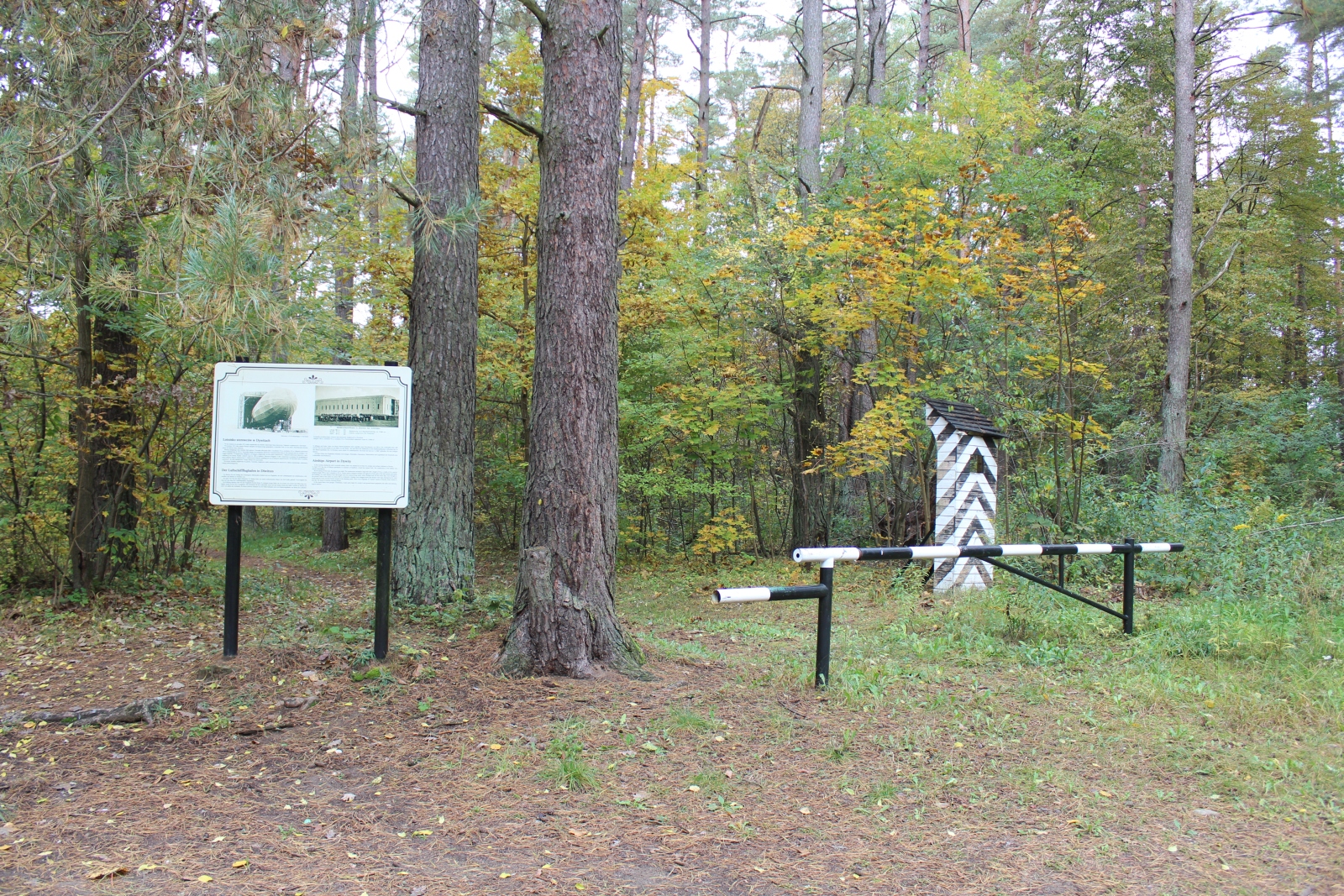
Today, a short historical and educational trail has been arranged on the site of the former base, centred on three massive moss-covered concrete blocks with preserved steel rings—once the anchoring points for the mooring lines of airships. The accompanying trilingual information boards and popular-science publications of the Municipality of Dywity place this site within the broader context of the technical heritage of Warmia, while Kuhl’s analyses make it possible to connect the modest forest relics with the still-existing industrial halls in Darmstadt, which constitute a material trace of the “second life” of the Dywity airship hall.
Bibliography
- Kuhl Walter, "The Zeppelin Halls on Landwehrstraße. Their Origin and Some No Longer Quite Modern Views" (Die Zeppelin¬hallen in der Landwehrstraße. Ihre Entstehung und einige nicht mehr ganz so moderne Ansichten), https://www.walter-kuhl.de/fabrikviertel/diver/zeppelinhallen.htm [accessed: 25.04.2025].
- Mondroch Henryk, "The Dywity Car Park in German Darmstadt" (Dywicki parking w niemieckim Darmstadt), “Gazeta Dywicka”, 2012, no. 37, p. 7.
- "Airship Base in Dywity" (Lotnisko sterowców w Dywitach), in: "Traditions of the Warmian Village. Architectural Monuments" (Tradycje Warmińskiej Wsi. Zabytki architektury), Municipal Cultural Centre in Dywity, https://kulturawarminska.pl/zabytki-architektury/lotnisko-sterowcow-w-dywitach/ [accessed: 26.04.2025].