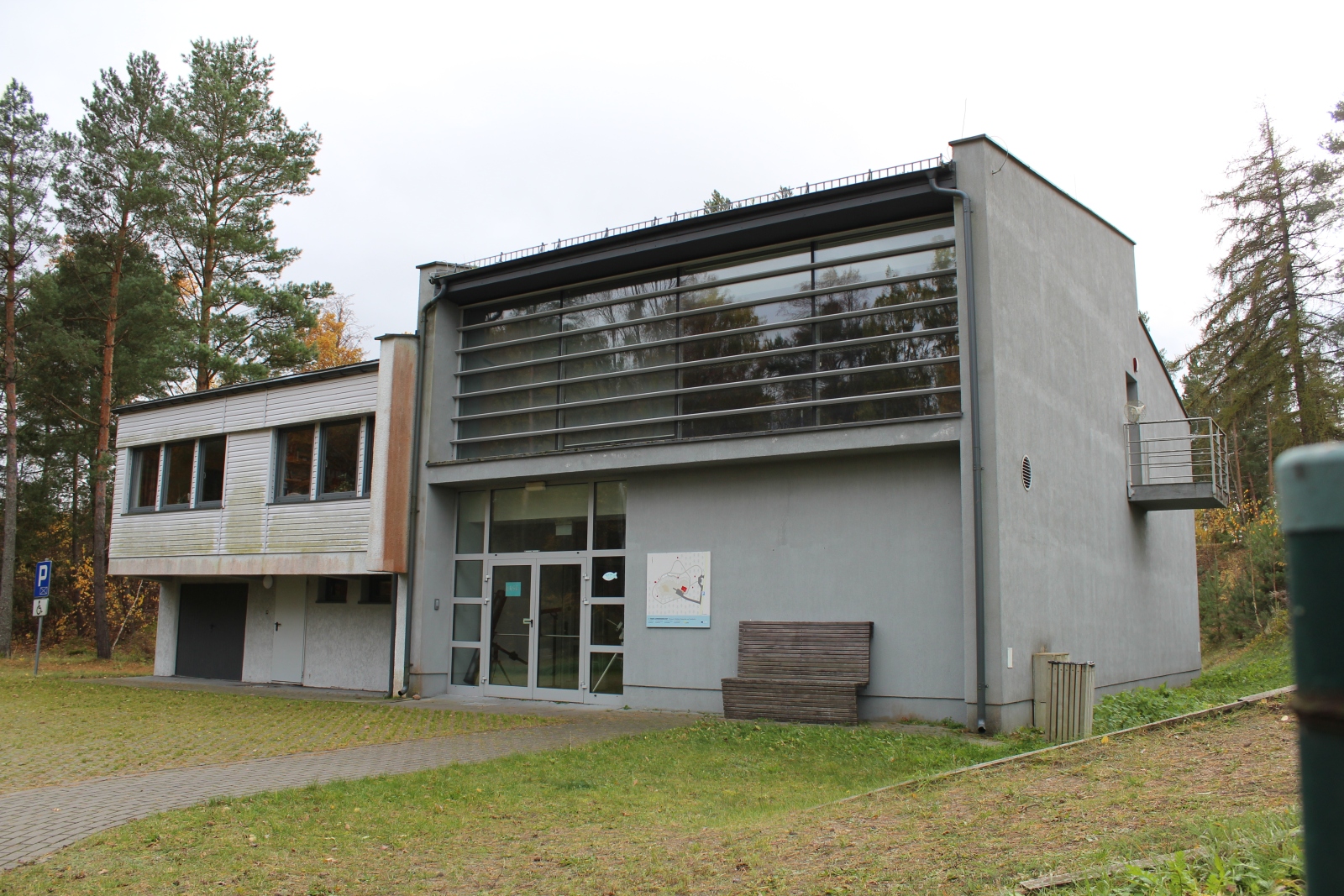
Astronomical Park of the Nicolaus Copernicus Museum in Frombork
General Information
The Astronomical Park of the Nicolaus Copernicus Museum in Frombork is an astronomical observatory and an educational institution constituting a branch of the Nicolaus Copernicus Museum – an institution of the self-government of the Warmian-Masurian Voivodeship. The site is administered by the Department of Education – Planetarium and Astronomical Park.
Location / Geographical Setting
The Park is situated on an elevation known as Crane Hill, in the village of Ronin, approximately two kilometres southeast of Cathedral Hill in Frombork, in an area which, according to one geological hypothesis, may have been formed as a result of a meteorite impact, that is, it may be an impact structure. The Park area lies at an elevation of approximately 47 m above sea level and belongs to the highest elevations in the vicinity. The hill is surrounded by cultivated fields and tree stands, and from the north-western side there is a view of Cathedral Hill and the Vistula Lagoon. The Park is reached by a local access road from Frombork, running in the direction of Ronin.
History
In 1981 (according to some sources, a year earlier), astronomy enthusiasts from Frombork, gathered in local structures of the Polish Society of Amateur Astronomers, initiated the construction of a small astronomical observatory on Crane Hill. They regarded this place as ideal for sky observation owing to the elevated terrain and distance from buildings that could disturb observations with light. The observatory, existing for three decades, served primarily educational functions and supported the work of the Planetarium located in the Radziejowski Tower.
In 2012, a decision was taken to expand the observatory and transform it into a modern centre of astronomical education. The project was implemented under the Operational Programme Sustainable Development of the Fisheries Sector and Coastal Fishing Areas for the years 2007–2013 and from funds originating from the budget of the self-government of the Warmian-Masurian Voivodeship. As part of the implementation of the project, a building housing reception rooms, research workshops, and a reference library was erected. Two observation towers were built – one with a telescope by Sendtner, the other with a telescope by Repsold. In addition, a pavilion with a measuring instrument by Bamberg and a pavilion with a photographic camera for recording images of the sky were erected. Works were also carried out to adapt the area to tourist traffic and ensure safety. A water reservoir intended for fire protection purposes was built together with a connection to the water supply network, the access road was illuminated, the area was fenced, and dirt paths with elements of small-scale architecture were created, enabling educational walks around the observatory grounds.
The inauguration of the full activity of the Astronomical Park took place in 2015, and all construction works and administrative procedures were finalized in 2016.
Characteristics / Functions / Equipment
Characteristics and Functions
The Park consists of seven observation pavilions with instruments intended for sky observation (telescopes and spyglasses), three observation terraces enabling unrestricted sky observation, a reception building, and two buildings containing educational rooms, conservation workshops, and a specialist reference library. The entire infrastructure is linked by a network of educational paths which lead participants through the history of astronomical observation methods from the times of Nicolaus Copernicus to the present day.
The idea of the Park is to acquaint visitors with the evolution of methods of observing celestial bodies, beginning with the sixteenth century and continuing to contemporary astronomical techniques of the twenty-first century. The institution serves above all educational purposes and popularizes astronomical knowledge, supporting the educational programme of the Nicolaus Copernicus Museum.
Equipment
Among the instruments located in the Park is a Cassegrain reflector telescope produced by Uniwersał (a Polish manufacturer of astronomical equipment from Żywiec), whose primary mirror has a diameter of 65 cm, while its focal length is 6.8 m. The diameter of the primary mirror makes it possible to observe faint astronomical objects, such as star clusters, nebulae, and galaxies. The light collected by the primary mirror is reflected from a small convex mirror and transmitted through an opening in the centre of the primary mirror to the eyepiece. The optimal magnification of the telescope is 650 times. The telescope is placed in an observation tower with a rotating dome with a slit shutter opened for the time of observation.
The pavilion with a sliding roof houses two smaller reflector telescopes with diameters of 15 and 20 cm, serving for the observation of nearer astronomical objects and phenomena occurring in the vicinity of the Earth. The fifteen-centimetre telescope is equipped with a special filter for the observation of sunspots.
The Park’s resources also include a spyglass by Sendtner of Munich from the turn of the nineteenth and twentieth centuries. The instrument was purchased in 1904 for the Sts Peter and Paul Higher Realschule in Gdańsk. After the Second World War, it was transferred to the reconstructed Observatory of the University of Warsaw. In the years 1972–1978, it was stored at the Observatory of the Polish Society of Amateur Astronomers in Grudziądz, and then in 1978 it was transferred to the Nicolaus Copernicus Museum by way of exchange. The instrument consists of a main telescope by Gustaw Heyde of Dresden with a focal length of 2.7 m and an objective diameter of 12.5 cm, a finder by Carl Zeiss Jena, a column with a mechanism guiding the telescope in accordance with the diurnal motion of the sky, an equatorial mount, and four knobs for clamping the telescope and carrying out precise movements in right ascension and declination.
The second of the historic observation instruments, the Reinfelder-Repsold refractor, has been in the Museum’s collection since 1984. It was transferred by the Astronomical Institute of the University of Wrocław. The instrument was produced before 1883 by the German firm A. Repsold & Söhne of Hamburg. It was originally equipped with an objective of 25 cm in diameter by Reinfelder & Hertel; however, in 1883 it was replaced with an objective by Carl Zeiss Jena. The telescope consists of a tube with an objective diameter of 25 cm, a column with a mechanism guiding it in accordance with the diurnal motion of the sky (Carl Zeiss Jena), an equatorial mount, a finder, and two knobs for clamping the telescope and two micrometric screws for carrying out slight movements in right ascension and declination. The age of the instrument – reaching almost one hundred and forty years – does not prevent its use for sky observation. The Repsold refractor was used in observing details of a lunar eclipse, being an instrument of historical and scientific significance.
Reconstructions of the original instruments used by Nicolaus Copernicus for his epoch-making observations are also exhibited in the Park. These reconstructions are based on descriptions contained in his work “De revolutionibus orbium coelestium” (On the Revolutions of the Celestial Spheres) of 1543. Copernicus used three wooden devices that were copies of Ptolemy’s instruments: a solar quadrant (a wooden board used to measure the height of the Sun above the horizon), an astrolabe, that is, an armillary sphere (Copernicus’s most complicated observation instrument, used to determine the positions of the Moon and planets in the sky), and a triquetrum, that is, a parallactic instrument (a triangle of variable length used for precise measurements of the height of celestial bodies).
In addition, the Park possesses copies of seventeenth-century Kalisz spyglasses, used by the Jesuits in Kalisz for the observation of sunspots. These instruments constitute valuable testimony to the development of optical technology in the early modern period and are particularly significant for the history of astronomy in Poland.
The Park’s resources also include a contemporary satellite camera used for recording images of the sky and for scientific research conducted within astronomical education. The instruments are equipped with various eyepieces allowing for changes of magnification, which enables observation of both nearby objects (such as the Moon or sunspots) and more distant cosmic structures.
Educational Function / Present Condition and Tourist Function
Educational and Tourist Function
The Astronomical Park performs primarily an educational function. It serves as a workshop facility for astronomy classes for primary and secondary school students and for conducting workshop classes for teachers. The site is also willingly visited by tourists interested in the history of astronomy. Night sky shows organized there attract enthusiasts of astronomy from local astronomical circles, students of astronomy and physics, and astrochemistry.
Bibliography
- Astronomical Park The Nicolaus Copernicus Museum in Frombork, https://its-poland.com/attraction/astronomical-park-the-nicolaus-copernicus-museum-in-frombork, [accessed: 12.11.2025].
- Astronomical Park (Park Astronomiczny), https://muzeumkopernika.pl/park-astronomiczny, [accessed: 12.11.2025].
- Astronomical Park of the Nicolaus Copernicus Museum in Frombork (Park Astronomiczny Muzeum Mikołaja Kopernika we Fromborku), https://www.podrozezklasa.pl/park-astronomiczny-muzeum-mikolaja-kopernika-we-fromborku, [accessed: 12.11.2025].
- An Astronomical Park Will Be Created in Frombork (We Fromborku powstanie park astronomiczny), https://naukawpolsce.pl/aktualnosci/news,391848,we-fromborku-powstanie-park-astronomiczny.html, [accessed: 12.11.2025].