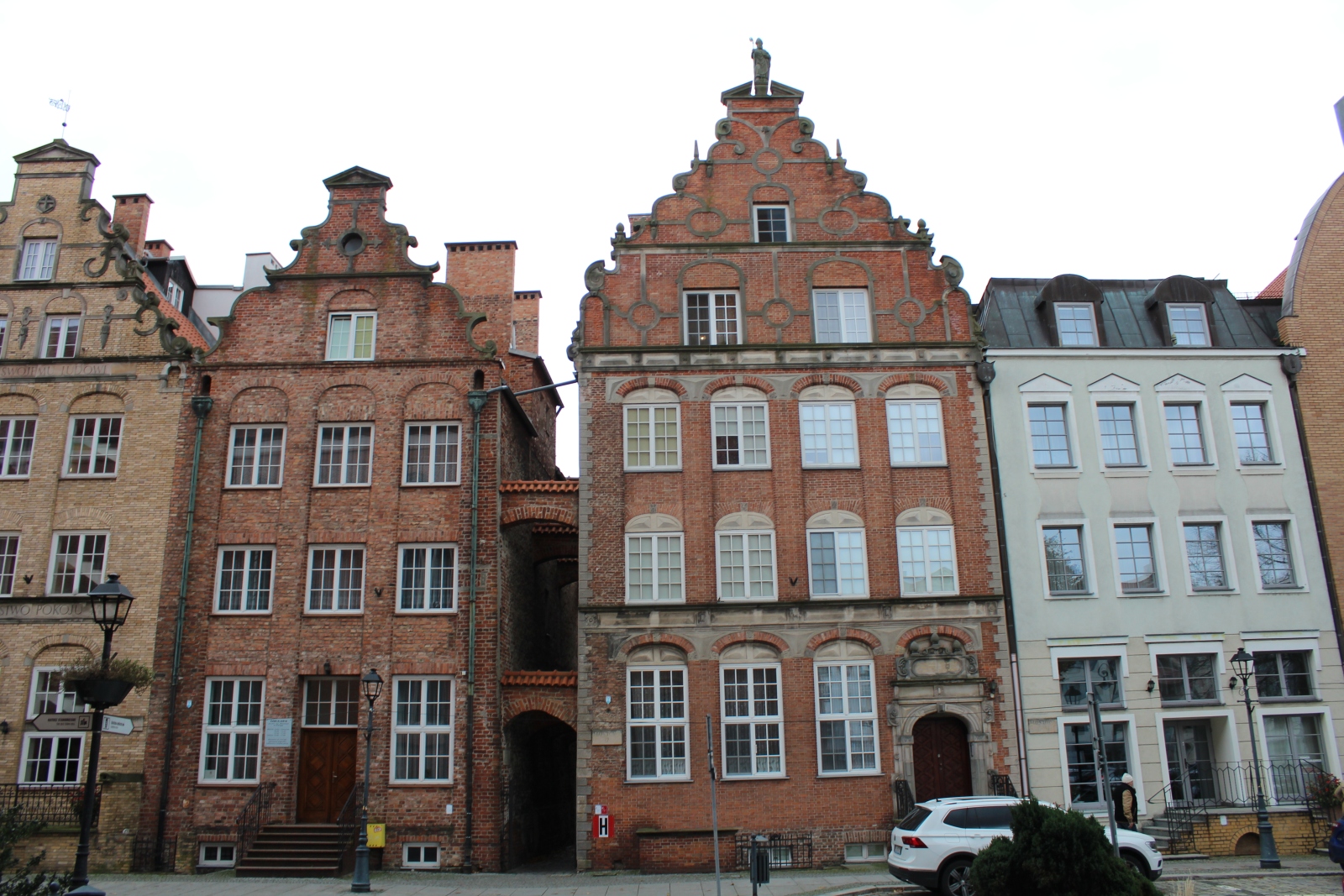
Church Path in Elbląg
General Information
The Church Path in Elbląg constitutes one of the most valuable, and at the same time least known, testimonies to medieval urban planning in the territories of East Prussia. It is a narrow passage between townhouses which, in its original form, ran through the centre of the Old Town, linking three principal churches belonging to the oldest parishes of Elbląg – the Church of the Holy Spirit, St. Nicholas’ Cathedral, and the Church of the Blessed Virgin Mary, which was associated with the Dominican monastery. The Church Path, as a unique relic of medieval urban planning, was entered into the register of immovable monuments on 14 October 1971. Today, the preserved fragment of the Church Path – connecting Świętego Ducha Street and Mostowa Street – constitutes one of the main tourist attractions of Elbląg’s Old Town.
History
The Church Path was laid out in the fourteenth century, during the period of dynamic urban development of the city, which, owing to its advantageous location and maritime trade, was becoming one of the key centres of the Teutonic Order’s state. The creation of this specific communication route resulted from the need to establish a quick and direct connection between the three most important churches of contemporary Elbląg: the Church of the Holy Spirit, St. Nicholas’ Church (the present cathedral), and the Dominican Church of the Blessed Virgin Mary (now the EL Gallery Art Centre). The name of the route directly reflected its original logistical and spiritual function.
In historical sources, another name for this passage also appears – the “Path of Bodies” (German: Leichenpfad). It is connected with the urbanization processes of the thirteenth century, when, because of the dense development within the defensive walls, there was no longer space for church cemeteries. A new necropolis was then designated outside the city, by St. James’ Church. The Church Path became a processional route by which the deceased were transported from the inner-city parishes to their place of eternal rest. It therefore combined a public utility function with the funeral rite, symbolically binding together the world of the living and the dead.
The site survived in its form for centuries, withstanding numerous wars and fires, until the tragic year 1945. During the fighting for the city at the turn of January and February, the buildings of the Old Town were destroyed to the extent of 98 percent. Paradoxically, the narrow passage with its characteristic arches survived amid a sea of ruins as one of the few authentic elements of the medieval urban structure.
In the post-war period, for more than 60 years, the passage remained inaccessible to visitors. This decision was dictated by the authorities’ concerns over the technical condition of the delicate structure and the risk of devastation. The northern section of the former path (from the cathedral to St. Mary’s Church) has not survived; the townhouses standing alongside it were demolished, and today new buildings have been erected in their place in the spirit of retroversion – referring in scale and style to the former development, yet not being faithful copies of it. A breakthrough came in 2006, when, on the occasion of the “Elbląg Days” celebrations, a decision was made to revitalize and open the surviving fragment to the public. From that moment on, the Church Path has been open to tourists daily from 9:00 a.m. to 5:00 p.m.
Architecture / Architecture and Spatial Layout
The preserved fragment of the route constitutes an outstanding example of the pragmatism of medieval builders combined with the aesthetics of Gothic architecture. The most characteristic architectural element of the path is the set of ten brick supporting arches (arcades) of a thrust-resisting and spreading character. These structures were created as a response to the dense development of urban plots – their task was to support the walls of the opposing townhouses mutually and to balance the thrust forces generated by the high storeys of the buildings, while at the same time preserving the passability of the pedestrian passage below.
The arches are made of ceramic brick, which is typical of the architecture of Prussia, a land poor in natural building stone. The form of the arches, although dictated by structural requirements, fits into the Gothic stylistic idiom, creating a dynamic, rhythmic structure above the heads of passers-by. Today, the Church Path is regarded as one of the most picturesque and authentic corners of Elbląg, allowing one to sense the atmosphere of dense medieval urban development.
Bibliography
- Grzegorz Baranowski, Elbląg and Its Surroundings (Elbląg i okolice), Gdańsk 1982.
- Jerzy Domino, Architecture of Elbląg in the Years 1945-2000 (Architektura Elbląga w latach 1945-2000), “Rocznik Elbląski”, 2004, vol. 20, pp. 119-162.
- History of Elbląg, vol. 2, part 1 (1466-1626) (Historia Elbląga, t. 2, cz. 1 (1466-1626)), ed. Andrzej Groth, Gdańsk 1996, pp. 25-28, 54.
- History of Elbląg Streets: Wigilijna and Świętego Ducha (episode 33) (Historia elbląskich ulic: Wigilijna i Świętego Ducha (odcinek 33)), https://www.portel.pl/dawny-elblag/historia-elblaskich-ulic-wigilijna-i-swietego-ducha-odcinek-33/78873, [accessed: 12.11.2025].
- Church Path in Elbląg (Ścieżka Kościelna w Elblągu), https://encyklopedia.warmia.mazury.pl/index.php/%C5%9Acie%C5%BCka_ko%C5%9Bcielna_w_Elbl%C4%85gu, [accessed: 12.11.2025].
- Franciszek Mamuszka, Elbląg and Its Surroundings. A Tourist Guide (Elbląg i okolice. Informator krajoznawczy), Gdańsk 1978, pp. 45-48.
- Józef Słodownik, Church Path – a Unique Monument of Elbląg (Ścieżka Kościelna – unikatowy zabytek Elbląga), “Tydzień w Elblągu”, 2006, no. 14, p. 5.
- Józef Włodarski, Introduction to the History of Elbląg (Wstęp do historii Elbląga), Gdańsk 2008.
- Józef Włodarski, Urban Planning of Medieval Elbląg (Urbanistyka średniowiecznego Elbląga), in: History of Elbląg, vol. I (Historia Elbląga, t. I), ed. Stanisław Gierszewski, Andrzej Groth, Gdańsk 1993, pp. 145–148.
- Józef Włodarski, From the History of St. Nicholas’ Church in Elbląg (Z dziejów kościoła św. Mikołaja w Elblągu), “Studia Elbląskie”, 2002, vol. 4, pp. 9-22.