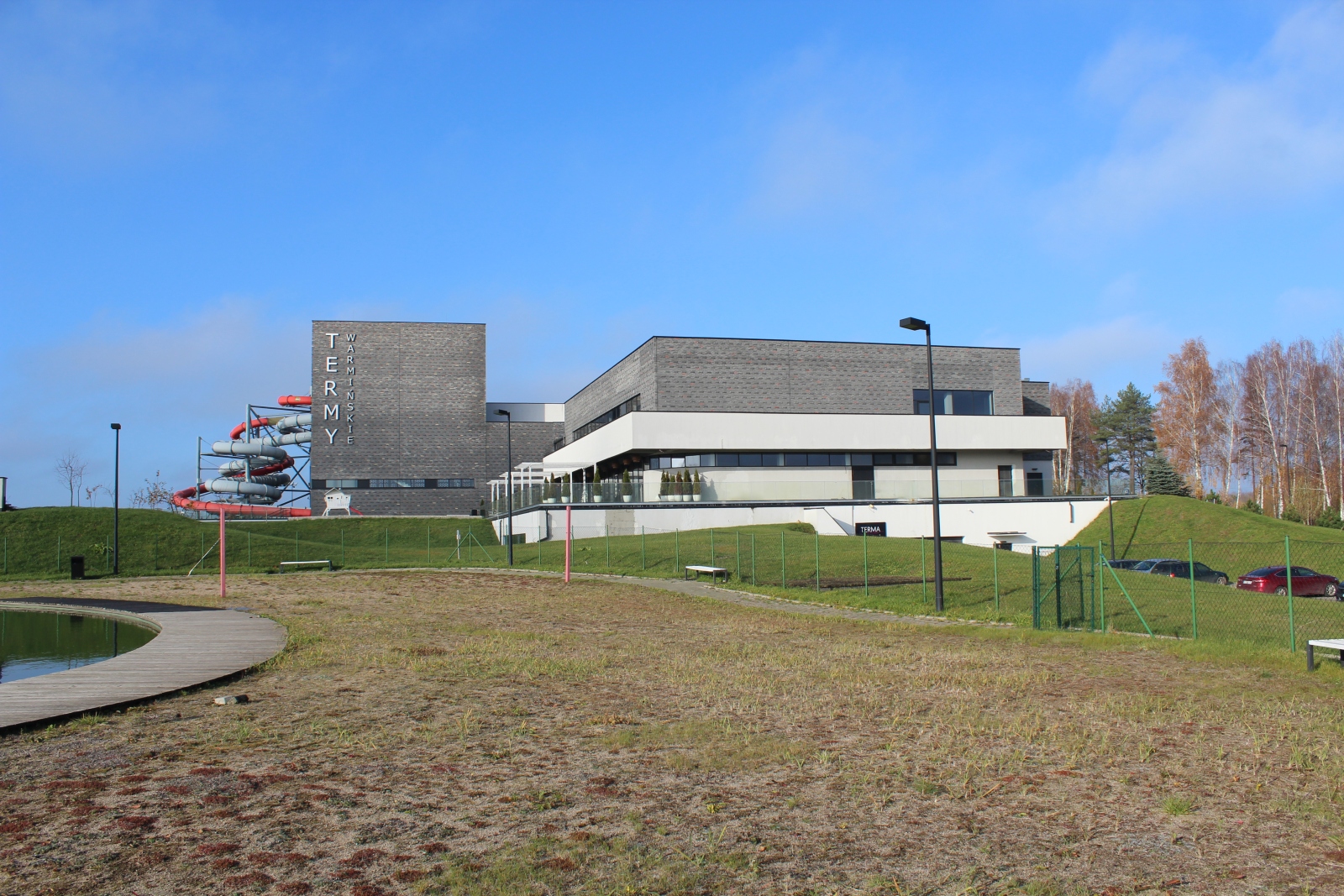
Warmian Thermal Baths in Lidzbark Warmiński
General Information
The Warmian Thermal Baths in Lidzbark Warmiński are a modern pool and hotel complex whose recreational function has been consciously linked with the use of local geothermal water resources and with building the future spa profile of the town. The site comprises an extensive pool zone (a sports and recreational section and a relaxation and balneological section), wellness and spa facilities, a conference and gastronomic section, and a “holiday village” with terraced development, which makes it one of the largest complexes of this type in north-eastern Poland.
Location / Geographical Setting
The Warmian Thermal Baths are located on the south-western outskirts of Lidzbark Warmiński, on Kąpielowa Street, in the immediate vicinity of national road no. 51 Olsztyn–Bezledy and in the hinterland of the historic town. The complex was situated on a moraine slope descending towards the Łyna valley, in the area of the Olsztyn Lakeland, within the boundaries of the planned spa protection area “Lidzbark Warmiński”, in landscape and climatic protection zone “C”.
History
The origin of the Warmian Thermal Baths is connected with the process of identifying and developing geothermal water resources in the Polish Lowlands, conducted from the late 1990s and intensifying after 2008. In studies devoted to new geothermal boreholes, it was indicated that in north-eastern Poland it is possible to use Lower Jurassic thermal waters primarily in balneotherapy and recreation, and not in classical district heating, owing to their relatively low temperature but high mineralization. In this context, the Lidzbark project was indicated as an example of an investment in which the chemical qualities of the water compensate for the limitations resulting from its “low-temperature” character.
A key stage in the preparation of the investment was the drilling of the Lidzbark Warmiński GT-1 borehole, the hydrogeological documentation of which was prepared in 2011. The borehole, with a depth of approximately 1035 m, identified an aquifer in Lower Jurassic formations, providing water with a yield of approximately 120 m³/h and a temperature of about 20–21°C at outflow, with high mineralization (approx. 17.7 g/dm³). In the light of geothermal criteria, these waters do not qualify as classically “hot”, but from the point of view of balneology they are a fully valuable therapeutic brine. In the spa report of Lidzbark Warmiński, it was emphasized that this is a chloride-sodium bromide-iodide-fluoride water, with a concentration of approximately 2.7% dissolved substances, intended in the first place for bathing and inhalation purposes.
On the basis of the hydrogeological documentation, a spa report for the spa protection area “Lidzbark Warmiński” was prepared, adopted in 2014 and constituting the basis for applying for the status of a spa commune. The report indicated that one of the key elements of the planned spa infrastructure would be a pool and hotel complex using water from the GT-1 borehole. Thus, the Warmian Thermal Baths project was inscribed into a broader strategy for the development of the spa and tourist function of Lidzbark, alongside the revalorization of the historic castle complex, the construction of a brine graduation tower, and other spa treatment facilities.
The implementation of the complex itself was entrusted to the PP-ARCHITEKCI office from Poznań. The design documentation and construction of the facility lasted from 2012 to 2015, and the total built-up area reached approximately 11,079 m². The architects designed a building with a horizontal, terraced composition, inscribed into the sloping hillside and opened with glass façades towards the Łyna valley. The set of low, terraced, sculpted volumes combines the pool section, the spa and wellness zone, the conference and gastronomic facilities, and a group of terraced houses. The composition based on flat roofs, extensive terraces, and large glazing reflects contemporary tendencies in the architecture of pool and hotel facilities, placing emphasis on the interpenetration of interiors with the surrounding landscape.
The functional layout of the Warmian Thermal Baths was subordinated to the principle of a clear differentiation of usage zones. The active zone includes, among other things, a sports pool, a multifunctional recreational pool with a “wild river”, a children’s pool, a slide tower, and a group of hydromassage tubs, creating a programme similar to that of a classic water park. The relaxation zone comprises three pools with different parameters (vital, therapeutic, and hyperthermal), jacuzzis, and elements of biological renewal, while the wellness/spa zone includes source pools and plunge pools, an outdoor thermal pool, a group of saunas (Finnish and steam), a salt grotto, massage rooms, and stations for hydrotherapy treatments. The complement is a holiday village with 33 terraced cottages, a conference section with halls, a restaurant, a club, and a bowling alley, as well as extensive land development (a pond with a beach, a rope park, sports fields, playgrounds), which strengthen the year-round character of the facility.
The parameters of the geothermal waters – high mineralization with moderate temperature – determined the manner of their use. In the geothermal literature, it is emphasized that the Lidzbark resources may be effectively used in balneotherapy and recreation, whereas their heating potential is limited and requires support from other energy sources. In practice, this means the necessity of heating the geothermal water to temperatures comfortable for pool users; the mineral character of the water, on the other hand, determined its use in brine and therapeutic pools. In the initial phase of operation, the fact of the low outflow temperature became the subject of public debate; local and national media referred to the facility as “cold thermal baths”, and the investment became a symbol of controversy surrounding the financing of infrastructure projects from EU funds. At the same time, explanatory proceedings confirmed the correctness of the stated water parameters (20.7°C after “warming up” the borehole) and the conformity of the geological documentation with the investor’s declarations.
After being launched in the middle of the second decade of the twenty-first century, the Warmian Thermal Baths became one of the principal elements of the tourist offer of Lidzbark Warmiński and an important argument in the town’s efforts to strengthen its spa function. In diagnostic reports concerning the development of tourism in the town, this facility is treated as a key investment in leisure-time infrastructure, corresponding with the historical heritage of the castle of the Warmian bishops and the new spa infrastructure (graduation towers, health paths). The Warmian Thermal Baths remain an important example of a contemporary balneorecreational investment, combining the use of low-temperature geothermal resources with the policy of development of a locality with historic cultural heritage.
Bibliography
- Bogdan Noga, Zbigniew Kosma, Henryk Biernat, Review of Currently Implemented Projects of the Use of Thermal Waters and Geothermal Energy in the Polish Lowlands (Przegląd obecnie realizowanych projektów wykorzystania wód termalnych i energii geotermalnej na Niżu Polskim), “Logistyka”, 2011, no. 6, pp. 3079–3088.
- Bogdan Noga, Zbigniew Kosma, Paweł Motyl, Possibilities of Developing Thermal Water Resources Documented in the Polish Lowlands (Możliwości zagospodarowania zasobów wód termalnych udokumentowanych na Niżu Polskim), “Logistyka”, 2014, no. 6, pp. 7852–7861.
- Spa Report of the Spa Protection Area “Lidzbark Warmiński” (Operat uzdrowiskowy obszaru ochrony uzdrowiskowej „Lidzbark Warmiński”), PUPiKZ HOT, Warszawa 2014.
- Report: Multidimensional Tourism Diagnosis of the Spa Town of Lidzbark Warmiński (Raport: Wielowymiarowa diagnoza turystyczna miasta uzdrowiskowego Lidzbarka Warmińskiego), Municipal Office in Lidzbark Warmiński, Lidzbark Warmiński 2023.