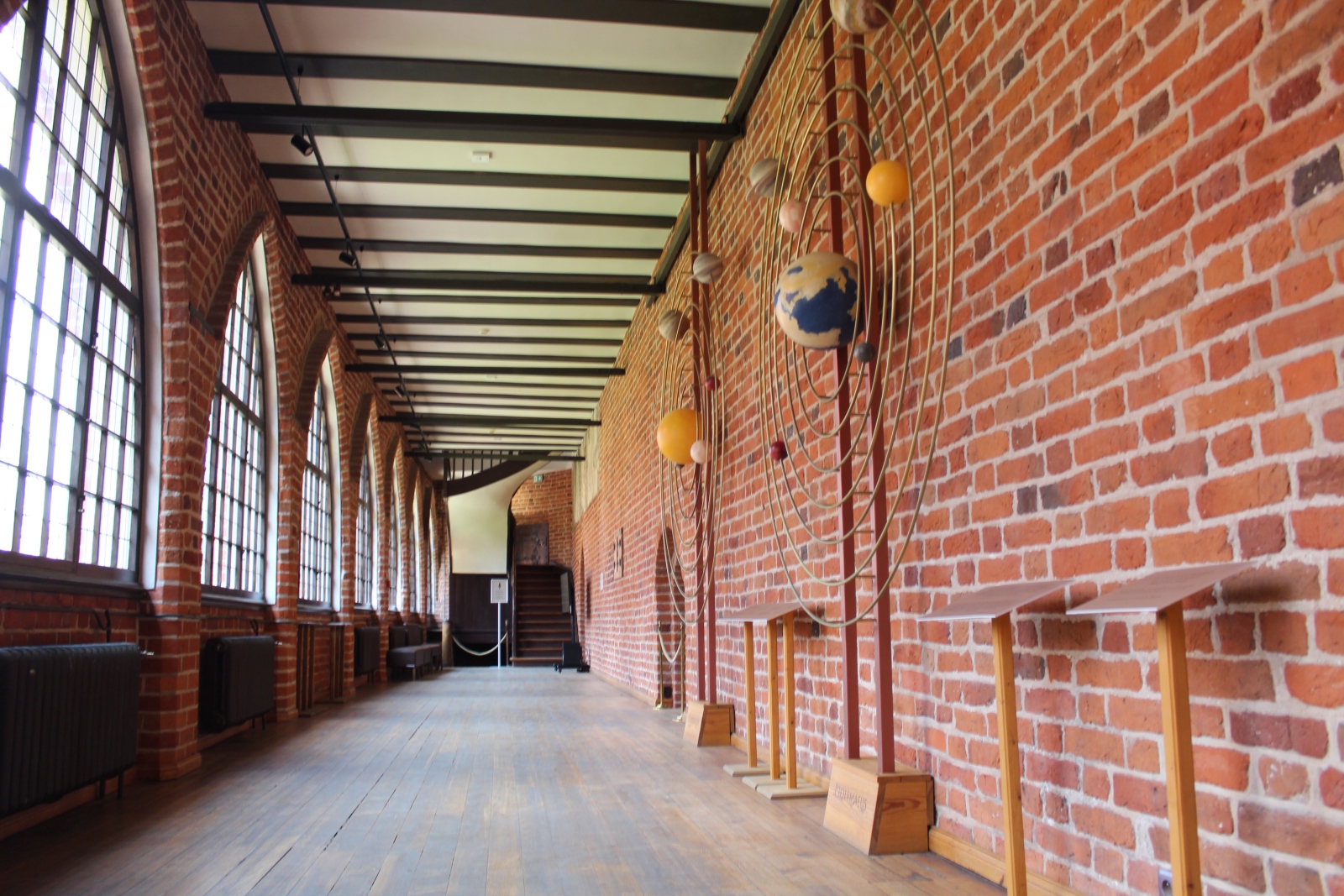
Astronomical Table at the Castle of the Warmian Chapter in Olsztyn
General Information
The astronomical experimental table of Nicolaus Copernicus (1473-1543) at the Castle of the Warmian Chapter in Olsztyn is the only known instrument of the scholar that has survived in its original form. The remaining observational instruments of Copernicus are known only from descriptions in "De revolutionibus orbium coelestium".
Location / Geographical Setting
The astronomical table is located in the Castle of the Warmian Chapter in Olsztyn, on the wall of the cloister in the northern wing.
History
The origin of the astronomical table is directly connected with Nicolaus Copernicus’s stay at the Castle of the Warmian Chapter in Olsztyn. The astronomer served there as administrator of the Warmian Chapter in the years 1516–1519 and 1520–1521, dealing with the management of estates, economic matters, and defence during the period of wartime tensions with the Teutonic Order. At the same time, this was a period of advanced work on "De revolutionibus" and of his participation in the discussion on the reform of the Julian calendar, initiated, among others, by the appeal of Paul of Middelburg (1446-1534) in 1513. In this context, the problem of determining precisely the length of the tropical year and the exact moment of the vernal equinox became a fundamental issue – both from the point of view of theoretical astronomy and of calendrical practice.
Against this background, the creation of the table, dated by researchers to the spring of 1517, appears as a natural development of Copernicus’s previous interests. Findings based on the analysis of the geometry of the table and the reconstruction of the movement of the light reflection indicate that in the spring of 1517 Copernicus conducted observations of the Sun over a period of about two months: roughly from one month before the equinox to one month after this phenomenon, at intervals of five days. Each such observational session corresponds to one “daily line” on the table (in total, fourteen daily paths were recorded in this way), one of which – distinguished by colour and a straight form – corresponds to the day of the equinox. Above this line there appears the group of letters T I C, interpreted as an abbreviation of formulae of the type "Trames Initii Calendarii" – “the path of the beginning of the calendar”, which aptly reflects the function of the equinoctial line as a reference point for the reckoning of the year.
Description of the Monument
The table takes the form of a large-scale drawing on plaster: a rectangular composition approximately 7 m long and more than 1 m high, covered with a network of lines in several colours, marked with Roman and Arabic numerals and single letters. It is a precisely designed observational scheme connected with the motion of the Sun across the celestial sphere. The uniqueness of the monument also lies in the fact that Copernicus did not mention it in any of his writings, and the attribution of authorship to him is based on the coincidence of the dating of the plaster and polychromy layers with the astronomer’s stay at the castle, as well as on historical-scientific analyses of the last decades.
The construction of the instrument assumed that in a period close to the vernal equinox, a ray of sunlight, reflected in a mirror placed on the part of the castle opposite the table, would fall upon the wall of the cloister and move across it in a strictly predictable way. On the surface of the table, Copernicus inscribed a system of lines and markings corresponding to the theoretically calculated trajectory of the point of light for successive days and hours. The equinoctial line has a form close to a straight line, whereas the lines corresponding to the days preceding and following the equinox take the form of curves similar to hyperbolae. This follows directly from the geometry of the phenomenon: on the day of the equinox, the plane in which the beam of reflected light moves (connected with the plane of the Earth’s equator) intersects the plane of the table along a straight line; on days of non-zero solar declination, the path of the light point is already a curve. In this way, the graphic form of the notation itself – one straight line among curves – distinguishes the day of the equinox from the others.
The functioning of the table was based on the use of the principle of reflection instead of the classical shadow of a gnomon. Instead of casting the shadow of a rod upon a plane, Copernicus used a small horizontal mirror, whose angular size – seen from the table – was comparable to the size of the solar disc. This mirror, placed at an appropriate distance on one of the towers or on the roof of the castle wing, reflected a beam of sunlight towards the cloister. The reflected light entered through an opening or window and fell upon the wall with the previously applied drawing. The geometry of the arrangement (the angle between the plane of the table, the direction of the ray, and the position of the mirror) was chosen in such a way that in the selected period of the year – precisely around the equinox – the travelling point of reflected light crossed successive daily and hourly lines. In the literature, there are also earlier hypotheses concerning the use of a liquid surface (e.g. mercury) as a mirror. Others emphasize that a small, horizontally placed mirror of appropriately chosen size was sufficient.
Geometric analyses show that the daily lines themselves were not drawn by continuous tracking of the path of the spot throughout the whole day, but arose from joining points determined at several selected moments and by further interpolation. Copernicus may first have laid out the hourly lines – straight lines corresponding to successive solar hours, related to an adopted reference meridian – and then, on specified days of the observational programme, marked at the intersection with one of them the position of the light reflection at a fixed hour. The five-day interval between sessions meant that the difference in the position of the light point on the same hourly line was proportional to the difference in the ecliptic longitude of the Sun. In practice, Copernicus could therefore determine the distance between points corresponding to successive observations and adopt it as the unit of spacing of the daily lines on the table. Then, using compasses, he transferred this distance onto other hourly lines, creating a network of nodes which he connected with straight segments. The daily lines thus obtained therefore have the character of polylines composed of straight segments, which contemporary numerical modelling confirms well.
In observational practice, the scheme of operation of the table may have looked as follows. In the selected period – comprising successive days at five-day intervals, approximately from one month before the equinox to one month after – Copernicus or a person cooperating with him recorded the position of the reflection on the table at the moments when the point of light passed through a specified hourly line. The temporal accuracy of such observations could have been ensured by a tower clock or a portable mechanical clock, regularly corrected to local solar time. The data collected over about two months made it possible to reconstruct the daily motion of the Sun near the equinox, and thus – after appropriate analysis – to determine the moment of the Sun’s passage through the equinoctial point with far greater precision than that provided by classical measurements with a quadrant.
Bibliography
- Jan Chroboczek, "500 Years of the Olsztyn Copernican Table" ("500 lat olsztyńskiej Tablicy Kopernika"), „Postępy Fizyki”, 2021, vol. 72, no. 3, pp. 8–17.
- Janusz Cygański, "Selected Issues from the History of Research and Conservation of Nicolaus Copernicus’s Astronomical Table at Olsztyn Castle" ("Wybrane zagadnienia z historii badań i konserwacji tablicy astronomicznej Mikołaja Kopernika na zamku w Olsztynie"), in: "Nicolaus Copernicus’s Astronomical Table at Olsztyn Castle. State of Research" ("Tablica astronomiczna Mikołaja Kopernika na zamku w Olsztynie. Stan badań"), Olsztyn 2013, pp. 9–33.
- Georg Graßhoff, Gerd Fischer, "Copernicus’s Heliograph at Olsztyn – the 500th Anniversary of a Scientific Milestone", „Annalen der Physik”, 2018, vol. 530, no. 12, art. 1800196.
- Elżbieta Jelińska, "Introduction" ("Wprowadzenie"), in: "Nicolaus Copernicus’s Astronomical Table at Olsztyn Castle. State of Research" ("Tablica astronomiczna Mikołaja Kopernika na zamku w Olsztynie. Stan badań"), Olsztyn 2013, pp. 7–8.
- Jerzy Miałdun, "Numerical Model of Nicolaus Copernicus’s Table at Olsztyn Castle" ("Numeryczny model tablicy Mikołaja Kopernika na olsztyńskim zamku"), in: "Nicolaus Copernicus’s Astronomical Table at Olsztyn Castle. State of Research" ("Tablica astronomiczna Mikołaja Kopernika na zamku w Olsztynie. Stan badań"), Olsztyn 2013, pp. 35–59.
- Tadeusz Przypkowski, "Nicolaus Copernicus’s Experimental Table in Olsztyn in the Light of the Latest Discoveries of 1956–1957" ("Tablica doświadczalna Mikołaja Kopernika w Olsztynie w świetle najnowszych odkryć 1956–1957 roku"), „Postępy Astronomii”, 1958, vol. 6, no. 3, pp. 107–109.
- Ada Romanowska, This Table Has No Equal. It Was Made by Copernicus, and Only Olsztyn Has It ("Ta tablica nie ma sobie równych. Zrobił ją Kopernik, ma ją tylko Olsztyn"), https://kopernik.warmia.mazury.pl/jedyna-taka-tablica-astronomiczna-na-swiecie/, [accessed: 25.06.2025].
- Jerzy Sikorski, "The Private Life of Nicolaus Copernicus" ("Prywatne życie Mikołaja Kopernika"), Olsztyn 1973.
- Paweł Sobotko, "Nicolaus Copernicus’s Astronomical Experimental Table at Olsztyn Castle. Bibliography" ("Astronomiczna tablica doświadczalna Mikołaja Kopernika na zamku w Olsztynie. Bibliografia"), „Komunikaty Mazursko-Warmińskie”, 2014, no. 4 (286), pp. 539–551.
- Jacek Szubiakowski, "The Astronomical Aspect of the Research on the Solar Observational Table at Olsztyn Castle" ("Astronomiczny aspekt badań słonecznej tablicy obserwacyjnej na olsztyńskim zamku"), in: "Nicolaus Copernicus’s Astronomical Table at Olsztyn Castle. State of Research" ("Tablica astronomiczna Mikołaja Kopernika na zamku w Olsztynie. Stan badań"), Olsztyn 2013, pp. 61–89.
- Nicolaus Copernicus’s Astronomical Table ("Tablica astronomiczna Mikołaja Kopernika"), https://muzeum.olsztyn.pl/1036,tablica-astronomiczna-mikolaja-kopernika.html, [accessed: 25.06.2025].
- "Nicolaus Copernicus’s Astronomical Table at Olsztyn Castle. State of Research" ("Tablica astronomiczna Mikołaja Kopernika na zamku w Olsztynie. Stan badań"), ed. Elżbieta Jelińska, Olsztyn 2013.
- Ernst Zinner, "Die Allensteiner Sonnenuhr des Nikolaus Coppernicus", „Berichte der Naturforschenden Gesellschaft in Bamberg”, 1946, vol. 29, pp. 28–29.