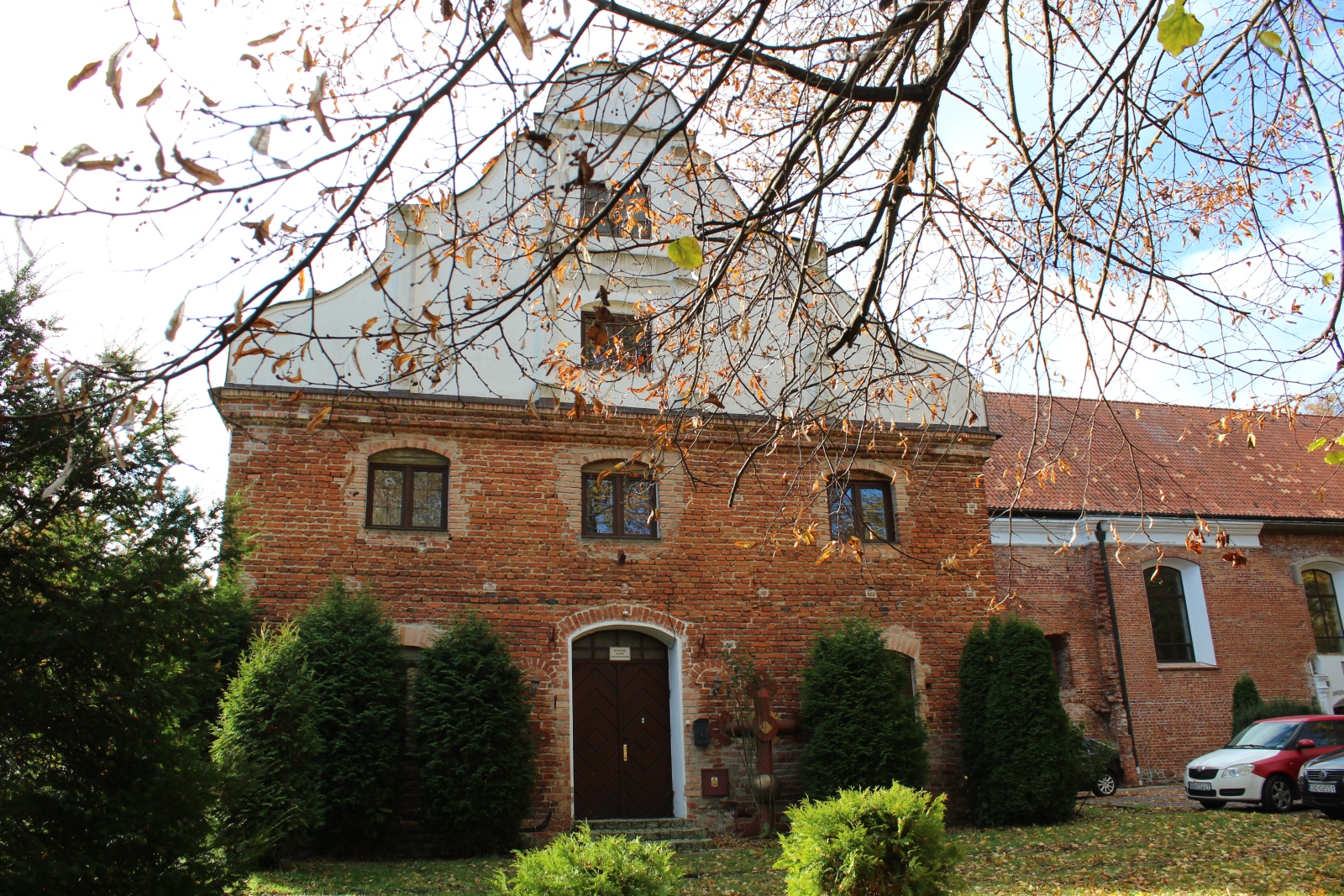
Ruins of the Reformed Franciscan Monastery
General Information
Nowe Miasto Lubawskie (historically Nowe Miasto nad Drwęcą, German: Neumark in Westpreußen) – a town in the Warmian-Masurian Voivodeship, Nowe Miasto County, on the Drwęca River. In 2024, the population was 10,089. Since 2010, the town has been a member of the Polish National Cittaslow Network of Towns.
Geographical Location
Nowe Miasto is situated on the Drwęca River, in the southwestern part of the Warmian-Masurian Voivodeship. The settlement stretches along both banks of the river, with its main part located on the right bank of the Drwęca.
The monastery was built in Łąki Bratiańskie, within the Chełmno Diocese; today, administratively, it is located on Grunwaldzka Street in Nowe Miasto Lubawskie (Łąki Miejskie), Nowe Miasto Lubawskie commune, Nowe Miasto County, Warmian-Masurian Voivodeship. The site lies right by National Road No. 15.
History
The area where the future Reformed Franciscan monastery complex was to be built had already been a sacred site in pagan times, as there was a holy linden grove where ceremonies were held in honor of Perkun and the goddess of spring Majuma. The place of worship was surrounded by a fence.
Around 1257, Jan of Sandomierz, a wealthy Polish knight who joined the Teutonic Order of the Hospital of St. Mary of Jerusalem and resided at the Bratian castle, built a wooden chapel at the site, which, according to tradition, was pointed out by the Virgin Mary in an apparition to children and later to two beggars. The place was venerated from the beginning due to miraculous healings attributed to the intercession of Mary. The chapel housed a miraculous figure of the Virgin Mary. Around 1400, Philipp von Kleeberg, the Teutonic warden of Bratian castle, erected a brick chapel with a small tower in Łąki, dedicated to the Virgin Mary. The construction was financed from the Teutonic Order’s treasury.
In 1624, Paweł Jan Działyński, the starosta of Bratian and Voivode of Pomerania, brought the Reformed Franciscans to Nowe Miasto. The following year, the monastery was plundered by Lisowczyk mercenaries, and in 1629, the suburbs and abbey were looted by the Swedes. The monks were moved to Łąki (2 km from Nowe Miasto), where the starosta funded the construction of a wooden monastery. When it soon burned down, Paweł Działyński and his wife Jadwiga Czarnkowska endowed the Reformed Franciscans with a brick church dedicated to the Assumption of the Virgin Mary and a monastery. The foundation was approved on 16 February 1639. The complex was surrounded by a wooden fence, later replaced with a wall. The monastery consisted of four one-story buildings and had two courtyards (one large with cloisters). The eastern part housed the refectory and sacristies, while the western part contained guest rooms. The church was located north of the monastery. Between 1683–1693, Bishop Kazimierz Jan Opaliński of Chełmno funded a chapel at the church and provided it with a relic of St. Casimir and a crypt, expressing his wish to be buried there. At the beginning of the 18th century, Tomasz Działyński, Voivode of Chełmno, and his wife Teresa Bielińska founded another small chapel dedicated to St. Peter of Alcantara, where they were buried. Between 1785–1790, the church was rebuilt in the Baroque style, and the monastery was expanded. The church had several entrances, with the main one located in a western portal shaped like a circular annex. The church consisted of a rectangular nave and presbytery, with an organ gallery above the vestibule.
From the moment the Reformed Franciscans moved to Łąki, the fame of the Bratian sanctuary began to spread widely. The cult of Our Lady of Łąki attracted pilgrims not only from the Lubawa and Warmia regions but also from the Grand Duchy of Lithuania. Numerous testamentary donations were made in favor of the church and monastery. On June 4, 1752, with the consent of Pope Benedict XIV, Bishop Wojciech Leski of Chełmno, accompanied by Auxiliary Bishop Fabian Pląskowski, crowned the miraculous figure of Our Lady of Łąki with papal crowns. Since 1752, on the second Sunday after Pentecost, annual indulgence celebrations were held in Łąki, lasting a week and attracting large pilgrimages. The sanctuary became known as the "Częstochowa of the North" or "Prussian Częstochowa" at the turn of the 18th and 19th centuries.
After the First Partition of Poland (1772), the Łąki convent came under the rule of the Kingdom of Prussia. It survived the 1810 decree abolishing monasteries in Prussia but was eventually closed on 27 September 1875 under another law abolishing religious orders. The monastery buildings became state property. On the night of 5–6 May 1882, lightning struck the church tower during a storm, igniting a fire that destroyed the tower, roof, and part of the interior. The miraculous statue of Our Lady of Łąki was saved and transferred to the church in Nowe Miasto Lubawskie, where it can still be seen in the main altar of St. Thomas the Apostle Basilica. In 1884, the monastery building also burned down. The remaining structures were dismantled to reuse the building materials. Today, little remains of the monastery—only a reconstructed gate and fragments of walls. The site was entered into the register of immovable monuments on 3 August 1968 and 19 September 2000.
Monuments
- The “economic” gate, restored in 2003—rebuilt, plastered, and fitted with wooden doors.
- Fragments of monastery walls.
- Completely preserved lower sections of the church walls.
Bibliography
- Andrzejewski A., Kajzer L., "The Former Monastery Complex in Łąki Bratiańskie near Nowe Miasto Lubawskie in the Light of Field Verification Studies", "Łódzkie Sprawozdania Archeologiczne", 2002/2003, vol. 8, pp. 265-274.
- Bączek K., "The Rural Cultural Landscape of Nowe Miasto Lubawskie County", "Komunikaty Mazursko-Warmińskie", 2018, no. 2 (300), pp. 288-330.
- Betlejewski A., "Łąki Bratiańskie. A Historical Sketch of Łąki in Lubawa County from Pagan Times, the Apparition of the Virgin Mary, and the Foundation of the Reformed Franciscan Monastery", Toruń 1903.
- "The Diocese of Chełmno. A Historical and Statistical Outline", Pelplin 1928.
- Fankidejski [J.], "Lost Churches and Chapels in Today’s Chełmno Diocese; Based on Official Church Records", Pelplin 1880.
- Korecki A., "The Marian Sanctuary in Łąki Bratiańskie", Pelplin 2002.
- "Nowe Miasto. From the History of the Town and County", ed. Z. Witkowski, Olsztyn 1963.
- Piszcz E., "Łąki Bratiańskie – the Oldest Marian Shrine in the Chełmno Diocese", "Nasza Przeszłość", 1971, vol. 34, pp. 177-203.
- "Ziemia Lubawska. Guide to Monuments", Rybno, ca. 2015.