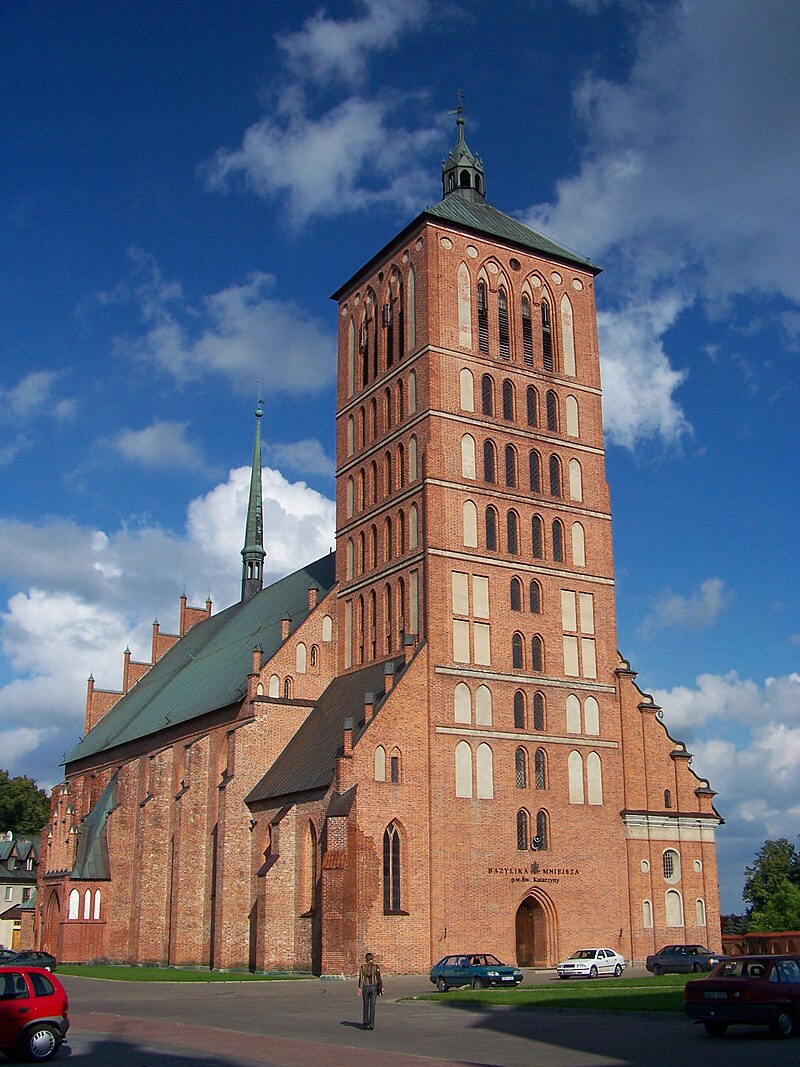
Minor Basilica of St. Catherine of Alexandria in Braniewo
General Information
The Basilica of St. Catherine is one of the biggest and most impressive Gothic churches in the Warmia region. For hundreds of years, this church was a symbol of the wealth and independence of the people of Braniewo, which used to be the first capital and most important trading town of the old Warmia bishopric. In 2001, Pope John Paul II gave the church the special title of "minor basilica."
Location
The church stands in the middle of the Old Town, at Katedralna Street 3. It was built on a small hill in a bend of the Pasłęka River. Its tall front tower can be seen from many kilometers away and has been the most important landmark in the flat landscape of the Warmia Plain for centuries.
History
Building of the current stone church began around 1343, starting with the chancel (the part around the altar), and construction went on in stages for over a hundred years, until 1446. In the first half of the 15th century, workers built the big west tower and the side aisles, giving the church its final Gothic shape.
In 1480, a fire caused by lightning made the strong inside pillars collapse, and the Gothic ceiling of the main aisle fell with them. The tower burned too. The builders had to rebuild right away. They made the new star-shaped ceiling even more beautiful, and at the same time raised the side aisles so the whole church became one open, hall-like space. In 1500, Bishop Łukasz Watzenrode paid for a stone music gallery near the chancel. The church was also damaged during the last war with the Teutonic Knights, when Grand Master Albrecht Hohenzollern attacked Braniewo in 1520. The tower was not rebuilt until 1526, and this time it reached 63 meters high.
The church caught fire several more times — in 1622, 1812, and 1828 — but each time the fire was put out quickly. In the 19th century, especially in the 1850s and 1890s, the church went through major repairs and building work. In the 18th century the church had 18 altars; by the time of a repair in 1859, only 14 were left. Rich decorations from the 16th and 17th centuries stayed in the church until 1945, with more beautiful artworks added over the following centuries.
Everything changed at the end of February and start of March 1945. During fierce fighting between Soviet and German troops for Braniewo, the retreating German army deliberately blew up the church, so that Soviet soldiers could not use the tower as a lookout point. Almost all the pillars, ceilings, roof, and the huge front tower collapsed. Only the burnt outer walls were left standing.
For thirty years after the war, the basilica stood as a giant ruin in the middle of the destroyed town, overgrown with bushes and with no protection. Rebuilding finally started in 1979, thanks to the huge effort of Father Tadeusz Brandys and money from both the state and the church. The work was done with great care to match the original design, and the rebuilt church was formally reconsecrated in 1982.
In a side aisle of the basilica there is a special place of worship — an altar holding the relics of Blessed Regina Protmann. She was born in Braniewo and in the 16th century she founded the Congregation of the Sisters of St. Catherine, one of the first groups of nuns dedicated to caring for the sick and educating girls. Her remains rested in the church from 1809 to 1929, and today her tomb (crypt) can be found under the basilica.
Architecture
The Basilica of St. Catherine is a brick church, rebuilt in the Gothic style. It has three aisles of equal height (called a "hall church") with six sections, and there is no separate chancel sticking out from the building — the altar area is inside the same rectangular shape as the rest of the church. The church is almost 60 meters long and 25 meters wide. On the west side, there is a huge, many-story square tower, over 60 meters tall, topped with a pointed spire.
The outside walls have tall, pointed windows, rebuilt to match medieval designs, along with buttresses (support pillars) spaced evenly along the walls. Inside, the star-shaped ceilings (in the main and side aisles) and net-shaped ceiling (in the north chapel by the tower) were faithfully rebuilt after the war — a real masterpiece of bricklaying. They rest on ten pairs of tall, eight-sided brick pillars, which make the inside feel light and very spacious.
Furnishings
The explosion and fire of 1945 destroyed almost 100% of the church's original decorations and furniture from past centuries. Because of this, today's interior mixes what little survived with modern religious art. A few original architectural pieces were saved, including fragments of Gothic doorways, carved ceiling stones, and a medieval stone baptismal font that survived buried under the rubble. The new main altar and the decoration of the chancel were designed in a modern, monumental style that matches the plain, strong look of the Gothic walls.
Did You Know?
While clearing the rubble in the 1970s, restorers decided to reuse as much of the historic material as possible. The original Gothic bricks lying inside the ruins were cleaned of old mortar by hand and used again to rebuild the pillars and ceilings. Because of this, the lower parts of the basilica are largely made of real, authentic 15th-century material.
Bibliography
- Achremczyk Stanisław, Szorc Alojzy, Braniewo, Olsztyn 1995.
- Bazylika mniejsza pw. Św. Katarzyny, https://www.it.braniewo.pl/index.php/warto-zobaczyc-2/bazylika-mniejsza-pw-sw-katarzyny (accessed 7.10.2025).
- Bazylika Świętej Katarzyny Aleksandryjskiej w Braniewie, https://leksykonkultury.ceik.eu/index.php/Bazylika_%C5%9Awi%C4%99tej_Katarzyny_Aleksandryjskiej_w_Braniewie#Bibliografia (accessed 7.10.2025).
- Buchholz Franz, Führer durch die St. Katharinenkirche zu Braunsberg, Braunsberg 1940, pp. 6-7.
- Jakutowicz Joanna, Kościół parafialny pw. św. Katarzyny, https://zabytek.pl/pl/obiekty/braniewo-kosciol-rzymskokatolicki-pw-sw-katarzyny-aleksandryjs (accessed 7.10.2025).
- Jodkowski Marek, Troska o stan materialny kościoła pw. św. Katarzyny w Braniewie w XIX i I połowie XX wieku, "Studia Warmińskie", 2010, vol. 47, pp. 87-107.
- Katalog zabytków sztuki w Polsce. Seria nowa, vol. 2: Województwo elbląskie, part 1: Braniewo, Frombork, Orneta i okolice, ed. Marian Arszyński, Marian Kutzner, Jerzy Z. Łoziński, Barbara Wolff-Łozińska, Warszawa 1980, pp. 14-17.
- Kościoły i kaplice Archidiecezji Warmińskiej, vol. 1: Święta Warmia, ed. Bronisław Magdziarz, Olsztyn 1999, pp. 124-125.
- Rzempołuch Andrzej, Przewodnik po zabytkach sztuki dawnych Prus Wschodnich, Olsztyn 1992, pp. 24-25.