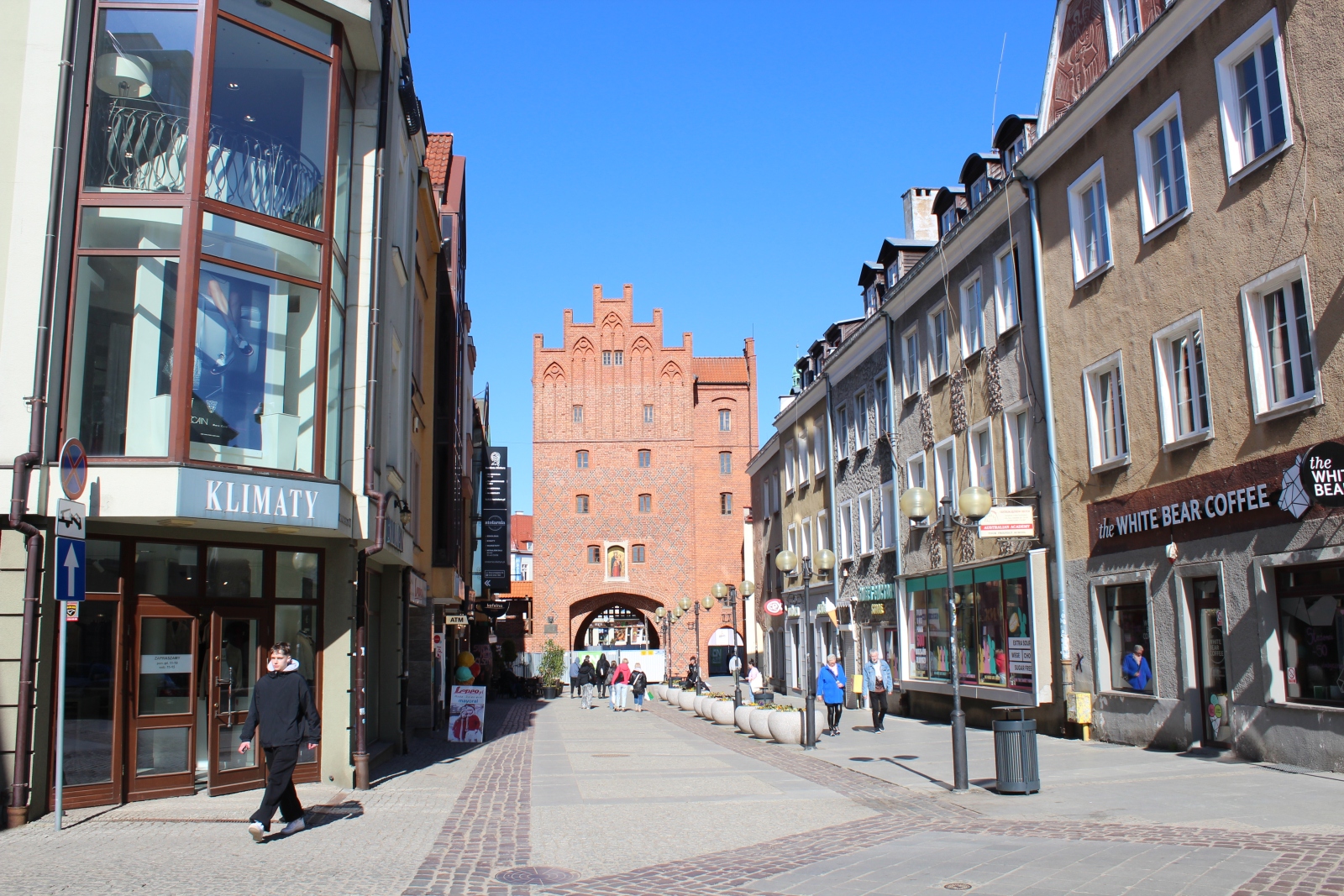
Upper Gate (High Gate) in Olsztyn
General Information
The Upper Gate, called the High Gate (German: "Obertor", "Hochtor"), is one of the most recognizable symbols of Olsztyn. It is the only surviving town gate out of the three that once guarded the entrance to the town (the others being the Lower Gate and the Mill Gate). As an integral element of the former defensive walls, this structure survived numerous historical upheavals, fulfilling over the centuries military and penitentiary functions, and in modern times – tourist and hotel-related ones.
Location / Geographical Setting
The gate is situated in the north-eastern part of the Old Town, closing the outlet of Staromiejska Street. In the medieval urban layout, the gate controlled the route leading towards Dobre Miasto and Lidzbark Warmiński. The monument is located at 1 Staromiejska Street.
History
The monument was erected in the fourth quarter of the fourteenth century, probably after 1378, when the boundaries of the chartered town were being expanded and the line of fortifications modernized. Its location was connected with the urban plan of medieval Olsztyn based on the north-south axis. One concept assumes that the entire system of the town fortifications was consistently developed from the second half of the fourteenth century (after 1353) until the first quarter of the fifteenth century.
The Upper Gate was damaged several times. For example, in the years 1620 and 1657, fires destroyed the wooden structural elements of the defensive walls as well as the ceilings and roof trusses of the towers. Probably after one of the seventeenth-century fires, the gable of the Upper Gate was rebuilt, its structure being changed to a timber-frame one. During the Great Northern War, when the Swedes burned Olsztyn in 1708, the Upper Gate also suffered damage, but it was repaired immediately. In 1788, an armoury for the squadron of Prussian dragoons stationed in the town was arranged within it.
At the end of the eighteenth century and the beginning of the nineteenth century, in the face of the development of warfare techniques, the defensive walls of Olsztyn lost their military usefulness and their demolition began. The decision to demolish the Upper Gate was blocked in 1858 by Ferdinand von Quast (1807-1877) – the first Prussian conservator of monuments, who recognized its unique architectural value. The building was then adapted for use as a municipal prison and its rebuilding was begun. An eastern annex with a staircase was added, and the tower’s crowning was also changed by the addition of pinnacled gables. In 1863, Wojciech Kętrzyński (1838-1918), accused of smuggling arms for the January insurgents, was imprisoned in the Upper Gate for five days. In the last decade of the nineteenth century, the pedestrian passage to the Old Town, still in use today, was pierced through the ground floor of the annex. In 1898, the prison was moved elsewhere and the building faced the threat of demolition. The gate was saved from destruction by the decision of Mayor Oskar Belian (1832-1918), who placed the fire brigade headquarters there. Later, it became the seat of a police post and a registration office. From 1907, trams passed beneath the gate, and in the interwar years the building was used for accommodation purposes.
The military operations of 1945 led to partial destruction of the building. Three years later, the adaptation of the Upper Gate into a hostel of the Polish Tourist Society was undertaken. In the following decades of the twentieth century, the building underwent numerous renovations. In 2003, conservation and restoration works were carried out. A year later, a mosaic image of the Blessed Virgin Mary Queen of Peace, donated by Pope John Paul II, was placed in the blind recess on the town side. The preserved building of the Upper Gate remains one of the most characteristic elements of Olsztyn’s fortifications. At present, the building houses a hotel.
Architecture / Architecture and Spatial Layout
The Upper Gate is a Gothic structure 23 m high, on a plan close to a square with a side length of 9.5 m. It was built in brick on a stone foundation. It has four storeys, with an additional usable level in the gable zone. The structure, with stepped gables, was covered with a gable roof. On the eastern side, a lower, four-storey annex also has a gable roof. The pointed-arch gate passage was protected on the outer side by a portcullis. Its preserved guide reaches up to the height of the second storey. In three elevations there are pointed-arch blind recesses. The southern elevation – facing the Old Town – has decoration in the form of a network of rhombuses laid in overfired brick, and above the gate passage there is a panel with a modern mosaic image of the Blessed Virgin Mary Queen of Peace. It is possible that the first gables of the structure were five-axis stepped ones, filled with two-part pointed-arch blind recesses. The present Neo-Gothic form of the gable is the result of restoration works carried out by the then provincial conservator of monuments Ferdinand von Quast. In modern times, a fragment of reconstructed high wall has been added to the western elevation. In front of the gate, on the northern side, below the present ground level, there are visible the remains of a tower discovered in 2012 – a rondel flanking the entrance to the town.
Bibliography
- Rafał Bętkowski, "Olsztyn as You Do Not Know It. 650 Years of Olsztyn" ("Olsztyn jakiego nie znacie. 650 lat Olsztyna"), Olsztyn 2003, pp. 29-31.
- Upper Gate in Olsztyn ("Brama Górna w Olsztynie"), http://leksykonkultury.ceik.eu/index.php/Brama_G%C3%B3rna_w_Olsztynie, [accessed: 25.06.2025].
- Bartłomiej Kaczyński, Adam Mackiewicz, "Archaeological Research on the Foregate of the Upper Gate in Olsztyn" ("Badania archeologiczne przedbramia Bramy Górnej w Olsztynie"), „Olsztyński Rocznik Konserwatorski” 2014, pp. 5-24.
- Maria Lewicka, "The Conservation and Utilitarian Aspect of the External Structures of the Upper Gate in Olsztyn Uncovered in 2012" ("Konserwatorski i utylitarny aspekt odsłoniętych w 2012 r. zewnętrznych budowli Bramy Górnej w Olsztynie"), „Olsztyński Rocznik Konserwatorski” 2014, pp. 43-67.
- Hanna Mackiewicz, High Gate ("Wysoka Brama"), https://zabytek.pl/pl/obiekty/g-257032, [accessed: 25.06.2025].
- Andrzej Rzempołuch, "Architecture and Urban Planning of Olsztyn 1353-1953" ("Architektura i urbanistyka Olsztyna 1353-1953"), Olsztyn 2004.
- Agata Wojciechowska-Grygo, "Architectural Research on the Relics of the Foregate Complex of the Upper Gate in Olsztyn" ("Badania architektoniczne reliktów zespołu przedbramia Bramy Górnej w Olsztynie"), „Olsztyński Rocznik Konserwatorski” 2014, pp. 29-41.