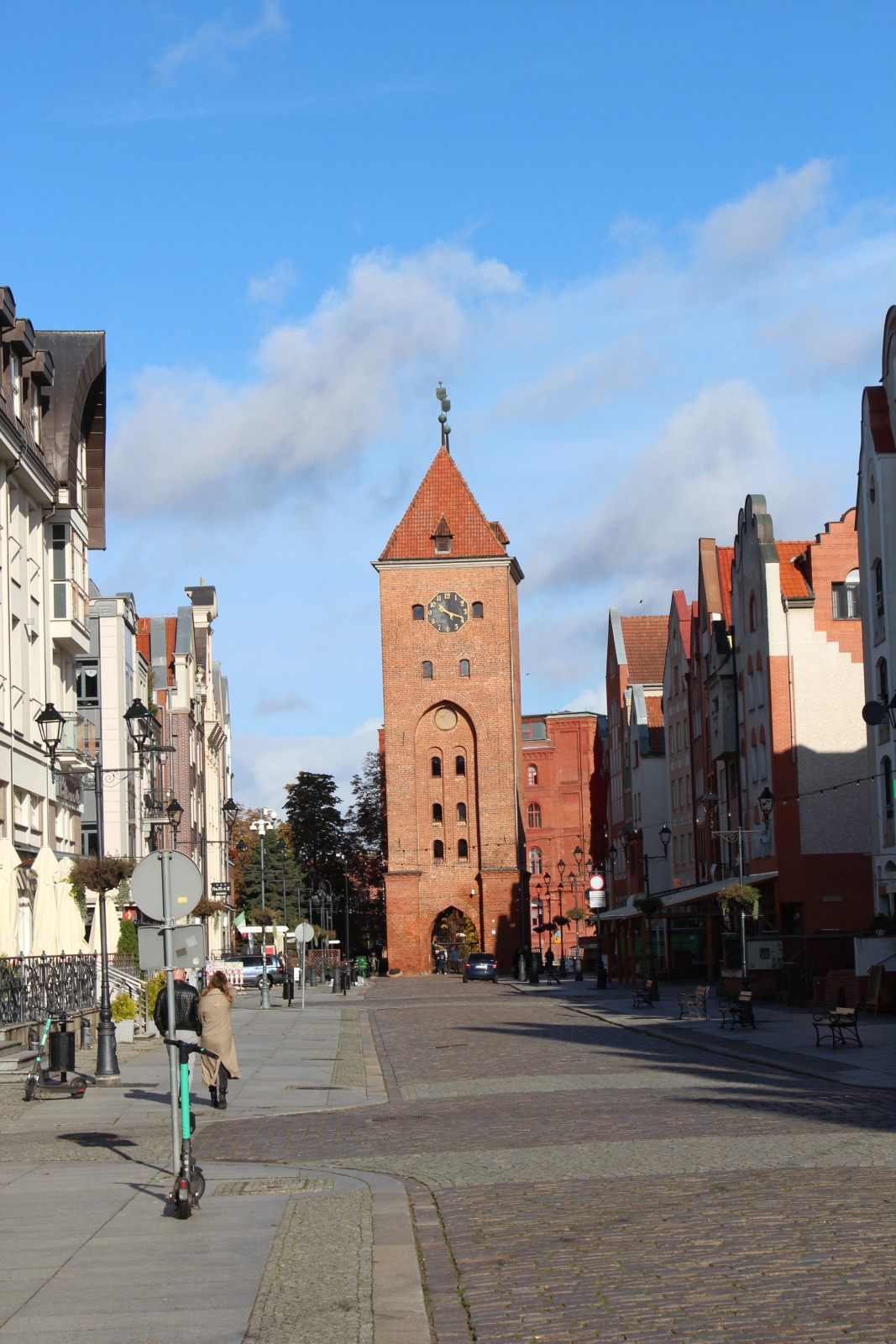
Market Gate in Elbląg
General Information
The Market Gate (German: "Markttor", "Markenthor") is one of the most recognisable and characteristic monuments of Elbląg. It is the only surviving structure from the complex of the city’s medieval fortifications. The monument has been entered into the register of historic monuments of the Warmian-Masurian Voivodeship and is regarded as an outstanding example of defensive architecture of Brick Gothic.
Location
The Market Gate is located at the edge of the Old Town, at the northern outlet of Stary Rynek Street—the main commercial artery of historic Elbląg.
History
Origins of the fortifications and construction of the Gate
The history of the Market Gate dates back to 1319, when construction of its lower section began. This period marked the erection of the first masonry defensive belt of Elbląg, which replaced earlier timber-and-earth structures that had proven insufficient in the face of growing threats to the city’s security. Elbląg, founded in 1237 by the Teutonic Order and being a member of the Prussian Hanse as well as one of the most important commercial centres in Prussian lands, required solid fortifications. The Market Gate was built to close the northern outlet of Stary Rynek towards the shipyard suburb. It was one of nine main city gates, whose function was to control the flow of people and goods and to defend against armed attacks. It was accompanied by other important gates, such as the Castle Gate and the Smiths’ Gate.
15th-century expansion
Initially, the height of the Gate was only about 13 metres. However, in the years 1420–1430, as the city developed dynamically and the ambitions of its authorities grew, a decision was made to significantly expand the fortifications. During these works, the gate was raised to its present height of 26 metres (seven storeys). The expanded structure was capable of accommodating storage rooms, a guardhouse, and all the equipment necessary for defence. At that time, a characteristic twin-towered foregate ("Vorwerk") was also added on the outer (northern) side, also known as the Gate of Three Bays or the Outer Market Gate. This structure protected access to the city at night and was equipped with a portcullis—the final line of defence. The foregate remained unchanged until 1775, when it was dismantled due to the decline in the importance of fortifications in the early modern period.
The Baker’s Apprentice legend and the events of 1521
An unusual feature of the Market Gate are the granite bumpers located at the edges of the entrance—solid stone blocks designed to protect the passage edges from damage. Carvings of baker’s paddles were engraved on these bumpers—tools which, according to legend, saved the city.
The legend dates back to 1521 and refers to events during the last Polish–Teutonic War (1519–1521). A Teutonic army under the command of Kasper von Schwalbach and Moritz von Knebel set out to capture Elbląg. The city authorities, acting on the orders of King Sigismund I the Old, reinforced the fortifications; however, the city remained under threat. At the decisive moment, when the Teutonic troops approached the open gate, an as yet unidentified baker’s apprentice appeared—according to historical accounts—who demonstrated remarkable presence of mind. Seeing the approaching enemy, the young craftsman seized his wooden paddle reinforced with iron and cut through the thick ropes holding the heavy, iron-studded portcullis. The gate dropped down, crushing the first attackers and preventing the rest of the troops from entering the city. Thanks to this swift action, Elbląg successfully defended itself against the Teutonic assault. This event was documented in a royal decree of 1521, which ordered the carving of baker’s paddles on the granite bumpers to commemorate the heroic act. These bumpers have survived to this day as a visible testimony of this episode.
Early modern period and installation of clocks
The history of the clocks of the Market Gate is a fascinating story of technical and social change. The earliest mention of a gate clock dates to 1639, when the merchant and city councillor Isaac Spieringus funded the first clock for the structure—a gift to the community and a sign of his wealth and philanthropy. In 1755, a new feature appeared on the roof—a Baroque helmet, financed by the citizens of Elbląg themselves. It symbolised civic pride and the desire for the city’s landmark to appear impressive. At the same time, a viewing terrace was created on one of the upper floors. Hexagonal clock faces were installed on both the southern and northern façades.
In 1819, the old dials were replaced with much larger ones featuring gilded numerals and hands, demonstrating the city’s prosperity and modernity. In 1857, the clocks underwent their last major modernisation, when a new mechanism was ordered from Berlin. This clock remained in operation for nearly ninety years, until February 1945.
War destruction and reconstruction
In February 1945, as a result of intense fighting for Elbląg, the Market Gate was almost completely destroyed. Its characteristic Baroque helmet and interiors were burned, and the walls were damaged. This was a major loss for the city. The gate became the first monument to be rebuilt after the war. Restoration works began in December 1948 and were completed in mid-August 1949—only four years after the end of the war. The heavily damaged walls were reinforced using modern techniques, including reinforced concrete ties and structural reinforcement of the wall crown. The clock niches were bricked up and replaced with windows and arrow slits. The most significant visual change was the replacement of the Baroque helmet with the present hipped (tent) roof, reconstructed based on historical engravings and documentation, restoring the medieval character of the structure.
In 2000, clock faces returned to the façades—north and south—funded by Ortwin Runde, Mayor of Hamburg, who was born in Elbląg. A comprehensive renovation was carried out in 2006.
Architecture
The Market Gate represents the Brick Gothic defensive style. The building is rectangular (approx. 10.3 × 9.3 m, height 26 m). It features a pointed-arch passage, façade niche with windows and a rosette, and a tent roof with dormers.
Baker’s Apprentice Monument
In 2006, a monument to the Baker’s Apprentice by Waldemar Grabowiecki was unveiled. It depicts a smiling young man holding a paddle.
Current use
Today, the gate functions as a tourist attraction, housing an information point and a viewing terrace overlooking the Old Town.
The image of the Market Gate was placed on the reverse of a commemorative two-złoty coin from the series “Historic Cities in Poland”, issued by the Polish Mint in 2006.
Bibliography
- "Market Gate in Elbląg" (Brama Targowa w Elblągu), http://leksykonkultury.ceik.eu/index.php/Brama_Targowa_w_Elblągu, [accessed: 12.11.2025].
- "Market Gate" (Brama Targowa), https://zabytek.pl/pl/obiekty/elblag-brama-targowa, [accessed: 26.11.2025].
- "Elbląg – City Defensive Walls" (Elbląg – miejskie mury obronne), https://medievalheritage.eu/pl/strona-glowna/zabytki/polska/elblag-miejskie-mury-obronne/, [accessed: 12.11.2025].
- Gierszewski Stanisław, "Elbląg. Past and Present" (Elbląg. Przeszłość i teraźniejszość), Gdańsk 1970.
- Herrmann Christofer, "Warmia and Mazury: A Guide to Art Monuments" (Warmia i Mazury: przewodnik po zabytkach sztuki), Bartąg 2008.
- "History of Elbląg", vol. 1: "The City and Its History until 1466" (Historia Elbląga, t. 1: Miasto i jego dzieje do roku 1466), ed. Stanisław Gierszewski, Gdańsk 1993, pp. 115–118, 222–225.
- Józefczyk Mieczysław, "The Middle Ages of Elbląg. On Social and Religious Issues" (Średniowiecze Elbląga. Z problematyki społeczno-religijnej), Elbląg–Pelplin 1996.
- Mamuszka Franciszek, "Elbląg and Its Surroundings. A Regional Guide" (Elbląg i okolice. Informator krajoznawczy), Gdańsk 1978, pp. 38–41.
- Myślińska Beata, "Elbląg and Its Surroundings Yesterday" (Elbląg i okolice wczoraj), Elbląg 1998, pp. 15–16.
- Nawrolska Grażyna, "The Origins of Elbląg in the Light of Archaeological Sources" (Początki Elbląga w świetle źródeł archeologicznych), Elbląg 2012.
- Nawrolska Grażyna, "Cultural Transformations in 13th-Century Elbląg as a Result of the Encounter between Tradition and External Influences" (Przemiany kulturowe w XIII-wiecznym Elblągu efektem spotkania tradycji i obcych wpływów), “Archaeologia Historica Polona”, vol. 21, 2013, pp. 97–117.
- Nawrolska Grażyna, "The Spatial Development of Elbląg in the Middle Ages and the Early Modern Period" (Rozwój przestrzenny Elbląga w średniowieczu i okresie wczesnonowożytnym), “Archaeologia Historica Polona”, vol. 23, 2015, pp. 163–180.
- Sierzputowski Włodzimierz, "The Spatial Layout of Elbląg in the Light of History" (Układ przestrzenny Elbląga w świetle historii), “Ochrona Zabytków”, vol. 8, 1955, no. 2 (29), pp. 109–115.