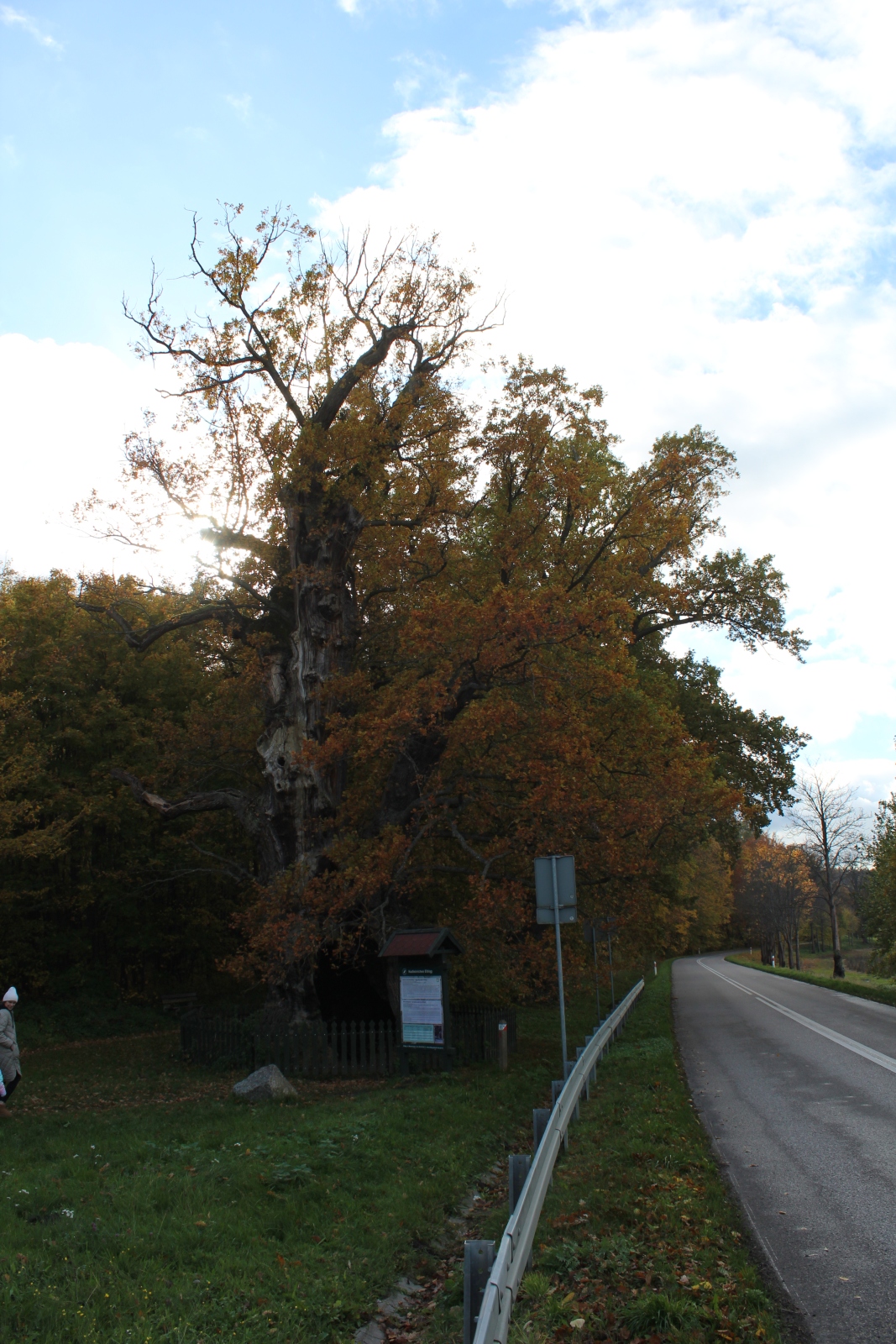
The Bażyński Oak in Kadyny
General Information
The Bażyński Oak is one of the oldest and at the same time one of the thickest specimens of pedunculate oak (Quercus robur L.) in Poland. It impresses with its extraordinary physical dimensions, which testify to its multi-century history. The present state of the object, measured in 2015, indicates a trunk circumference at breast height of approximately 1003 to 1015 cm, which makes it one of the thickest pedunculate oaks in Poland. The height of this specimen reaches approximately 25 m, although researchers note signs of a natural reduction of the upper crown, being a consequence of advanced age and processes of remodification of the tree structure. The crown spread at the level of 14 to 21.5 m indicates that several centuries ago the tree may have had an even more powerful silhouette.
Location / Geographical Setting
The Bażyński Oak is located in the village of Kadyny (Tolkmicko commune). The tree grows by road no. 503 leading from Elbląg to Tolkmicko, and those travelling from the direction of Elbląg will see it on the right-hand side.
History
History of the Name and Symbolic Meaning
The history of the oak’s naming is a complex chapter in the knowledge of the cultural and political changes that took place in East Prussia over the past centuries. More than one hundred years ago, it bore the name “The Thousand-Year-Old Oak of Germany” and was regarded as a symbol of Prussian natural heritage. From 1898, when the Kadyny estate passed into the hands of the German Emperor Wilhelm II, the tree, bearing the new name “The Royal Oak”, symbolized its belonging to the imperial private estate. After the Second World War, the tree received the name “The Kadyny Oak”, emphasizing its geographical location and Polish identity. Soon afterwards, the tree was also called the “Oak of the Rebirth of Poland”, referring to the symbolism of rebuilding independence. Ultimately, the name of the tree was changed to the “Bażyński Oak”, commemorating Jan Bażyński, the former owner of these lands.
Jan Bażyński, referred to in German sources as Hans von Baysen (c. 1390–1394-1459), was a Prussian nobleman, heir to Kadyny, and one of the most outstanding political leaders of that period. He came from the Flemish von Baysen family, which had arrived from the vicinity of Lübeck in the thirteenth century and settled in Warmia, where it adopted its surname from the estate it owned in Bażyny near Orneta. Bażyński initially served in diplomatic functions in the service of the Teutonic Order, undertaking diplomatic missions to England, Denmark, and Portugal in the years 1419–1422. According to a chivalric legend, he received nobility from the King of Portugal for bravery in battles against the Moors. After the death of Grand Master Michael Küchmeister (c. 1422), Bażyński abandoned service in the Order and sided with the Prussian oppositionists. In the years 1431–1432, he received landed property in Kadyny as repayment of the financial debts of the Teutonic Order, which remained in family possession until 1503. Bażyński actively engaged in the activity of the Prussian Confederation, an organization of Prussian nobility and towns striving to limit the power of the Order and achieve the incorporation of Prussia into the Polish Crown. In 1454, as leader of the Confederation, he formally asked King Casimir Jagiellon for the incorporation of Prussia into the Kingdom of Poland, which marked the beginning of the Thirteen Years’ War between the Order and Poland. For his services to the Polish cause, Bażyński received the office of governor of Royal Prussia – territories which remained under Polish rule under the terms of the Second Peace of Toruń of 1466.
Age and Dendrochronological Studies
It is estimated that the tree is approximately 715 years old. Such an advanced age places the Bażyński Oak among the oldest living organisms in the Warmian-Masurian Voivodeship, surpassing in longevity the famous Bartek Oak growing in Pomerania.
Health Condition and Morphological Transformations
The health condition of this natural monument is no longer the best, which is the result of the natural ageing process of such a powerful organism. The tree exhibits numerous symptoms of advanced age – significant internal decay, serious losses in the wood tissue both within the trunk and in the structure of the upper crown. The oak has an enormous basal hollow, which begins right at the base of the trunk and extends to a depth of many metres.
Specialists from the Elbląg Forest District indicate that despite significant structural damage, the tree remains alive and productive, although the fruit it produces is no longer capable of germination. Assessment of the object’s health condition results in maintenance treatments being carried out regularly, every few years, aimed at prolonging the functioning of this specimen. Degradation of the natural environment, a decline in groundwater levels, and the direct proximity of the national road, causing seasonal salinization in winter, contribute to the progressive pathological changes in the structure of the main elements of the root system.
History of Conservation Protection and Restoration Measures
For many decades, the tree was supported by means of a reinforcing concrete filling, which, however, degraded as a result of fungal growth developing on its surface and penetrating deeply into the wood of the trunk. This filling was removed around 1994, in accordance with the recommendations of conservators, who recognized that its further retention could contribute to greater internal destruction. The hollows in the trunk were then secured with specialist mesh, intended to prevent nesting birds from inhabiting the interior of the structure. In 2000, the Elbląg Forest District carried out a thorough modernization of the natural support system, implementing a special drainage system combined with simultaneous aeration of the root system, aimed at improving physiological conditions for gas exchange and water transport.
The Bażyński Oak as a Tourist Attraction
A turning point in the history of Kadyny and of the Bażyński Oak associated with it came on 15 December 1898, when the last German Emperor Wilhelm II took over the estate from Artur Birkner, the last of the Elbląg merchant family who had possessed Kadyny for many decades. In exchange for transferring the property, Birkner received a lifelong imperial annuity. Wilhelm II made Kadyny his summer residence, allocating enormous financial resources to the expansion and modernization of the existing buildings and to the construction of new monumental structures. As part of these investments, the emperor commissioned the construction of a guardhouse situated in the immediate vicinity of the Bażyński Oak, where a uniformed guard was stationed permanently. This decision testifies to the high regard Wilhelm II had for this natural monument, treating it as part of his imperial heritage.
In the shade of the spreading crown of the Bażyński Oak, during summer stays, the most eminent guests from all over Europe spent time. Emperor Wilhelm II was often accompanied by his wife, Empress Augusta Victoria. The presentation of the area of Kadyny, with its natural heritage and modern infrastructure, was intended to serve the strengthening of international alliances and the demonstration of the power of the German Empire.
In the first decades of the twentieth century, during the flourishing of tourism in East Prussia, entrepreneurs noticed the potential of this natural object. The spacious hollow was transformed into a beer-drinking establishment, where visitors could refresh themselves, and the golden beverage was poured directly from barrels placed inside the tree.
Seven Oaks and the Legend of Princess Kadyna
In the immediate vicinity of the main Bażyński Oak, six further mighty pedunculate oaks grow, their age estimated at 300–350 years. Local tradition links these trees with the foundation myth of the locality. According to legend, the name of Kadyny derives from the figure of Princess Kadyna, daughter or sister of the Old Prussian ruler Widewut, whose territory encompassed these lands. The princess, famous for her extraordinary beauty, was said to have lived in the area of present-day Kadyny together with her spouse. The six oaks accompanying the main tree are traditionally interpreted as commemorating the six sons of this legendary figure.
Legal Status
The Bażyński Oak has been protected since 1962 as a natural monument. It belongs to the most valuable specimens included in the Register of Polish Monument Trees (class A+).
Bibliography
- Krzysztof Borkowski, Polish Trees (Polskie drzewa), Poznań 2014.
- Tomasz Chudzyński, It Is Extraordinary – Ancient and Majestic. It Saw Much and Survived to Our Times (Jest niezwykły – wiekowy i majestatyczny. Widział wiele i przetrwał do naszych czasów), https://dziennikbaltycki.pl/jest-niezwykly-wiekowy-i-majestatyczny-widzial-wiele-i-przetrwal-do-naszych-czasow/ar/c1p2-28111227 [accessed: 10.11.2025].
- The Bażyński Oak (Dąb Bażyńskiego), https://encyklopedialesna.com/haslo/dab-bazynskiego/ [accessed: 10.11.2025].
- The Bażyński Oak. Register of Polish Monument Trees (Dąb Bażyńskiego. Rejestr Polskich Drzew Pomnikowych), https://www.rpdp.hostingasp.pl/Trees/UI/TreeFormRO.aspx?tID=200&tiID=3430, [accessed: 10.11.2025].
- Robert Dorr, Cadinen. Ein Kulturführer. Danzig 1900.
- Kadyny – Oak of Jan Bażyński (Kadyny – Dąb im. Jana Bażyńskiego), https://fotopolska.eu/Kadyny/b32363,Dab_im_Jana_Bazynskiego.html, [accessed: 10.11.2025].
- Małgorzata Omilanowska, Emperor Wilhelm II and His Architectural Initiatives on the Eastern Borders of the German Empire (Cesarz Wilhelm II i jego inicjatywy architektoniczne na wschodnich rubieżach Cesarstwa Niemieckiego), in: Art in the Circle of Power (Sztuka w kręgu władzy), ed. Elżbieta Pilecka and Katarzyna Kluczwajd, Warszawa 2009, pp. 245-266.
- Cezary Pacyniak, The Oldest Trees in Poland. A Guide (Najstarsze drzewa w Polsce. Przewodnik), Warszawa 1992.
- Jan Piotrowski, Health Condition of the Bażyński Oak in Kadyny (Stan zdrowotny Dębu Bażyńskiego w Kadynach), “Rocznik Nadleśnictwa Elbląg”, 2023, vol. 14, pp. 45–58.
- The Bażyński Oak in Kadyny – the Oldest in Warmia and Masuria (Dąb Bażyńskiego w Kadynach – najstarszy na Warmii i Mazurach), https://podroze.wm.pl/131934,Dab-Bazynskiego-w-Kadynach-najstarszy-na-Warmii-i-Mazurach.html, [accessed: 10.11.2025].
- The Bażyński Oak in Kadyny (Dąb Bażyńskiego w Kadynach), https://www.pomniki-przyrody.pl/?p=8170 [accessed: 10.11.2025].
- Paweł Zarzyński, Robert Tomusiak, 90 Trees – Extraordinary Specimens (90 drzew – Okazy niezwykłe), Warszawa 2014.
- Paweł Zarzyński, Robert Tomusiak, Krzysztof Borkowski, Trees of Poland (Drzewa Polski), Warszawa 2016.