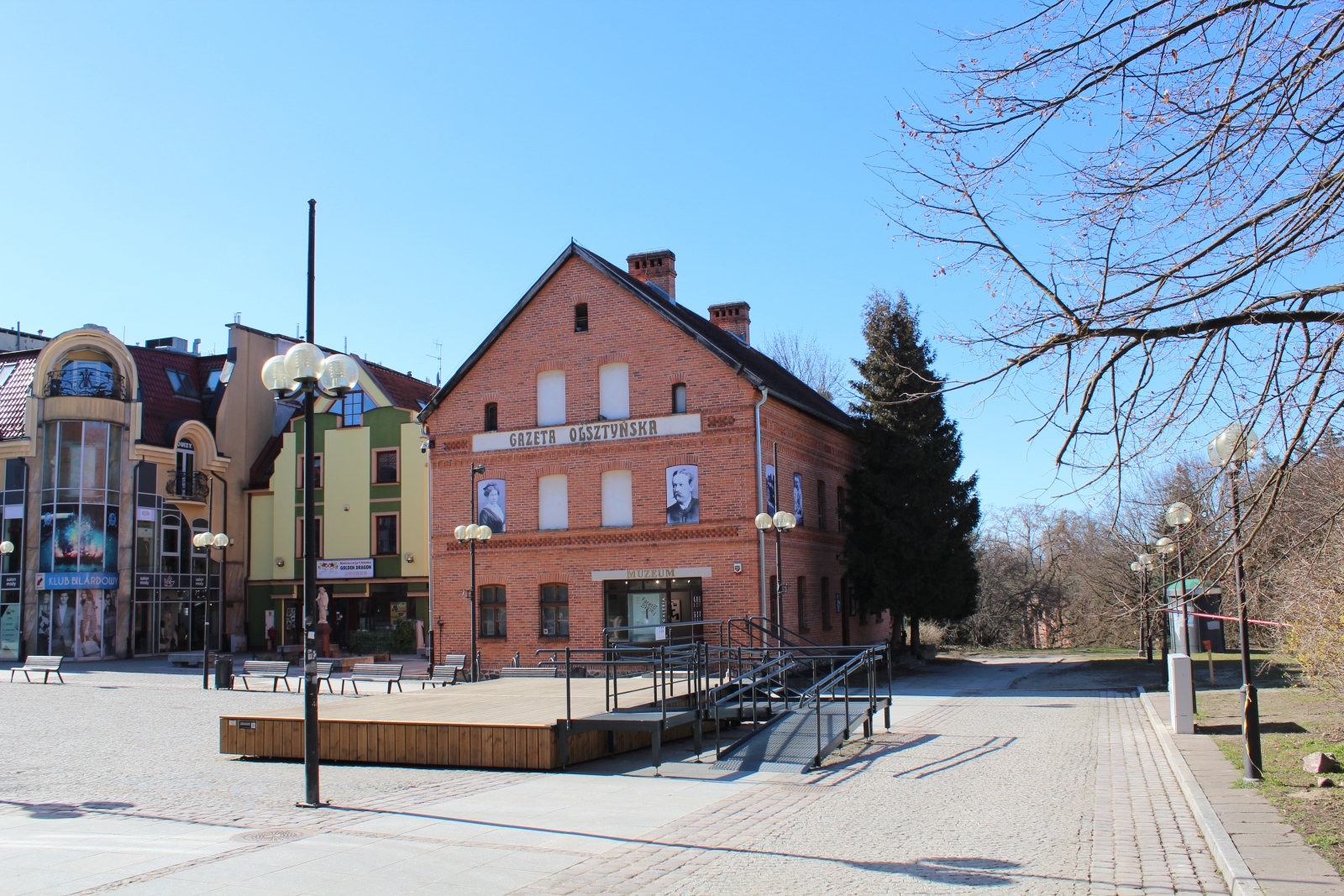
House of the Olsztyn Newspaper in Olsztyn
General Information
The House of the Olsztyn Newspaper is one of the most symbolic monuments on the map of Olsztyn. Although the present-day building is a reconstruction, the site constitutes a memorial in the struggle for the Polish identity of Warmia. For several years the building served as the editorial office and printing house of “Gazeta Olsztyńska” – a newspaper published in the Polish language in the German East Prussia. At present, the building functions as a branch of the Museum of Warmia and Mazury, fulfilling educational and exhibition purposes.
Location
The monument is situated in the Old Town, at Targ Rybny 1. This location was not accidental – at the end of the nineteenth century and the beginning of the twentieth century, Targ Rybny was a commercial and craft centre, visited by inhabitants of the surrounding area.
History
The history of the building is inseparably connected with the fate of the Pieniężny family, which played a key role in sustaining Polish national identity in the region. “Gazeta Olsztyńska” was founded in 1886 by Jan Liszewski (1852-1894). In 1891 the editorial office was taken over by Seweryn Pieniężny (the elder) (1864-1905). Initially the newspaper changed locations until, in 1920, the Pieniężny family purchased a townhouse at Targ Rybny, moving there the printing house, editorial office, and private residence. In the interwar period the house became an unofficial Polish cultural consulate. It was here that the social life of the Polish minority flourished, patriotic articles were edited, and attacks by German militias were resisted. The last editor-in-chief was Seweryn Pieniężny (the younger) (1890-1940), who at the beginning of September 1939 was arrested by the Gestapo and in 1940 executed in the Hohenbruch camp. The printing-house equipment was completely destroyed, and the building itself was levelled to the ground by the Germans in November 1939 in an attempt to erase traces of Polishness from the urban space.
In the post-war period the site of the townhouse remained empty. The idea of rebuilding the house for museum purposes arose in 1986, on the centenary of the newspaper. In November of that year the Social Committee for the Reconstruction of the House of “Gazeta Olsztyńska” was established, headed by Władysław Ogrodziński (1918-2012). In the years 1988–1992 the building was faithfully reconstructed on the basis of preserved photographs and archival plans. In June 1992 the museum was ceremonially opened, and it continues to operate to this day.
Architecture
In architectural terms the building represents an eclectic style with distinct Neo-Gothic elements, characteristic of urban architecture in East Prussia at the turn of the nineteenth and twentieth centuries. It is a basemented, two-storey building with an attic storey, covered with a gable roof. Particularly noteworthy is the characteristic façade of red facing brick, contrasting with plastered light blind recesses and decorative panels. The windows have arched lintels, and the symmetry of the façade gives the building an elegant townhouse character, perfectly fitting into the frontage of Targ Rybny.
Furnishings
The present-day interiors of the building have been adapted for museum purposes, combining modern exhibition space with elements of historical reconstruction. In the basements and on the ground floor the atmosphere of the former printing house has been recreated. The most valuable elements of the furnishings include historic printing machines, frame presses, type cases with fonts, and paper guillotines from the period.
The museum possesses a rich collection of original issues of “Gazeta Olsztyńska”, personal documents of the Pieniężny family, photographs, as well as Polish occasional prints and textbooks that were clandestinely distributed in Warmia. The interiors are equipped with exhibition cases presenting the history of Olsztyn and the region, with particular emphasis on the plebiscite of 1920, as well as the history of local journalism.
Bibliography
- House of “Gazeta Olsztyńska”, https://www.podrozezklasa.pl/dom-gazety-olsztynskiej, [accessed: 12.09.2025].
- House of the Olsztyn Newspaper, https://visit.olsztyn.eu/place/342/dom-gazety-olsztynskiej, [accessed: 12.09.2025].
- Museum – House of the Olsztyn Newspaper – branch of the Museum of Warmia and Mazury in Olsztyn, http://leksykonkultury.ceik.eu/index.php/Muzeum_%E2%80%93_Dom_Gazety_Olszty%C5%84skiej_%E2%80%93_oddzia%C5%82_Muzeum_Warmii_i_Mazur_w_Olsztynie, [accessed: 12.09.2025].
- Strzyżewska Małgorzata, "The House of “Gazeta Olsztyńska”", “Komunikaty Mazursko-Warmińskie”, 1997, no. 2, pp. 267-270.
- Strzyżewska Małgorzata, "The House of “Gazeta Olsztyńska” – reconstruction of the seat and museum activity", “Komunikaty Mazursko-Warmińskie”, 2002, no. 4, pp. 627-646.
- Strzyżewska Małgorzata, "Museum of the House of “Gazeta Olsztyńska” in the years 1992–2012", “Komunikaty Mazursko-Warmińskie”, 2013, no. 2, pp. 369-383.