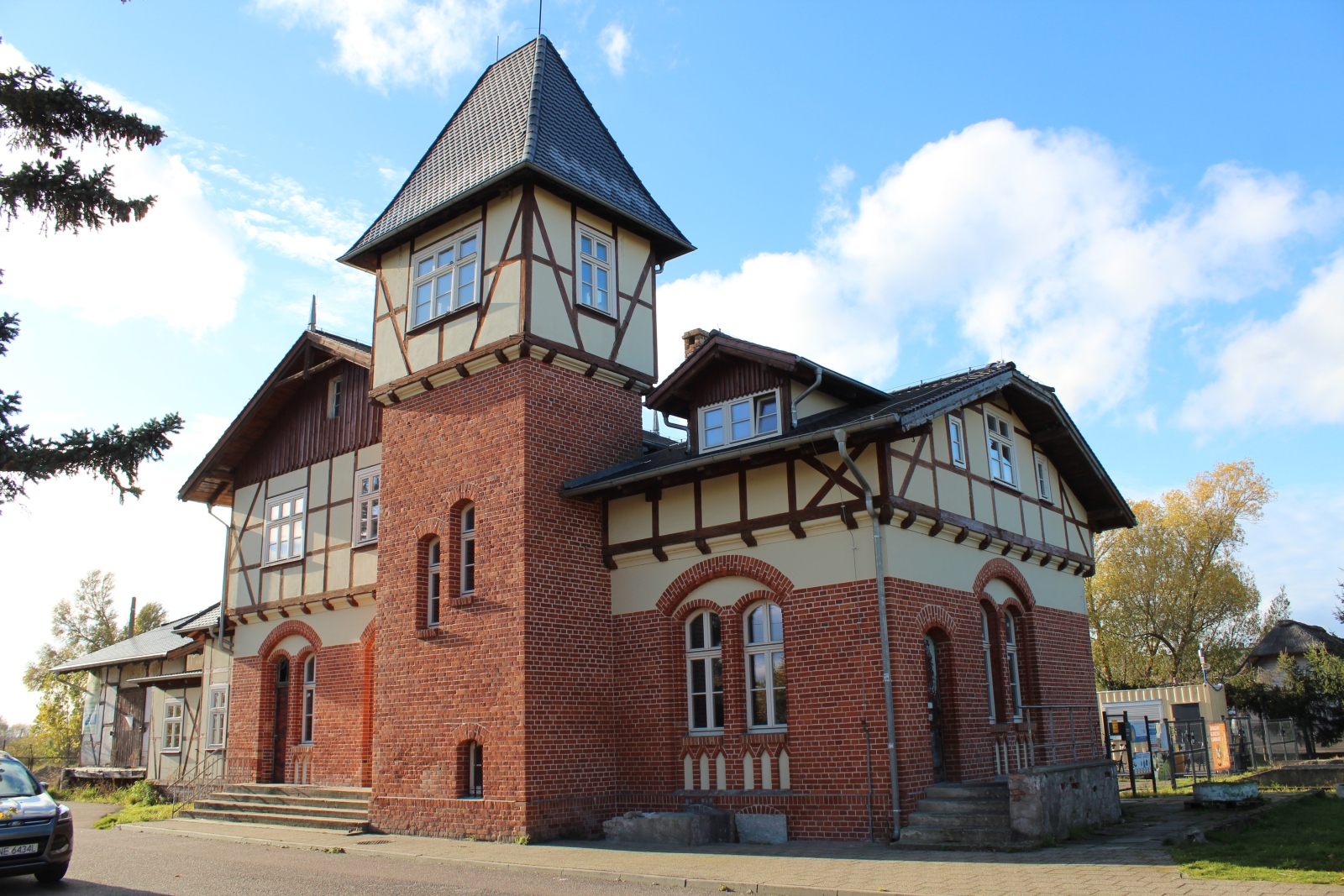
Railway Station in Tolkmicko
General Information
The railway station in Tolkmicko, also referred to as the station building, is a historic railway infrastructure building erected to serve the Vistula Lagoon Railway line. The building was entered in the provincial register of immovable monuments in 1995 under number A-448, together with the adjacent station toilet building (register number A-3814).
Location
The railway station is situated at 4 Morska Street, directly on the shore of the Vistula Lagoon. The building stands in the centre of the town’s historic urban fabric, in the immediate vicinity of the port, which was of fundamental importance for its functioning in the past.
History
Construction and inauguration
The Vistula Lagoon Railway, officially bearing the German name "Haffuferbahn" (HUB – from "Haff", meaning lagoon, "Ufer", meaning shore, and "Bahn", meaning railway), was a railway line constructed in the years 1897–1899. The idea of building a railway along the shore of the Vistula Lagoon arose from the initiative of local landowners and businessmen, especially Ernst Hantel of Frombork – an entrepreneur engaged in dairy and milling production – who for decades fought to obtain permission for the investment from the authorities in Berlin and from the Cathedral Chapter, which, as the owner of extensive landed estates, had a decisive voice in the matter. Ultimately, the undertaking was carried out by the private joint-stock company "Ostdeutsche Eisenbahn Gesellschaft", headquartered in Königsberg. Construction works were supervised by the engineers Lucht and Baum, the surname of the latter becoming preserved in the popular humorous expansion of the acronym HUB – “Hantel und Baum”. In May 1899, construction of the section connecting Elbląg with Frombork was completed, and in September of the same year the entire line from Frombork to Braniewo was opened for use. The station in Tolkmicko, which was the principal station on the route, was built in 1901, and its inauguration was associated with the commencement of full passenger and freight traffic on the entire line. The creators of the Vistula Lagoon Railway demonstrated pragmatism in choosing the standard track gauge (1435 mm) instead of the much cheaper narrow-gauge solution. This enabled seamless integration with the railway network of East Prussia and the direct transport of goods from other regional centres.
Functioning in the imperial period
After the line was opened, the Vistula Lagoon Railway became not only an economic artery of the region, but also an object of tourist importance. The line offered regular passenger connections for tourists and residents, while at the same time serving an important economic function by transporting commercial goods and agricultural products from the region. The Vistula Lagoon Railway gained particular significance after 1898, when Emperor Wilhelm II (1859–1941) acquired the estate in Kadyny and began to organise manoeuvres and hunting events there regularly until the outbreak of the First World War. Imperial trains carrying His Imperial Majesty and the entire court apparatus passed through Tolkmicko, making the station the principal transfer point for members of the court and escort officers. In the 1930s – already during the Weimar Republic – traffic on the line increased dynamically, and the railway carried more than 400 thousand passengers annually and approximately 250 thousand tonnes of freight. The station functioned as a transport hub where passengers travelling to Krynica Morska transferred to maritime transport. On the station grounds there was a locomotive shed, a wagon repair workshop, and a forwarding building in which goods were transshipped between railway transport and ships.
Post-war period
After the Second World War, passenger traffic on the line ceased, yet for subsequent decades the station continued to handle freight transport and individual special connections serving the needs of the local economy. However, for economic and technical reasons, regular passenger services were suspended on 1 April 2006. The last passenger train stopped at Tolkmicko on 7 July 2013, bringing to an end the era of regular tourist services operated by the Pomeranian Society of Railway Enthusiasts. The station building, uninhabited for many years and subject to degradation, was purchased in 2017 by a private individual – entrepreneur Adam Stankiewicz – with the intention of carrying out a general renovation. The restoration works, conducted under the supervision of the provincial monument conservator, include the refurbishment of the façades, the restoration of authentic architectural elements, and the planning of a new use for the building. Among the options considered for the station’s future function are the establishment of a local craft brewery or a tourist and educational centre.
Architecture
Stylistic character and building material
The railway station in Tolkmicko represents Art Nouveau architecture in its Prussian variant, characteristic of railway construction at the turn of the nineteenth and twentieth centuries. The Art Nouveau style is distinguished by an organic integration of form and function, with decorative elements simultaneously serving structural purposes and referring to local building traditions. The building was erected of face-fired ceramic brick, joined by traditional masonry methods, which constitutes an example of the architecture characteristic of transport infrastructure buildings in East Prussia. The upper storeys and attic were executed in "Prussian wall" construction – a regional timber-framed brick-filled system in which visible transverse wooden beams form a decorative half-timbered pattern filled with brick.
The station is characterised by an asymmetrical, dynamic massing with a complex plan, typical of Art Nouveau station architecture. The building is four storeys high, with a clearly marked vertical accent – a characteristic tower-like turret on a rectangular base, narrowing in its upper parts and crowned with a hipped roof covered in ceramic tiles. The turret constitutes the dominant element of the architectural composition. It fulfilled a dual role – signalling for travellers and aesthetic expression, distinctly dominating the surrounding small-town development. The foundations and basement storey were constructed of brick joined with traditional lime mortar, ensuring durability despite the humidity connected with the immediate vicinity of the Vistula Lagoon. The roofs are covered with traditional ceramic tiles in a brick-red colour, forming part of the architectural landscape of East Prussia.
Elevations and architectural details
The façades of the building are diversified by the rhythm of windows closed with semicircular or pointed heads, characteristic of Art Nouveau. The decorative character of the elevations is reinforced by the half-timbered elements of the Prussian wall – transverse wooden beams visible on the façade, forming the characteristic pattern filled with brick. In the Tolkmicko station this solution has survived in its original, unaltered form, constituting a faithful example of Prussian building tradition. The façades were adorned with multicoloured plasterwork, remnants of which have survived beneath layers of later renovations. The principal and side entrances were placed at functionally justified points – leading to the waiting hall, ticket offices, and office rooms. The main portal is framed by a decorative cornice and reveals, constituting an attempt to elevate the architectural rank of the building above the level of ordinary provincial stations.
Interior and room arrangement
Although the interior underwent substantial changes through decades of neglect and makeshift repairs, the authentic arrangement of rooms characteristic of turn-of-the-century railway stations has survived. The waiting hall, supported on timber posts, was separated from the ticket offices and office rooms by wooden partitions. The staircase leads to the upper floor, where the rooms for station employees and the stationmaster’s office were located. From the top of the turret, reached by stairs, there is a view over the entire station – formerly this position served for observation of railway traffic and signalling.
Adjacent structures
The station was directly connected with the forwarding building (freight warehouse), which formed an integral part of the station complex. On the station grounds there was a locomotive shed with a staff of engine drivers and assistants, a wagon repair workshop, as well as a station toilet building – constructed in more or less the same style as the station itself – which, since its renovation in 1995, has been protected under a separate entry in the monument register.
Present condition
Today, the railway station in Tolkmicko remains one of the most valuable surviving monuments of the Vistula Lagoon Railway. The building is undergoing renovation and conservation works aimed at restoring its usability and protecting its historic architectural substance. It no longer fulfils railway functions, yet its architecture and location endow it with considerable tourist and cultural potential.
Bibliography
- Dworzec kolejowy w Tolkmicku (Railway Station in Tolkmicko), https://stotom.wordpress.com/2024/06/14/dworzec-kolejowy-w-tolkmicku/, [accessed: 1.12.2025].
- Dworzec w Tolkmicku (Railway Station in Tolkmicko), https://encyklopedia.warmia.mazury.pl/index.php/Dworzec_w_Tolkmicku, [accessed: 12.11.2025].
- "Eine Geschichte der Haffuferbahn" (A History of the Haffuferbahn), https://magazin-westpreussen.de/eine-geschichte-der-haffuferbahn/, [accessed: 12.11.2025].
- Elbląg-Frombork-Braniewo, Kolej Nadzalewowa, linia 254 (Elbląg-Frombork-Braniewo, Vistula Lagoon Railway, Line 254), https://www.kochamywarmie.pl/2017/04/elblag-frombork-braniewo-kolej.html, [accessed: 12.11.2025].
- Fey Grzegorz, "Kolej Nadzalewowa" (The Vistula Lagoon Railway), “Świat Kolei”, 2001, no. 1, pp. 22-26.
- "Haff – Ufer – Bahn", https://nadzalewowa.pl/de/haff-%E2%80%93-ufer-%E2%80%93-bahn, [accessed: 12.11.2025].
- "Haffuferbahn – kolej nadzalewowa" (Haffuferbahn – the Vistula Lagoon Railway), https://www.historia-wyzynaelblaska.pl/kolej-nadzalewowa-hub.html, [accessed: 12.11.2025].
- Kolej Nadzalewowa (The Vistula Lagoon Railway), https://www.info.elblag.pl/8,1547,Kolej-Nadzalewowa.html, [accessed: 12.11.2025].
- Pasewicz-Rybacka Magdalena, "Haffuferbahn. Historia Kolei Nadzalewowej do 1945 roku" (Haffuferbahn. History of the Vistula Lagoon Railway until 1945), Grajewo 2020.
- Przystanek kolejowy Tolkmicko (nieczynny) (Tolkmicko Railway Stop, inactive), https://polska-org.pl/7386089,Tolkmicko,Przystanek_kolejowy_Tolkmicko_nieczynny.html, [accessed: 12.11.2025].
- Remontują zabytkowy dworzec w Tolkmicku (The Historic Railway Station in Tolkmicko Is Being Renovated), https://www.portel.pl/spoleczenstwo/remontuja-zabytkowy-dworzec-w-tolkmicku/119356, [accessed: 12.11.2025].
- "Tolkmicko. Dzieje miasta" (Tolkmicko. History of the Town), ed. Janusz Hochleitner, Piotr Adamczyk, Tolkmicko 1999, pp. 189-192.
- Trzydzieści pięć lat różnicy, czyli kiedy uruchomiono Kolej Nadzalewową (Thirty-Five Years of Difference, or When the Vistula Lagoon Railway Was Opened), https://nadzalewowa.pl/trzydziesci-piec-lat-roznicy-czyli-kiedy-uruchomiono-kolej-nadzalewowa, [accessed: 12.11.2025].