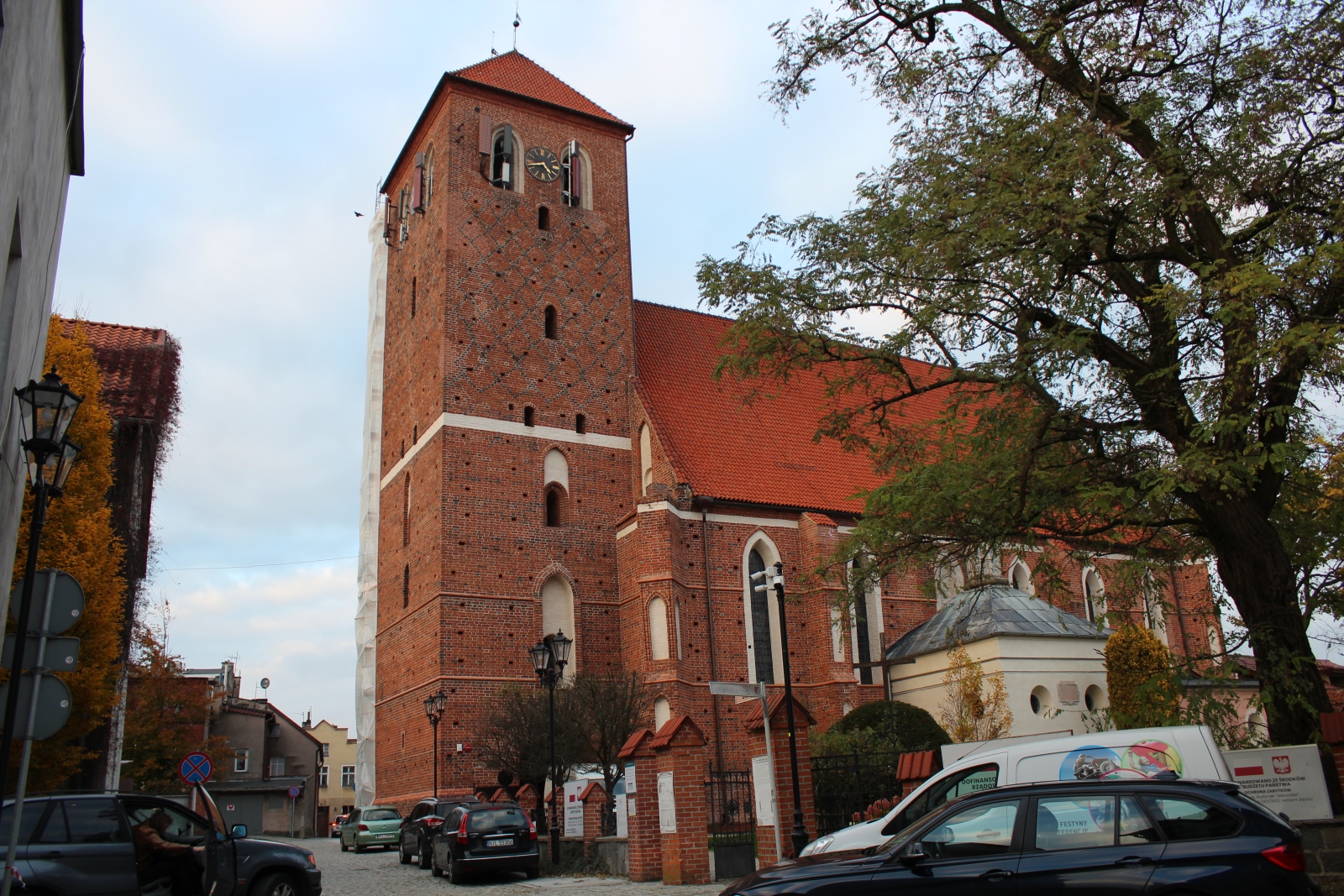
Church of the Visitation of the Blessed Virgin Mary and Saint Anne in Lubawa
General Information
The Roman Catholic parish church of the Visitation of the Blessed Virgin Mary and Saint Anne is one of the most important sacred monuments of the Lubawa Land. The church was erected in the Gothic style in the fourteenth century and for centuries was an important centre of the religious life of the region. At present it belongs to the Gdańsk ecclesiastical province, the Diocese of Toruń, and the Lubawa deanery. The building was entered in the voivodeship register of immovable monuments on 20 March 1957.
Location / Geographical Setting
The Church of the Visitation of the Blessed Virgin Mary and Saint Anne is located at 5 Kościelna Street (formerly Kaznodziejska Street, situated within the town walls). Lubawa is situated in the south-western part of the Warmian-Masurian Voivodeship, within the Iława Lakeland, in the valley of the Sandela River, which is a left-bank tributary of the Drwęca. The town lies on national road no. 15.
History
Ecclesiastical sources maintain that the first wooden church in Lubawa was built in 1233. The brick building in the Gothic style was erected around 1330. The first parish priest in Lubawa whose name we know was Jan – he appears as a witness in the location charter (1326). In the 1420s, the annual benefice of the parish priest in Lubawa amounted to 6 grzywnas of silver, and 30 years later it was two grzywnas smaller. The church was damaged by fires in 1533 and 1545 and rebuilt in 1550. This second fire was caused by candles still burning in the church and not fully extinguished. The church survived intact the fire which in 1724 destroyed the whole town. Around the church there extended a cemetery enclosed within a low wall.
The question of the church’s patronage is unclear. The document "Visitatio Strzészovina" 1672 considers two versions probable – the original patronage of the Blessed Virgin Mary, and then the addition of the invocation of Saint Anne to it, or the granting of both patronages simultaneously, whereas the source "Visitatio Potockiana" 1706 mentions only the invocation of Saint Anne. This last version is the one most frequently given and is the most probable, because twentieth-century sources speak of a decree of the Holy See of 7 April 1954, which changed the title of the church from Saint Anne to the Visitation of the Blessed Virgin Mary and Saint Anne. Since the time of its establishment, the main parish of the town has been located here.
The Museum of the Lubawa Land was created by the parish, where epitaphs, paintings, and sacred goldsmith works were gathered.
Architecture / Architecture and Spatial Layout
In subsequent centuries, various alterations were made to the church, adding Renaissance elements. Around 1600, a sacristy was added on the southern side and the eastern gable was rebuilt. At the beginning of the seventeenth century, the northern porch was rebuilt into the Chapel of the Guardian Angels, and in the nineteenth century a rectangular baptistery was added. After 1615 (and before 1618), on the southern side the Chapel of St. Barbara (Annunciation of the Blessed Virgin Mary) was added, founded by Magdalena Mortęska, sister of the Chełmno voivode Ludwik Mortęski (the Mortęski Chapel). Jerzy Dygdała questions the year 1582, appearing in numerous studies, as the time of construction of the chapel. It is a magnificent late Renaissance structure on a square plan, with circular window openings set in the walls, covered with a hipped roof, with a hexagonal lantern crowned with a dome. In the chapel, in the gilded medallion of the altar, there is the miraculous figurine of Our Lady of Lipsk. Beneath the chapel there is the burial crypt of the Mortęski family.
The church is oriented, single-nave, built on a rectangular plan (16.4 x 32.4 m) with a three-storeyed, four-sided tower (7.9 x 9.6 m), situated on the western side. The external walls of the church were strengthened with buttresses, which in the corners were set at an angle, and in other places perpendicularly to the walls. The buttresses were adorned with blind recesses and pinnacles. The church has pointed-arch windows.
Furnishings
The interior of the church is characterized by a rich décor. The late Baroque, gilded high altar, dating from 1723, was made in the sculptural workshop of the Lubawa woodcarver Jerzy Dąbrowicz. In the central part of the altar there is an image of Our Lady of the Rosary, dated to around 1600, while in the retable there is an altar of the Crucifixion from the second decade of the sixteenth century. In the upper part of the altar there is a twentieth-century copy of the late Gothic image of Saint Anne with the Virgin and Child. In the chancel of the church, set at an angle to the great altar, there are two side marbled Rococo altars, placed there in the mid-eighteenth century. These are the altars of the Holy Trinity and of the Sacred Heart of Jesus. From the main nave to the Chapel of the Guardian Angels, the entrance is adorned with a late Renaissance wooden carved portal, while to the Mortęski Chapel leads a similar, but already Baroque, portal. Among the monuments located in the church, it is worth distinguishing the pulpit from the first half of the seventeenth century and a Baroque bench from the same century, adorned with the Odrowąż coat of arms, as well as the heraldic cartouches of the bishops of Chełmno – Piotr Kostka (d. 1595) and Wawrzyniec Gembicki (1559-1624). Attention should also be paid to the numerous epitaphs, among them: that of the Chełmno voivode Ludwik Mortęski (1554-1615), made after 1625; that of the Malbork voivode and treasurer of Prussian lands Samuel Żaliński (d. 1629) and his wife Zofia Mortęska from 1629; and that of the mayor of Lubawa Johann Christian Fabricius from 1678.
The church also possesses a valuable collection of historic goldsmith’s art. Among the collection there are, among others: a fifteenth-century holy water kettle, silver and gilded chalices from the fifteenth to seventeenth centuries, a silver tray for cruets from 1603, a gilded silver monstrance from 1689, a gilded reliquary and pyx from the end of the seventeenth century, as well as a monstrance, a vessel for holy oils, and an incense boat from 1715. The church also contains a collection of silver votive offerings dating mainly from the seventeenth and eighteenth centuries.
Bibliography
- "Corpus Inscriptionum Poloniae", vol. 9: Olsztyn Voivodeship, fasc. 1: Lubawa and Surroundings ("Województwo olsztyńskie, z. 1: Lubawa i okolice"), ed. Jarosław Wenta, Jan Wroniszewski, Toruń 1995, pp. 9, 13-14, 47-101.
- Category: Lubawa – Parish Church ("Kategoria: Lubawa – fara"), https://perlyziemilubawskiej.pl/index.php/category/lubawa_fara/, [accessed: 5.09.2025].
- Gustav Liek, "The Town of Lubawa in West Prussia with Consideration of the Lubawa Land" ("Miasto Lubawa w Prusach Zachodnich z uwzględnieniem Ziemi Lubawskiej"), ed. Andrzej Radzimiński, trans. Liliana Lewandowska, Lubawa 2016, pp. 266-291.
- "Lubawa. History of the Town and the Region" ("Lubawa. Dzieje miasta i regionu"), ed. Kazimierz Grążawski, Lubawa 2016, pp. 113, 120-121, 141, 143, 160-162.
- Józef Śliwiński, "Lubawa. From the History of the Town and Its Surroundings" ("Lubawa. Z dziejów miasta i okolic"), Olsztyn 1982, pp. 51, 55, 277-278.
- "Saint Anne in Faith, Devotion, and Art – Then and Now. Universal and Regional Perspective" ("Święta Anna w wierze, pobożności i sztuce – dawniej i dziś. Perspektywa uniwersalna i regionalna"), ed. Ewelina M. Mączka, Sylwia Mikołajczak, Olsztyn 2021, pp. 49-51, https://uwm.edu.pl/wt/sites/default/files/u4/sw_anna.pdf, [accessed: 5.09.2025].
- "The Lubawa Land. A Guide to Monuments" ("Ziemia Lubawska. Przewodnik po zabytkach"), [Rybno c. 2015], pp. 48-49.