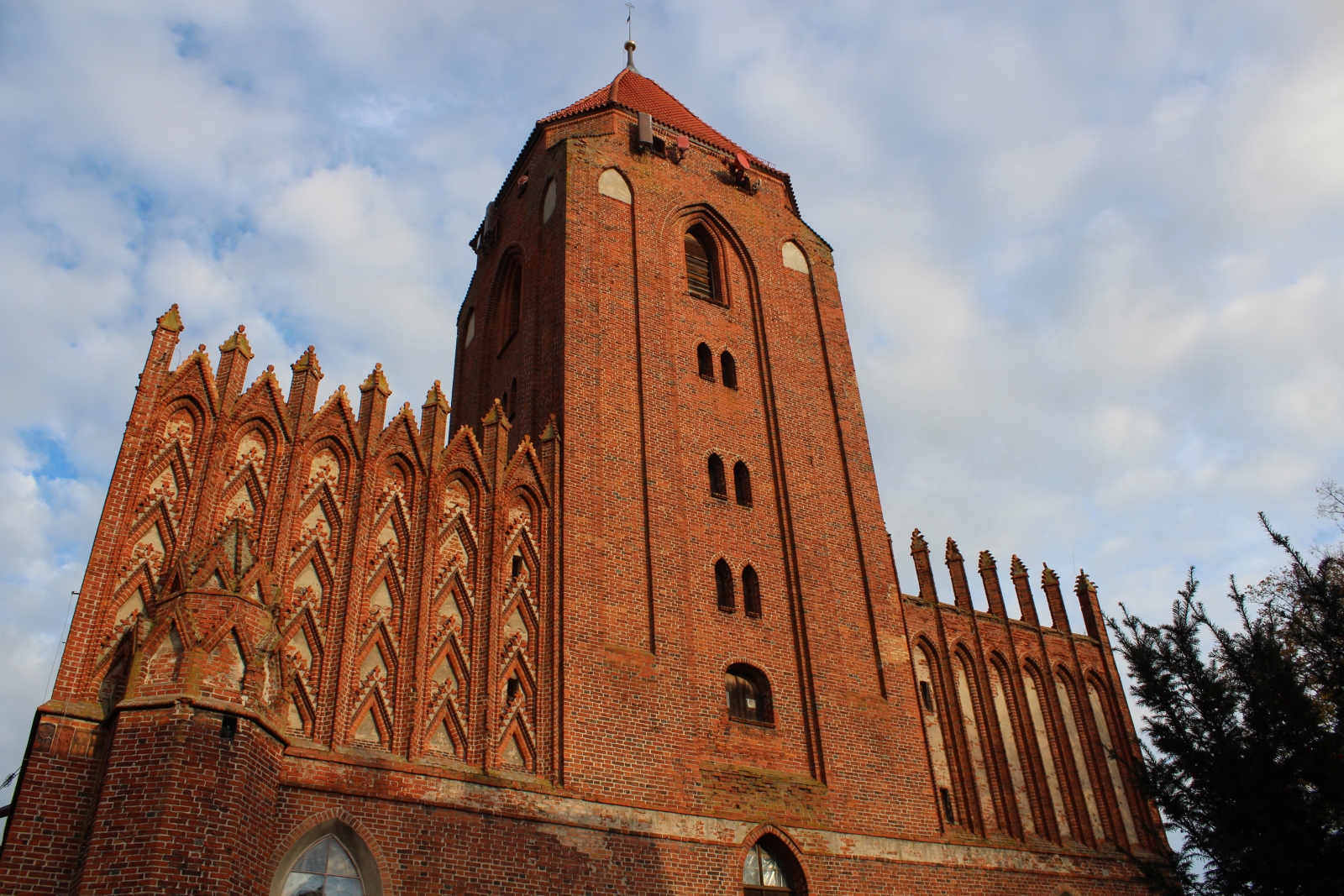
Church of St. John the Baptist in Orneta
General Information
The Church of St. John the Baptist is one of the most unique Gothic churches in northern Poland. What distinguishes it from other European churches of this period are the side chapels with their rich ceramic sculptural decoration, unmatched in monastic and diocesan architecture of that time.
Location / Geographical Setting
The church is located in the town centre at 3 Kościelna Street, constituting its most important landmark. Thanks to its central location, beside the picturesque escarpment descending towards the valley of the Drwęca Warmińska River, it is easily accessible to both residents and tourists.
History
The construction of the church began before 1350, during the rule of the Warmian bishop Herman of Prague (c. 1280-1349). The first consecration of the church took place in 1379. It was performed by Bishop Henryk III Sorbom (c. 1340-1401). In the fifteenth century, the church was extended by erecting the vaults of the nave and adding side chapels, covering them with a roof and thus, as it were, creating a fourth and fifth aisle. The church was renovated in 1525, after the end of the Polish-Teutonic War. The wall was then decorated with brick ceramics and the chapel gables were added.
In the eighteenth century, the church underwent an extensive Baroquization of its interior (c. 1739–1764). This was connected with the artistic programme of the Warmian bishops: Teodor Andrzej Potocki (1664-1738), Krzysztof Jan Szembek (1680-1740), and Adam Stanisław Grabowski (1698-1766). The works, carried out by eminent Warmian sculptors – Jan Chrystian Schmidt (c. 1701-1759), Krzysztof Perwanger (c. 1700-1785), and Jan Frey (1711-1784) – gave the interior a uniform Baroque-Rococo character.
In the following centuries, the church accumulated extremely rich furnishings, and by the end of the nineteenth century it possessed more than a dozen altars. However, at the beginning of the twentieth century, during a campaign of partial regothicization, many of these altars were dismantled, and numerous paintings and sculptures were dispersed or lost.
In 1956, the church was entered in the register of monuments, and today the parish continues its liturgical and conservation activity. Art historians emphasize that the church in Orneta constituted in the eighteenth century a kind of “laboratory of forms”, where the traditions of the Święta Lipka workshop intermingled with South German Rococo tendencies.
Architecture / Architecture and Interior Furnishings
The Church of St. John the Baptist is a Gothic three-aisled brick basilica dating from the fourteenth and fifteenth centuries, with a distinctly higher central nave and a massive western tower. It was given the form of an oriented basilical building, three-aisled and four-bay, laid out on an elongated rectangular plan without a distinct chancel, with a sacristy and porch on the north side and a tower on the west side. The interior of the church is covered with multiple-star vaults. The elevations are decorated with ceramic friezes and brick architectural details with bas-reliefs of male and female heads (on the street side). A characteristic feature, unique in Warmia, is the roof breaks of the nine chapels, fitted with far-projecting gargoyles in the shape of dragons, used to discharge rainwater from the roof.
The eighteenth-century Baroquization did not disturb the structure of the Gothic body, but completely transformed the character of the interior by equipping it with a coherent sculptural and pictorial programme. The church furnishings include numerous altars, polychromes, tabernacles, side chapels, sculptures, and a rich set of sacred details.
The most valuable is the high altar (1738–1744) by Jan Chrystian Schmidt of Reszel. It is monumental, three-axis, and about 13 m high. In the centre there is a painting of the Baptism of Christ, flanked by figures of the Apostles. Spiral columns, elaborate cornices, and the vertical composition emphasize monumentality. The crowning element is a figure of the church’s patron saint. Also from Schmidt’s workshop comes the Late Baroque pulpit of 1744. The octagonal basket is covered with a canopy and decorated with sculptures of the Evangelists, Doctors of the Church, and Christ. The composition refers to the pulpit from the Jesuit church in Braniewo; the forms reveal affinities with the Święta Lipka workshop. The Altar of Our Lady of the Rosary from 1761 – the first outstanding Rococo work in Warmia – was made by the sculptor Krzysztof Perwanger of Tolkmicko. It is characterized by lightness, asymmetry, and soft modelling, typical of mid-eighteenth-century South German sculpture. Jan Frey of Braniewo, in turn, is the author of the Altar of the Holy Family from about 1764. It is maintained in the spirit of moderate classicism, with a compact, vertical structure. The figures are marked by calm expression and geometrized draperies.
The wall paintings are also rich, including the Coronation of the Blessed Virgin Mary from about 1380, concealed behind the Altar of the Holy Family, the Wise and Foolish Virgins (c. 1420–1440), St. Anne with the Virgin and Child accompanied by St. John the Evangelist and St. James the Greater (late fifteenth century), and the Martyrdom of St. Sebastian (early sixteenth century).
Among other valuable monuments, mention should also be made of the church organ of 1609, a set of Renaissance and Mannerist altar panels, a portrait of Cardinal Stanislaus Hosius from 1570 painted during his lifetime and placed in the stall of the municipal jurors, a chandelier from 1576 made by Herman Bering of Gdańsk, and a freestanding Gothic cross from the fifteenth century. In addition, the church contains a number of monuments of goldsmith’s art, including a Late Gothic monstrance from the beginning of the sixteenth century, a Baroque reliquary with an image of St. Barbara, and an eternal lamp from around 1700.
As a result of the work of the three great eighteenth-century sculptural workshops and the rich furnishings, the interior of the church in Orneta today constitutes one of the best-preserved syntheses of Late Baroque and Rococo sacred art in Warmia.
Bibliography
- "Catalogue of Art Monuments in Poland. New Series", vol. 2, fasc. 1, "Elbląg Voivodeship: Braniewo, Frombork, Orneta and Surroundings" ("Katalog zabytków sztuki w Polsce. Seria Nowa, t. 2, z. 1, Województwo elbląskie: Braniewo, Frombork, Orneta i okolice"), ed. Marian Arszyński, Marian Kutzner, Warszawa 1980, pp. 145-156.
- Kazimierz Kisielew, Wojciech Krzysztof Szalkiewicz, "The Surroundings of the Holy Warmia Route. A Tourist Guide" ("Okolice szlaku Świętej Warmii. Podpowiednik turystyczny"), Olsztyn 2021, pp. 120–123.
- "Churches and Chapels of the Archdiocese of Warmia", vol. 1, "Holy Warmia" ("Kościoły i kaplice Archidiecezji Warmińskiej, t. 1, Święta Warmia"), ed. Bronisław Magdziarz, Olsztyn 1999, pp. 222–226.
- Parish Church of St. John the Baptist ("kościół parafialny pw. św. Jana Chrzciciela"), https://zabytek.pl/pl/obiekty/orneta-kosciol-par-pw-panny-marii-ss-jana-chrzciciela-i-jana, [accessed: 20.06.2025].
- Church of St. John the Baptist and St. John the Evangelist in Orneta ("Kościół pw. św. Jana Chrzciciela i św. Jana Ewangelisty w Ornecie"), http://leksykonkultury.ceik.eu/index.php/Ko%C5%9Bci%C3%B3%C5%82_pw._%C5%9Bw._Jana_Chrzciciela_i_%C5%9Bw._Jana_Ewangelisty_w_Ornecie, [accessed: 20.06.2025].
- Mieczysław Orłowicz, "Illustrated Guide to Prussian Masuria and Warmia" ("Ilustrowany przewodnik po Mazurach Pruskich i Warmii"), prepared for print by Grzegorz Jasiński, Andrzej Rzempołuch, Robert Traba, Olsztyn 1991, pp. 249–252.
- "Through Holy Warmia with Mieczysław Orłowicz. Illustrated Guide, Past and Present" ("Po Świętej Warmii z Mieczysławem Orłowiczem. Ilustrowany przewodnik dawny i współczesny"), ed. Wojciech Krzysztof Szalkiewicz, Olsztyn 2023, pp. 109–111.
- Andrzej Rzempołuch, "Churches in Warmia, Mazury, and Powiśle" ("Kościoły na Warmii, Mazurach i Powiślu"), Olsztyn 1991, pp. 32–35.
- Roman Catholic Parish of St. John the Baptist in Orneta ("Rzymskokatolicka Parafia Świętego Jana Chrzciciela w Ornecie"), http://www.orneta.parafia.info.pl/?p=main&what=16, [accessed: 20.06.2025].
- Mariusz Smoliński, "Sculptor Jan Chrystian Schmidt: The Role of Warmia as an Artistic Province in the Eighteenth Century" ("Rzeźbiarz Jan Chrystian Schmidt: rola Warmii jako prowincji artystycznej w XVIII wieku"), Olsztyn 2006, passim.
- Grzegorz Świderski, "Tomb Slabs from the Church of St. John the Baptist in Orneta" ("Płyty nagrobne z kościoła pw. św. Jana Chrzciciela w Ornecie"), „Warmińsko-Mazurski Biuletyn Konserwatorski”, vol. 8, 2016, pp. 147–169.
- Arkadiusz Wagner, "The Non-Extant Altar of the Holy Trinity from the Church of St. John the Baptist in Orneta: From Research on the Work of the Sculptor Krzysztof Perwanger in the Diocese of Warmia" ("Nieistniejący ołtarz Świętej Trójcy z kościoła św. Jana Chrzciciela w Ornecie: z badań nad twórczością rzeźbiarza Krzysztofa Perwangera w diecezji warmińskiej"), „Komunikaty Mazursko-Warmińskie” 2003, no. 3, pp. 297–310.
- Arkadiusz Wagner, "Problems of Attribution in Late Baroque Warmian Sculpture: J. Chr. Schmidt, J. Frey and K. Perwanger and the Baroquization of the Church of St. John the Baptist in Orneta" ("Problemy atrybucyjne późnobarokowej rzeźby warmińskiej: J. Chr. Schmidt, J. Frey i K. Perwanger a barokizacja kościoła p.w. św. Jana Chrzciciela w Ornecie"), „Komunikaty Mazursko-Warmińskie” 2001, no. 1, pp. 17–32.