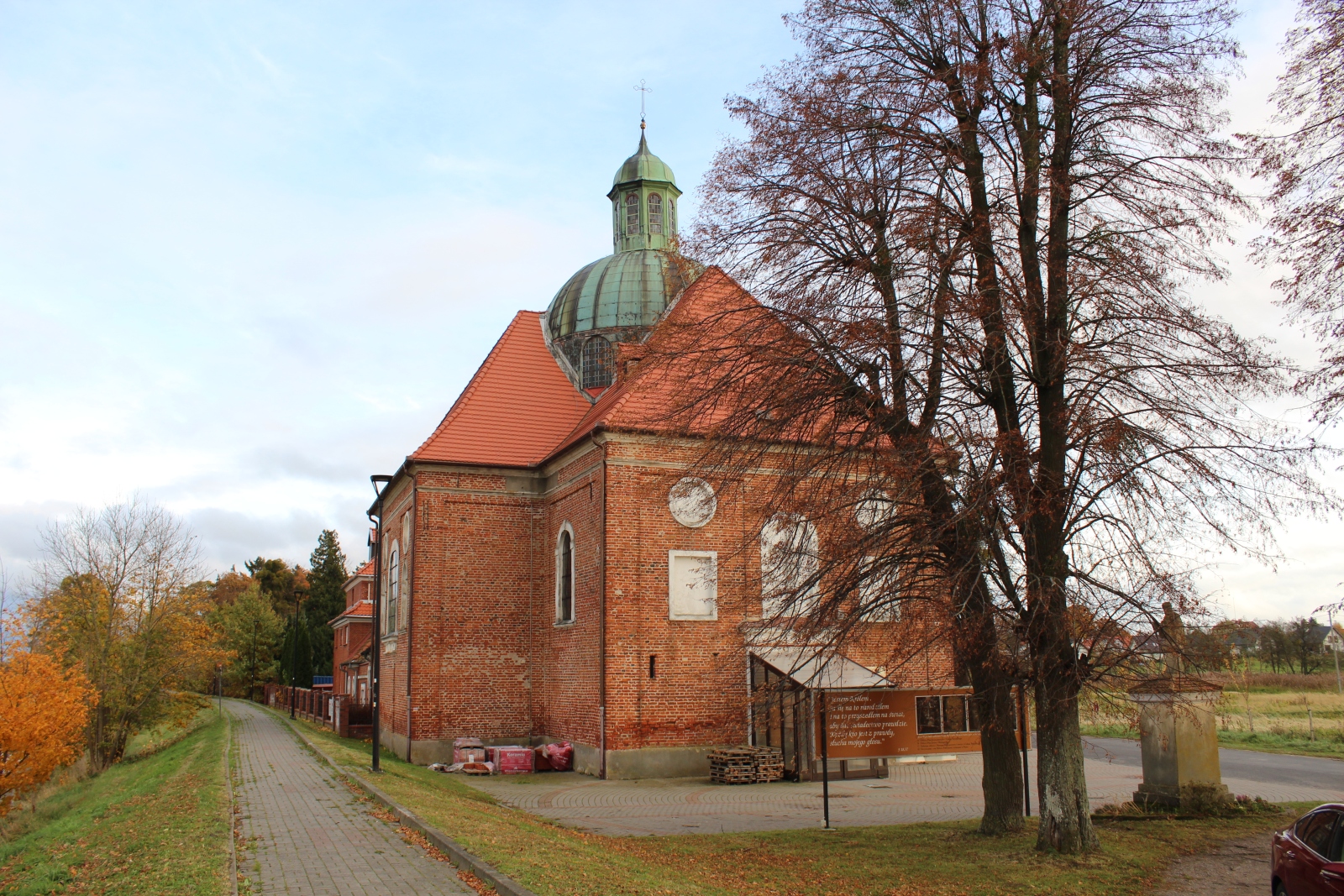
Holy Cross Church in Braniewo
General Information
The Holy Cross Church (Sanctuary of the Exaltation of the Holy Cross) in Braniewo is one of the important pilgrimage destinations in Warmia and an interesting monument of late Baroque sacral architecture. The church, erected in the first half of the eighteenth century, was established as a votive offering of gratitude and as a place of worship of the miraculous painting of the Holy Trinity. The building is distinguished by its unique spatial layout, uncommon in the traditional sacral architecture of this region. For centuries the church was under the care of the Jesuits, and since the interwar period the sanctuary has been entrusted to the Redemptorist Fathers. The monument is entered in the register of historic monuments and constitutes a jewel of the Baroque in northern Poland.
Location
The church is located at 10 Świętokrzyska Street. The sanctuary was situated outside the historic defensive walls of the town, in a picturesque valley on the Pasłęka River. The choice of this site was not accidental – the sanctuary was erected precisely where, according to historical accounts, the miraculous event occurred that initiated the cult of the Holy Cross.
History
The origins of the cult and the establishment of the Catholic religious cult centre in the place where the Holy Cross Church now stands are connected with a miracle from the period of the Polish-Swedish war of 1626-1635. In 1625, a painting of the Holy Trinity was hung on a tree above the Pasłęka. In the following year, three Swedish soldiers profaned the image by shooting at it with muskets. According to witnesses, blood began to ooze from the pierced painting. This event, which shocked the local community, was used as an argument in the anti-Swedish propaganda campaign and in the Counter-Reformation campaign conducted by the Braniewo Jesuits. Skilfully fuelled anti-Lutheran sentiments caused the site to become a destination for numerous pilgrimages.
A considerable role in the spread of the cult of the painting was played by the Dominican Father Fabian Birkowski (1566-1636), who in 1629 published in Kraków a sermon about the events of 1626. In Braniewo, the Jesuits built in 1631 a modest wooden chapel around the tree on which the miraculous painting had originally hung, and in the years 1665-1668 it was expanded to the size of a church. In this wooden church, after being recovered from Warsaw, the miraculous painting was hung in 1672, which resulted in even more numerous and more frequent pilgrimages.
The dynamic development of the cult prompted the chapter and the bishops of Warmia to erect a worthy edifice. The construction of the presently existing brick church was initiated in 1722 by the rector of the Jesuit college, Father Teofil Zabłocki, and in the following year, on the आदेश of Bishop Teodor Andrzej Potocki (1664-1738), who was staying in Warsaw, the cornerstone was blessed by the Warmian canon Michał Remigiusz Łaszewski (1682-1764). He himself, already as auxiliary bishop, performed the solemn consecration of the unfinished church in 1731. The construction works on the church were completed in 1742. Care of the site was entrusted to the Braniewo Jesuits.
After the suppression of the Jesuit order in 1773, the church continued to be cared for by the Jesuits for several more years, and from 1780 the church was cared for by priests from St Catherine’s Church in Braniewo. In 1923, Bishop Augustyn Bludau (1862-1930) handed the church over to the Redemptorist Fathers who had come from Bonn, and they erected a monastery next to it and revived the pilgrimage movement. Fortunately, during the war operations in 1945, which reduced Braniewo to ruins, the Holy Cross Church suffered relatively minor damage, thanks to which the Baroque fabric of the interior has survived to this day. After the war, the church was taken care of by Polish Redemptorists, who repaired the damage, among other things by restoring the organ and repairing the dome. In 2009, Archbishop Wojciech Ziemba (1941-2021) elevated the church to the rank of the Archdiocesan Sanctuary of the Exaltation of the Holy Cross. It is worth mentioning that the church belongs to the Baroque so-called Warmian indulgence churches, such as Chwalęcin, Głotowo, Krosno, Międzylesie Lidzbarskie, and Święta Lipka.
Architecture
In architectural terms, the Holy Cross Church is a building representing the trend of geometric Baroque, laid out on the plan of a Greek cross inscribed in an octagon. It is a brick structure, unplastered on the outside, decorated with niches in which statues are placed. To this central body were added an elongated presbytery and two towers on the façade side. The front of the church is adorned with two low Baroque towers covered with decorative helmets. The most characteristic feature of the building, however, is the ambulatory encircling the main nave. This architectural device allowed crowds of pilgrims to walk smoothly around the main altar with the miraculous painting without disturbing religious services. The interior is covered by a monumental dome with a lantern, supported on massive pillars. A complex of monastery buildings adjoins the church from the east.
Furnishings
The interior of the church dazzles with a uniform late Baroque and Rococo décor. The central point of the church is the monumental, richly gilded high altar from 1738 from the Reszel workshop of Jan Chrystian Schmidt (1701-1759). In its central field was placed the Miraculous Painting of the Holy Trinity (Throne of Grace) from the first quarter of the seventeenth century. On the canvas, three authentic holes from Swedish bullets are still visible, constituting direct testimony to the events of 1627. The side altars, dedicated to Our Lady of Sorrows and St Valentine, were also made in the above-mentioned workshop in Reszel. Attention is also drawn to the intricately carved pulpit – made in 1745 by Jan Frey (1711-1784) – with rich sculptural decoration, constituting an outstanding example of Warmian Baroque woodcarving; the wooden chalice-shaped baptismal font; the classicist-Neo-Baroque organ prospectus with mechanism from the second half of the eighteenth century; and the glass paintings in the internal portal depicting the Finding of the Holy Cross and its Exaltation.
The dome and the vaults are covered with magnificent illusionistic painted decoration executed by the Neapolitan painter Giovanni Francesco Rossi (partly renewed in the nineteenth century). The frescoes depict scenes connected with the Exaltation of the Holy Cross and the history of the Braniewo miracle.
Curiosities
Within the sanctuary complex, in a side chapel, the so-called Holy Stairs were founded – a rare Calvary element being a replica of the stairs from the palace of Pontius Pilate in Jerusalem.
Historians emphasise that the church owes its survival in 1945 precisely to its peripheral location. Because it stood in a river valley outside the strict, densely built-up town centre, it escaped the heaviest artillery bombardments and deliberate arson attacks that consumed the rest of historic Braniewo.
Bibliography
- Domino Maurycy, Kościół klasztorny jezuitów, ob. parafialny pw. Świętego Krzyża, https://zabytek.pl/pl/obiekty/braniewo-kosciol-odpustowy-pw-krzyza-swietego-obecnie-kosciol-, [accessed: 15.09.2025].
- Katalog zabytków sztuki w Polsce. Seria nowa, t. 2: Województwo elbląskie, z. 1: Braniewo, Frombork, Orneta i okolice, oprac. aut. Marian Arszyński i Marian Kutzner, red. Jerzy Z. Łoziński, Barbara Wolff-Łozińska, Warszawa 1980, pp. 20-23.
- Kościoły i kaplice Archidiecezji Warmińskiej, t. 1: Święta Warmia, red. Bronisław Magdziarz, Olsztyn 1999, pp. 128-129.
- Kościół pw. Świętego Krzyża w Braniewie, http://leksykonkultury.ceik.eu/index.php/Ko%C5%9Bci%C3%B3%C5%82_pw._%C5%9Awi%C4%99tego_Krzy%C5%BCa_w_Braniewie, [accessed: 15.09.2025].
- Mazur Zdzisław, Michał Remigiusz Łaszewski (1682-1764) – biskup pomocniczy warmiński, “Komunikaty Mazursko-Warmińskie”, 1979, no. 2, pp. 165-181.
- Poklewski Józef, Kościół św. Krzyża w Braniewie, “Acta Universitatis Nicolai Copernici. Zabytkoznawstwo i Konserwatorstwo”, 1989, 13 (186), pp. 81-91.
- Rzempołuch Andrzej, Przewodnik po zabytkach sztuki dawnych Prus Wschodnich, Olsztyn 1992, pp. 25-26.
- Szymańska Anna, Konserwacja obrazu „Tron Łaski” z kościoła Świętego Krzyża w Braniewie, “Warmińsko-Mazurski Biuletyn Konserwatorski”, 2000, no. 2, pp. 195-200.