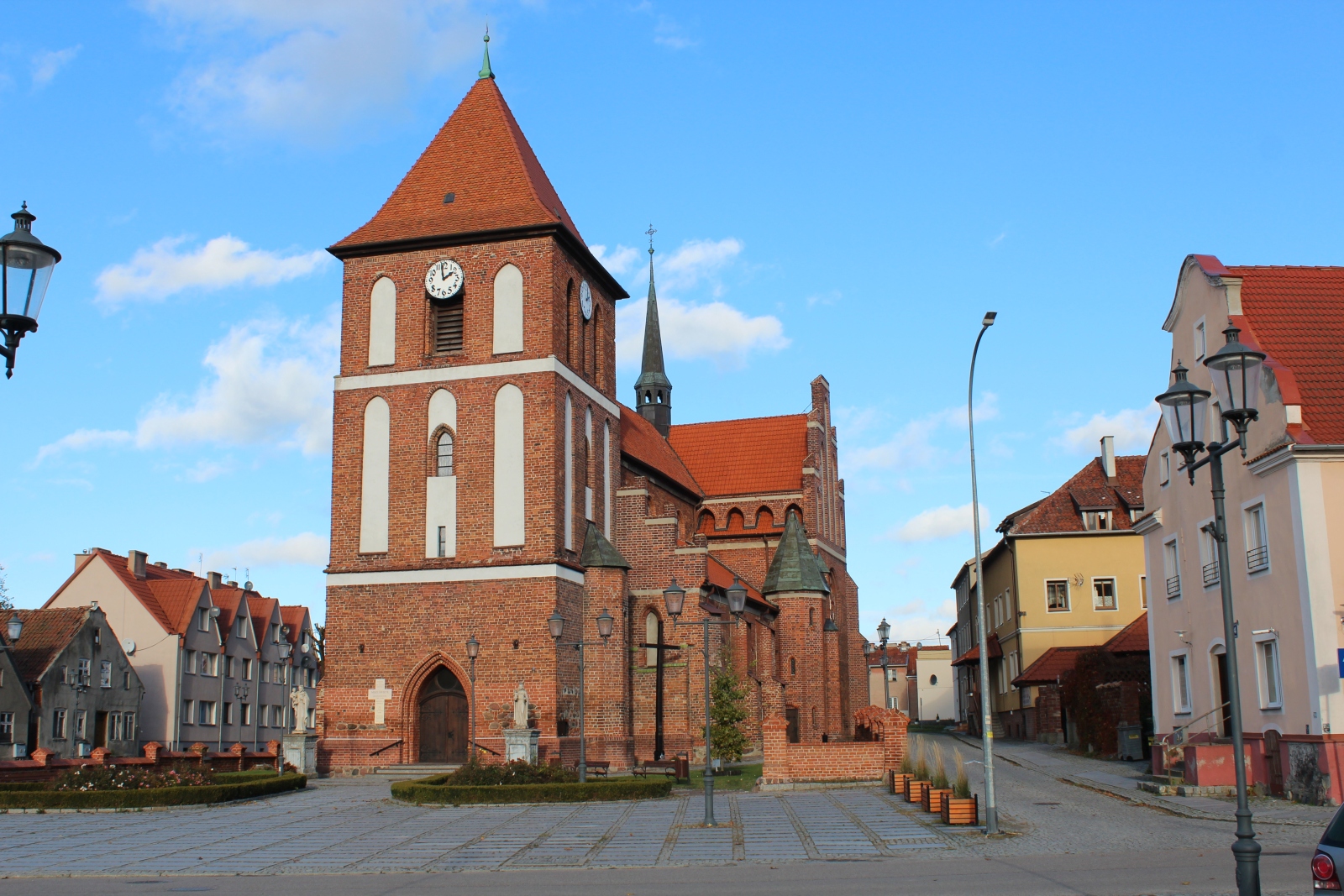
Church of Saint James the Apostle in Tolkmicko
General Information
The Roman Catholic parish church of Saint James the Apostle is a Gothic temple that is one of the most picturesque sacral monuments situated on the Vistula Lagoon. It currently belongs to the Diocese of Elbląg and the Elbląg-North deanery. The building is entered in the register of monuments, constituting one of the most valuable examples of sacral architecture in the lagoon region. Since 1967, pastoral care of the parish has been provided by the Salesian priests.
Location
The church is situated in the central part of Tolkmicko, at 2 Kościelna Street, in close proximity to the market square and the fishing port. Its powerful mass clearly dominates the town’s low-rise development. Tolkmicko itself is picturesquely located on the Elbląg Upland, directly on the shore of the Vistula Lagoon, the proximity of which historically determined the development and strategic importance of the settlement.
History
The origins of the temple in Tolkmicko date back to the second half of the fourteenth century. The original wooden church was replaced by a masonry structure, whose solemn consecration was performed on 28 October 1376 by the Bishop of Warmia, Henryk III Sorbom (c. 1340-1401). The newly erected temple received a triple dedication: Saint James the Apostle, the Blessed Virgin Mary, and the Holy Cross. The turbulent history of the town did not spare the church, which fell victim to devastating fires three times: in 1550, 1636, and 1767.
Particularly severe was the fire of 1767, after which the reconstruction of the temple was supported by the faithful from all of Warmia, who donated contributions for this purpose. The renovation works were completed in 1783, giving the building a Baroque character, visible among other things in the form of the then tower helmet.
A key moment for the present appearance of the church was the major reconstruction carried out in 1901–1902. At that time, due to the increase in the number of parishioners, it was decided to enlarge the temple in the Neo-Gothic style. A transept (cross nave), a new elongated chancel, and two sacristies were added to the body of the church. The interior received new vaults and uniform furnishings, which have survived to the present day. The building passed through the Second World War without major damage, preserving its historic substance almost in its entirety.
Architecture of the church
The Church of Saint James the Apostle is an oriented building, constructed of brick, originally erected in the Gothic style and subsequently transformed in the spirit of Neo-Gothic. It currently has the form of a three-aisled basilica with a transept, which is a layout less frequently encountered in the small towns of the region, where hall and aisleless churches predominated.
On the west side of the nave body there adjoins a massive, three-storey tower on a square plan, crowned with a tent roof. The elevations of the tower and nave are decorated with white-plastered blind niches and bands, creating a characteristic contrast with the red brick. The gables of the transept are stepped in form, typical of Gothic architecture, and are richly decorated with blind niches.
The interior of the temple is covered with various types of vaulting: stellar vaults were used in the main nave, whereas ribbed cross vaults were introduced in the chancel and sacristies. The side aisles are separated from the main nave by massive pillars, and above them rise galleries (balconies), added during the expansion at the beginning of the twentieth century.
Furnishings of the church
Most of the present interior furnishings date from the period of the Neo-Gothic reconstruction of 1901–1902. The high altar, made by the Elbląg sculptor Oskar Roemer in 1902, has the form of a triptych (or pentaptych). In its centre there are figures of saints: Elizabeth of Hungary, Barbara, and Francis Xavier (the fourth sculpture probably depicts Saint John the Evangelist or another apostle), while the side wings show scenes of the Annunciation and the Coronation of the Blessed Virgin Mary. The same artist also made two side altars: that of Saint Anne and that of the Virgin Mary.
In the chancel, stained-glass windows from the beginning of the twentieth century have been preserved, depicting among others the Sacred Heart of Jesus, Saint Catherine, Saint Andrew, Saint James, and Saint Roch. Also noteworthy are the organs from 1902, built by the renowned firm of Eduard Wittek from Elbląg.
An extremely valuable element of the church complex consists of two Baroque stone sculptures placed outside, in front of the façade of the temple. They depict the Immaculate Virgin (from 1745) and Saint John of Nepomuk (from 1736). Their author is Krzysztof Perwanger (after 1700-1785), an outstanding Rococo sculptor and at the same time a former mayor of Tolkmicko. On the southern wall of the church there is also a sculpture of Christ in Gethsemane.
Bibliography
- Dettlaff Danuta, Dettlaff Jan P., "Kościoły Diecezji Elbląskiej: nasze dziedzictwo: dekanaty Elbląga", Bydgoszcz: Studio Plus 2006, p. 152.
- Historia okolic Elbląga: Tolkmicko (episode 36), https://www.portel.pl/dawny-elblag/historia-okolic-elblaga-tolkmicko-odcinek-36/94892, [accessed: 20.11.2025].
- Parish church of Saint James the Apostle, https://zabytek.pl/pl/obiekty/tolkmicko-kosciol-par-pw-sw-jakuba-apostola, [accessed: 20.11.2025].
- Church of Saint James the Apostle in Tolkmicko, http://leksykonkultury.ceik.eu/index.php/Ko%C5%9Bci%C3%B3%C5%82_pw._%C5%9Bw._Jakuba_Aposto%C5%82a_w_Tolkmicku, [accessed: 20.11.2025].
- Parish of Saint James the Apostle in Tolkmicko, https://petla-zulaw.pl/obiekty/koscioly/515,parafia-sw-jakuba-apostola-w-tolkmicku.html, [accessed: 20.11.2025].
- Tolkmicko – Church of Saint James, https://medievalheritage.eu/pl/strona-glowna/zabytki/polska/tolkmicko/, [accessed: 20.11.2025].