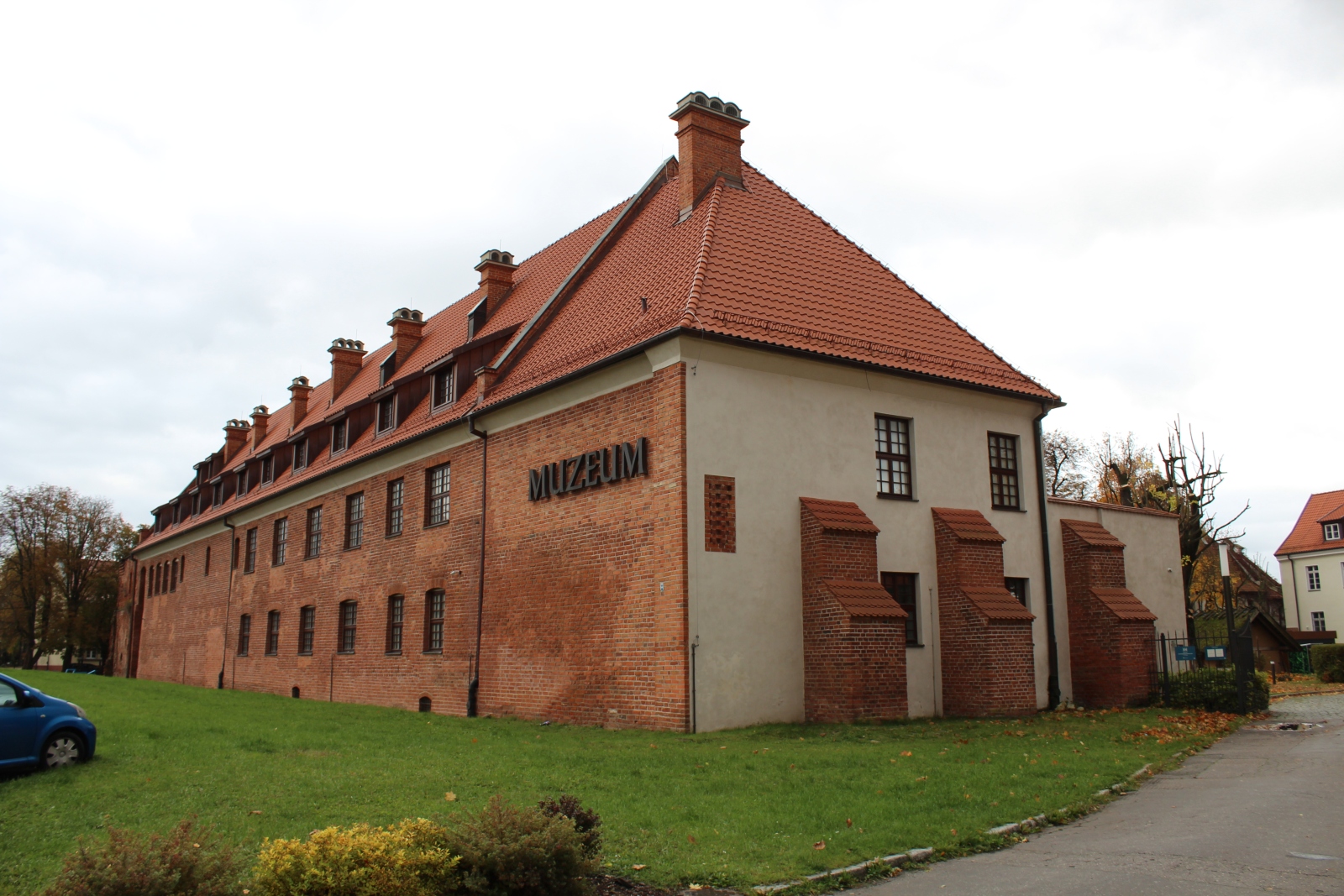
Archaeological and Historical Museum in Elbląg
General Information
The Archaeological and Historical Museum in Elbląg is a Cultural Institution of the City of Elbląg and constitutes the oldest museum institution in the Warmian-Masurian Voivodeship. The museum collects more than 115 thousand objects, constituting testimony to the rich and complex past of this region of Europe.
Location / Geographical Setting
The museum is located in the historic centre of the Old Town, at 11 Bulwar Zygmunta Augusta. The seat of the museum is situated on the site of the former outer bailey, in the area where one of the most powerful Teutonic castles in Prussia once stood. The institution occupies two historic buildings – the former malt house (customarily referred to as the Podzamcze) and the building of the former Elbląg Gymnasium.
History
The beginnings of museology in Elbląg date back to 8 November 1864, when the city magistrate decided to establish the Municipal Museum (Städtisches Museum), gathering dispersed collections of coins, numismatics, antiquities, and works of art. The pre-war museum collections were partially dispersed during the Second World War, but a significant part of them survived – fragments were found in Rakowo and in the cellars of the pre-war building on Wigilijna Street.
The present Archaeological and Historical Museum was established on 24 March 1954 on the basis of a resolution of the Civic Executive Committee of the Jubilee Year of the City of Elbląg. Its establishment was the result of an initiative of the local authorities, which decided to recreate museum activity by drawing upon dispersed monument material.
The first seat of the museum consisted of townhouses no. 11 and 12 on Wigilijna Street, where the official opening of the institution took place on 8 June 1954. The exhibition was then arranged in the form of four thematic exhibitions devoted to: Elbląg craftsmanship, archaeological monuments, photographic documentation of the city in the past and present, and amateur painting. The institution initially operated without legal personality, therefore on 12 February 1955, by virtue of ordinance no. 25 of the Minister of Culture and Art, it was taken over by the ministry and renamed the “Museum in Elbląg”, and supervision over it was entrusted to the Central Board of Museums and Monument Protection through the District Pomeranian Museum in Gdańsk.
In 1973, the institution was moved to the building of the former Elbląg Gymnasium – a structure with a tradition dating back to the sixteenth century, which during the Reformation period served as a humanist school. Fourteen years later, in 1987, on the occasion of the celebrations of the seven hundred and fiftieth anniversary of the founding of the city, the Podzamcze building – the former Teutonic malt house – was put into use and handed over to the museum.
Architecture / Architecture and Spatial Layout
The museum functions in two historic buildings inseparably connected with the history of Elbląg. The building of the former gymnasium was erected on the site where, from 1458, a Bridgettine convent functioned, transformed after the Reformation into the first humanist school in Prussia. The building contains Gothic cellars dating from the thirteenth to the fifteenth centuries, constituting a relic of earlier conventual and urban development.
The Podzamcze building formed part of the defensive and economic system of the Teutonic castle, separating the fortress from the urban development. Fragments of the defensive walls, although preserved only partially, constitute tangible testimony to the power of Teutonic fortifications from the thirteenth and fourteenth centuries. In the years 1984–1987, the former malt house was adapted for museum purposes, exposing the preserved elements of medieval architecture.
The Teutonic Castle in Elbląg – the Architectural Past of the Site
Of fundamental importance for understanding the historical context of the museum is the fact that its buildings were erected on the site of the former mighty castle, which in the years 1251–1309 was the most important fortress in the Teutonic state. Construction of the castle began around 1237–1240 – it was the first brick monastic castle in the Prussian lands. The complex included an extensive defensive system, the Church of St. Andrew with relics of the Holy Cross, and numerous economic buildings. The Elbląg castle was considered second only to Malbork in terms of military and aesthetic qualities in the entire monastic state. After the transfer of the seat of the Grand Master to Malbork in 1309, the castle remained the seat of the Order’s Grand Hospitaller and the Elbląg commander.
In 1440, at the assembly of the Prussian estates in Elbląg, the Prussian Confederation was established – an association of nobility and cities opposing the rule of the Teutonic Order. The fate of the castle was sealed by the burghers’ uprising on 12 February 1454 – members of the Prussian Confederation captured the fortress, expelled the Teutonic garrison, and then set fire to and systematically demolished the fortifications in order to prevent the Order from retaking them. The castles in Gdańsk and Toruń met a similar fate in the same year. The ruins were finally dismantled at the end of the sixteenth century. After the conclusion of the Second Peace of Toruń in 1466, Elbląg found itself within the borders of the Polish Crown, obtaining the status of a royal port and receiving new trade privileges from King Casimir Jagiellon. To the present day, only fragments of the defensive walls, Gothic cellars, and a granite column that once supported the vault of the castle refectory have survived from the former stronghold.
Monuments / Collections / Present Condition and Educational Function
Characteristics of the Museum Collections
The museum collects archaeological materials originating from three principal research sites of fundamental importance for understanding the history of the region.
Elbląg Old Town
The most extensive collection consists of finds from the area of the Old Town in Elbląg. Since 1980, systematic excavations conducted under the direction of Tadeusz and Grażyna Nawrolski have yielded approximately one million fragments of artefacts from all periods – from prehistory to the modern era. Thus far, archaeological research has been carried out over an area of more than 13,000 m², which places Elbląg among the best investigated European cities. The works revealed the foundations of medieval wooden houses, usually lying 3–4 m below the present ground level. Particularly valuable proved to be discoveries in former municipal latrines – the anaerobic conditions prevailing within them ensured excellent preservation of wooden and organic artefacts, which in other conditions undergo biological decomposition. The latrines thus became an extraordinary source of information about the everyday life of the medieval city.
The Settlement of Truso
The Viking settlement of Truso, situated on the shore of Lake Drużno in the village of Janów Pomorski, was between the eighth and tenth centuries one of the most important trading ports of Northern Europe. The discovery of this site in 1981 by the archaeologist Marek F. Jagodziński remains a breakthrough in European archaeology. Truso was the only known Scandinavian trading emporium from the Early Middle Ages on the territory of Poland, mentioned in the account of the Anglo-Saxon sailor Wulfstan from the end of the ninth century.
During systematic excavations carried out since 1982, approximately half a million fragments of animal bones, more than sixty thousand fragments of pottery, and more than one thousand coins and weights were recovered, testifying to extensive trade contacts. Artefacts identified with Viking craftsmanship include imports from England, the Rhineland, and the Abbasid Caliphate.
The Cemetery in Weklice
In Weklice, located near Elbląg, a cemetery of the Wielbark culture from the Roman Iron Age (1st–3rd century AD) was discovered. The site belongs to the best-recognized burial places in Poland from the time of the Roman Empire – more than 600 graves have been discovered thus far. The collection includes more than four thousand objects made of gold, silver, bronze, and iron, as well as imported glassware and vessels, testifying to the advanced contacts of this community with the Mediterranean world.
Unique Exhibits
The museum presents a collection of unique objects of European significance. Among them is the oldest pair of spectacles found in Poland, dated to the first half of the fifteenth century. The frame made of antler with dark green, non-corrective lenses probably served to protect the eyes from the sun and dust – the green glass had properties alleviating eye fatigue. Among the collection of musical instruments, a medieval gittern from the fourteenth to fifteenth centuries stands out, regarded as the predecessor of the modern mandolin, discovered in a latrine in the Old Town. It is one of three preserved examples of this instrument in the world. The collection is complemented by flutes, violins, and other string instruments.
A separate category consists of wax tablets used as writing material – they were used as teaching aids or carriers of commercial information. Valuable monuments also include pilgrim signs (medallions and badges) worn by pilgrims visiting important Christian shrines, providing insight into the spiritual sphere of medieval society.
Permanent Exhibitions and Educational Function
In the museum courtyard there is a replica of a Viking hut from former Truso, reconstructed on the basis of research conducted by Dr. Marek F. Jagodziński. Nearby, one can view the remains of castle walls from various periods of the site’s history. In the summer season, voyages take place on a replica Viking boat, presenting the manner of travelling and trading in the Early Middle Ages. Permanent exhibitions present, among others, the history of the Goths and the inhabitants of the Truso emporium (“Truso – Legend of the Baltic”, since 2015), the material culture of the Wielbark population (“The Goths. From the Baltic to Rome”), and the history of medieval Elbląg from an archaeological perspective (“Elbląg reconditus”, since 2014). In 2014, within the framework of the programme “Museums beyond Borders”, the eastern part of the Podzamcze building was modernized, installing equipment for holographic projections presenting three-dimensional reconstructions of the Truso settlement and Teutonic castles.
The museum also gathers a collection of Kadyny ceramics – products from the manufactory established in 1904–1905 by Emperor Wilhelm II in nearby Kadyny. Artistic objects modeled on ancient Greek and Etruscan pottery and on Italian Renaissance maiolica were produced there.
Practical Information
Detailed information on opening hours, tickets, and group reservations is available on the website: www.muzeum.elblag.pl, by telephone at +48 55 232 72 73, or by e-mail: muzeumel@elblag.com.pl.
Bibliography
- Czerniakowska Małgorzata, From the History of the Library of the Elbląg Gymnasium (Z dziejów Biblioteki Gimnazjum Elbląskiego), “Rocznik Elbląski”, 2004, vol. 20, pp. 15-44.
- History of Elbląg, vol. V (1945-1975) (Historia Elbląga, t. V (1945-1975)), ed. Andrzej Groth, Gdańsk 2005, pp. 210-212.
- Jagodziński Marek, Truso. Between Weonodland and Witland (Truso. Między Weonodlandem a Witlandem), Elbląg 2010, pp. 5-15.
- Jóźwiak Sławomir, Trupinda Janusz, The Teutonic Castle in Elbląg: Topography and Spatial Layout (Zamek krzyżacki w Elblągu: topografia i układ przestrzenny), in: Teutonic Commandery Castles in Prussia. Topography and Spatial Layout on the Basis of Medieval Written Sources (Krzyżackie zamki komturskie w Prusach. Topografia i układ przestrzenny na podstawie średniowiecznych źródeł pisanych), Malbork 2012.
- Marcinkowski Mirosław, The Elbląg Municipal Museum in the Years 1864–1945 (Elbląskie Muzeum Miejskie w latach 1864–1945), in: Treasures of the Elbląg Museum. 150 Years of Museology in Elbląg (Skarby elbląskiego muzeum. 150 lat muzealnictwa w Elblągu), ed. Kazimierz Arbart, Elbląg 2014, pp. 11–25.
- Milewska Danuta, The Museum in Elbląg 1954-1974 (Muzeum w Elblągu 1954-1974), “Rocznik Elbląski”, 1976, vol. 7, pp. 267-278.
- Archaeological and Historical Museum in Elbląg (Muzeum Archeologiczno-Historyczne w Elblągu), http://leksykonkultury.ceik.eu/index.php/Muzeum_Archeologiczno-Historyczne_w_Elblągu, [accessed: 12.11.2025].
- Nawrolska Grażyna, The Beginnings of Elbląg in the Light of Archaeological Sources (Początki Elbląga w świetle źródeł archeologicznych), Elbląg 2012.
- On the Tedious Beginnings of an Ambitious Undertaking (70 Years of the Elbląg Museum) (O żmudnych początkach ambitnego przedsięwzięcia (70 lat elbląskiego Muzeum)), https://www.portel.pl/kultura/o-zmudnych-poczatkach-ambitnego-przedsiewziecia-70-lat-elblaskiego-muzeum/138541, [accessed: 12.11.2025].
- Pawlak Lech, Elbląg. Castle – Outer Bailey – Museum (Elbląg. Zamek – Podzamcze – Muzeum), Elbląg 2012, pp. 12-45.
- Treasures of the Elbląg Museum. 150 Years of Museology in Elbląg (Skarby elbląskiego muzeum. 150 lat muzealnictwa w Elblągu), ed. Kazimierz Arbart, Elbląg 2014.
- Studies on Truso, vol. II: Janów Pomorski site 1. Results of Rescue Archaeological Research in 2007–2008 (Studia nad Truso, t. II: Janów Pomorski stan. 1. Wyniki ratowniczych badań archeologicznych w latach 2007–2008), ed. Mateusz Bogucki, Marek F. Jagodziński, Elbląg 2013.
- Torbus Tomasz, Conventual Castles of the Teutonic State in Prussia, part 1 (Zamki konwentualne państwa krzyżackiego w Prusach, cz. 1), Gdańsk 2000.
- Castle in Elbląg (Zamek w Elblągu), https://www.zamki.pl/?idzamku=elblag, [accessed: 12.11.2025].