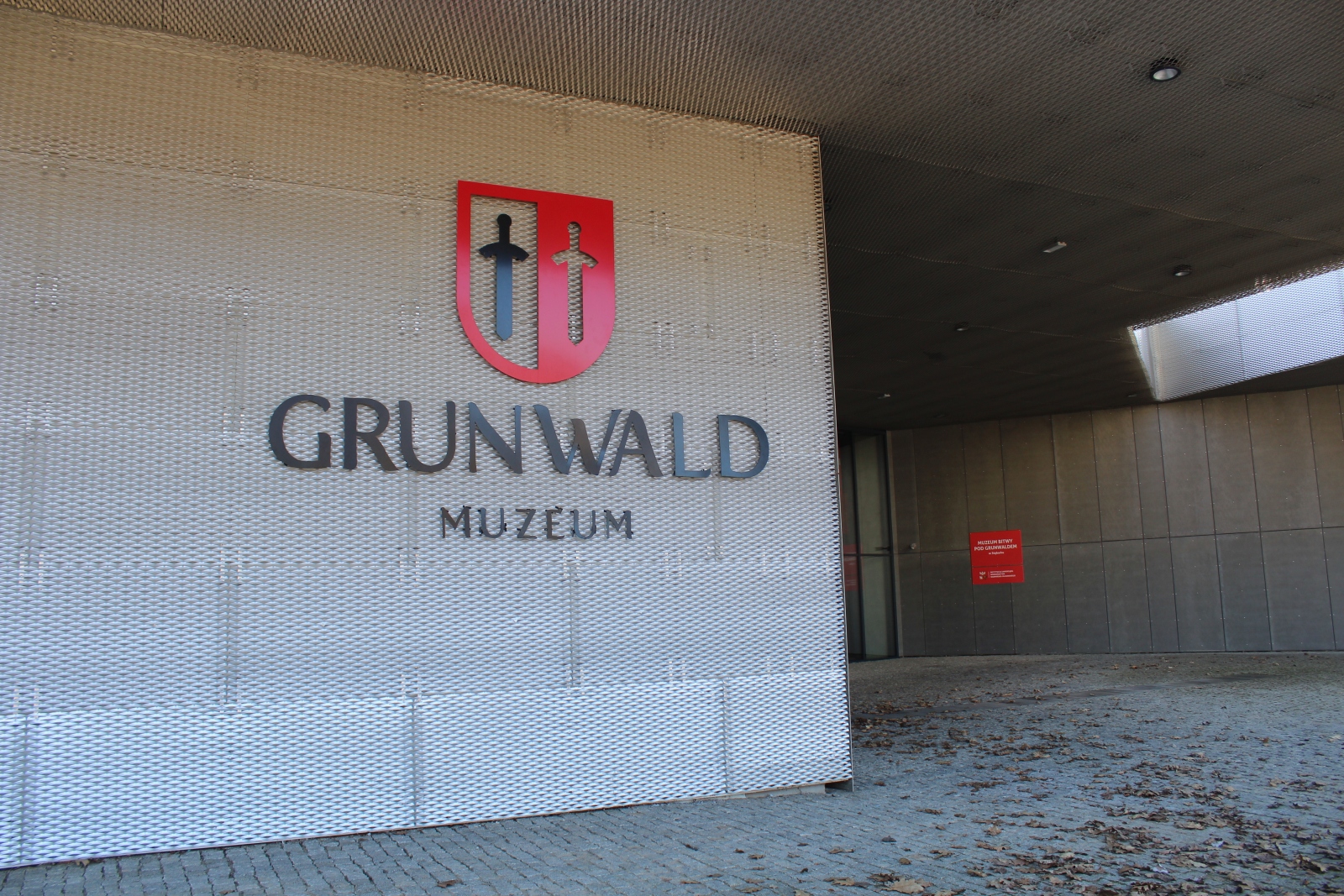
Museum of the Battle of Grunwald in Stębark
General Information
The Museum of the Battle of Grunwald in Stębark is a cultural institution in Warmia and Mazury, located directly on the Grunwald Fields – the site of one of the largest battles of medieval Europe. In recent years, the museum has undergone a profound transformation, and since 2022 a modern building has been open to visitors. Nearby Stębark (German: Tannenberg) is a small village inhabited by 435 people (2021).
Location / Geographical Setting
Stębark is situated near the site of the 1410 Battle of Grunwald and lies about 14 km south-west of Olsztynek and approximately 25 km east of Lubawa. The address of the museum itself is Stębark 1.
History of the Village
The origins of Stębark date back to the Teutonic period. The earliest mention of the settlement appears in the years 1334-1335, when a certain Henryk of Stębark was recorded in sources as a witness to a document. In 1380, the village appears as a knightly estate with an area of 80 włókas, subordinate to the commandry in Dąbrówno; in the same year, the village headman Berthold received a renewed privilege for the headman’s włókas. On the nearby fields – in the area between Grunwald, Stębark, and Łodwigowo – on 15 July 1410, the great battle was fought between the forces of the Teutonic Order and the Polish-Lithuanian armies, one of the largest battles in medieval Europe. A year later, the Teutonic Knights erected a chapel at the place where Grand Master Ulrich von Jungingen (c. 1360-1410) died. In 1414, during the so-called “Hunger War”, it was destroyed by Polish troops, but was soon rebuilt. In 1511, the chapel was plundered of its valuables.
In the fifteenth century, the estates in Stębark were in the hands of various representatives of the local nobility. In the following century, the village changed owners many times. In the years 1515-1519, it belonged to the nobleman Samiński, and in 1540 almost all of Stębark was in the possession of Albrecht Finck. At that time, the settlement comprised 80 włókas of land and had a fairly developed social structure – it was inhabited by 24 free peasants, 5 cottagers, 2 innkeepers, a blacksmith, and a village headman. There was also a church and a parish school.
In the seventeenth century, Stębark was affected by wars and natural disasters. In 1656, during the Tatar raid – that is, the plundering expedition of Tatar troops allied with the Polish-Lithuanian Commonwealth during the Swedish Deluge – the chapel was destroyed and rebuilt only in 1681. In subsequent years, the structure was again ruined.
In the eighteenth century, the village belonged to Councillor von Brandt. A school had been operating in Stębark since 1756. In 1772, 95 children from several surrounding villages attended it.
In 1820, Stębark had 24 houses and 120 inhabitants. In the nineteenth century, the village developed gradually – in 1861 the estate covered more than 4,000 mórgs of land, and the population grew steadily. By the end of the century, the village numbered 274 inhabitants.
At the beginning of the twentieth century, Stębark once again found itself at the centre of historical events. In August 1914, during the German-Russian Battle of Tannenberg (also known as the First Battle of the Masurian Lakes), the local school housed the headquarters of the German general Paul von Hindenburg. In 1939, the village was inhabited by 664 people. The name “Tannenberg” then became the codename for a German extermination campaign directed against the Polish intelligentsia.
After the Second World War, Stębark became part of Poland. In the years 1954–1959, it was the seat of a "gromada", that is, the smallest territorial unit in the Polish People’s Republic, and in the period 1975-1998 it belonged administratively to Olsztyn Voivodeship. Today, the village is known primarily as a place associated with the Grunwald battlefield – the Museum of the Battle of Grunwald operates here, and the surrounding area constitutes an important site of historical memory and a space for cultural events, including meetings and reenactments referring to the multicultural past of the region.
In Stębark, it is worth seeing the Baroque church of the Holy Trinity from 1681, rebuilt in the eighteenth century and enlarged in 1909. From the time of the Reformation until 1945, it served the Evangelical community, whereas after the Second World War it was taken over by the Catholic population who settled here after the border changes. It is assumed that the church may be the burial place of knights who fell in the Battle of Grunwald. Next to the church there is an Evangelical cemetery (in use in the years 1800-1972), whose oldest gravestone dates from 1803. Another point of interest is the manor and park complex, consisting of a manor house from around 1890, a family cemetery, and a park. In 2006, the manor was purchased by a private owner, who carried out its renovation. Since the early 2020s, a project entitled “Development of the Area of the Manor and Park Complex in Stębark” has been implemented, co-financed by European Union funds. A sum of PLN 305,500 has been allocated to its execution, with the main aim being the development of agritourism activity. The results of these efforts are already visible – the former manor park is gradually regaining its historic character and former splendour.
History of the Museum
The Museum of the Battle of Grunwald inaugurated its activity in July 1960, on the day of the unveiling of the monumental monument commemorating the 550th anniversary of the Battle of Grunwald. During the first three years of operation, the institution was subordinate to the Warsaw-Olsztyn Tourist Enterprise. Then, from 1963, it functioned as a branch of the Masurian Museum in Olsztyn (today the Museum of Warmia and Mazury). In the years 1970-1975, it was subordinated to the Museum of Folk Architecture in Olsztynek. Preparations to establish the institution as an independent unit began on 26 October 2010 with a resolution of the Regional Assembly of Warmia and Mazury, and since 1 March 2011, the Museum has functioned as an independent cultural institution subordinate to the Marshal’s Office of the Warmian-Masurian Voivodeship.
The new seat of the Museum of the Battle of Grunwald in Stębark was opened on 21 September 2022. The building offers approximately 1,300 m² of exhibition space. Visitors may see the permanent exhibition entitled “The Great War with the Teutonic Order in the Years 1409-1411”, which combines modern multimedia solutions with the traditional presentation of exhibits. The exhibition is divided into thematic panels covering a broad chronological perspective – from the period of feudal fragmentation to the present day. It presents the political background of the conflict, its course together with the Battle of Grunwald itself, as well as the history of archaeological research conducted on the battlefield. The route ends in an exhibition hall, where themes connected with the Grunwald tradition through the ages are presented. The whole is supplemented by films, applications, interactive maps, and artefacts obtained during excavations, as well as reconstructions of the arms, equipment, and dress of medieval knighthood. An element adding variety to the visit is the screening of a fragment of Aleksander Ford’s film "Knights of the Teutonic Order" ("Krzyżacy") – a 23-minute sequence depicting the Battle of Grunwald. In addition, three other film productions devoted to the clash are also presented.
The Grunwald Fields also feature a granite monument of two knights by Jerzy Bandura and Witold Cęckiewicz, as well as 30-metre masts bearing the banners of the armies of Jagiełło and Vytautas. Other accessible objects include the ruins of the chapel erected by the Teutonic Knights in 1411 and a collection of stones from the Grunwald Monument funded in 1910 in Kraków by Ignacy Jan Paderewski and destroyed by the Germans in 1939. Fragments of the plinth were hidden in conspiracy and in 1976 transferred to the Museum of the Battle of Grunwald, where their present form was given in 1983. The site also includes Jagiełło’s Mound – raised by scouts in 1960 at the presumed location of the king’s command post – as well as a boulder indicating the supposed place of death of the Grand Master of the Teutonic Order and stones commemorating the oaths of the soldiers of the 1st Tadeusz Kościuszko Infantry Division.
The museum organises and co-organises numerous educational and historical undertakings. The most important include the annual “Grunwald Days” together with the reenactment of the battle, tournaments within the framework of the Knightly Tournament League of the Grunwald Academy of the Sword, commemorative events (including the National Day of Remembrance of the Cursed Soldiers, Polish Army Day, and the Night of Museums), horse archery competitions of the European Cup rank, as well as the winter outdoor reenactment “Raid to Nidzica Castle and the Grunwald Fields”. Its rich exhibition activity and broad range of events make the Museum of the Battle of Grunwald an attractive place for visitors throughout the year.
Architecture
The museum building was designed by the architectural studio "Warsztaty Architektury" of Krzysztof Kozłowski from Sopot. The architects’ intention was to blend the building into the terrain so that it would not disrupt the panorama of the historic Grunwald Fields, which hold the status of a Monument of History. For this reason, the structure was largely concealed underground and symbolically emerges from the earth, revealing a characteristic pointed corner on the south-western side. The entrance façade was finished with perforated sheet metal, and one element of the roof is a glass cube (a skylight), which allows natural daylight to enter directly into the underground exhibition halls.
Bibliography
- Bałdowski Jan, "Warmia, Mazury, and Suwałki Region: A Guidebook" ("Warmia, Mazury, Suwalszczyzna: przewodnik"), Warsaw 1996, pp. 75-76.
- Darmochwał Tomasz, Rumiński Marek Jacek, "Warmia, Mazury. A Guidebook" ("Warmia, Mazury. Przewodnik"), Warsaw 2003, pp. 24-25.
- Drej Szymon, "The Ethos of Grunwald. From the Great Battle to a Monument of History" ("Etos Grunwaldu. Od wielkiej bitwy do pomnika historii"), in: [Wojtkowski Jacek Maciej, Drej Szymon, Hochleitner Janusz], "Monuments of History in Warmia and Mazury" ("Pomniki historii na Warmii i Mazurach"), Olsztyn-Grunwald 2014, pp. 49-50.
- "History of the Museum of the Battle of Grunwald in Stębark" ("Historia Muzeum Bitwy pod Grunwaldem w Stębarku"), https://muzeum-grunwald.pl/o-muzeum/historia-muzeum/, [accessed: 15.09.2025].
- [Lodzińska Ewa, Wieczorek Waldemar], "Warmia and Mazury. Guidebook + Atlas" ("Warmia i Mazury. Przewodnik + atlas"), Warsaw 2012, pp. 224-225.
- "Stębark", https://polska-org.pl/7396462,Stebark.html, [accessed: 15.09.2025].
- "Stębark (Warmian-Masurian Voivodeship) – Renovation of a Historic Manor House" ("Stębark (woj. warmińsko-mazurskie) – renowacja zabytkowego dworu"), https://rekonstrukcjeiodbudowy.pl/stebark-woj-warminsko-mazurskie-renowacja-zabytkowego-dworu/, [accessed: 15.09.2025].
- "In the Footsteps of Nicolaus Copernicus" ("Śladami Mikołaja Kopernika"), introduction by Jerzy Sikorski, Lidzbark Warmiński 2022, p. 28.
- Świderski Grzegorz, "History of Archaeological Research on the Medieval Battlefield of Grunwald" ("Historia badań archeologicznych pola średniowiecznej bitwy pod Grunwaldem"), “Komunikaty Mazursko-Warmińskie”, 2010, no. 2, pp. 137-167.
- "Warmia and Mazury. A Guidebook" ("Warmia i Mazury. Przewodnik"), comp. Szymon Drej, Jarosław Swajdo, Olszanica 2008, pp. 261-263.
- "The Village of Stębark in Numbers" ("Wieś Stębark w liczbach"), https://www.polskawliczbach.pl/wies_Stebark, [accessed: 15.09.2025].