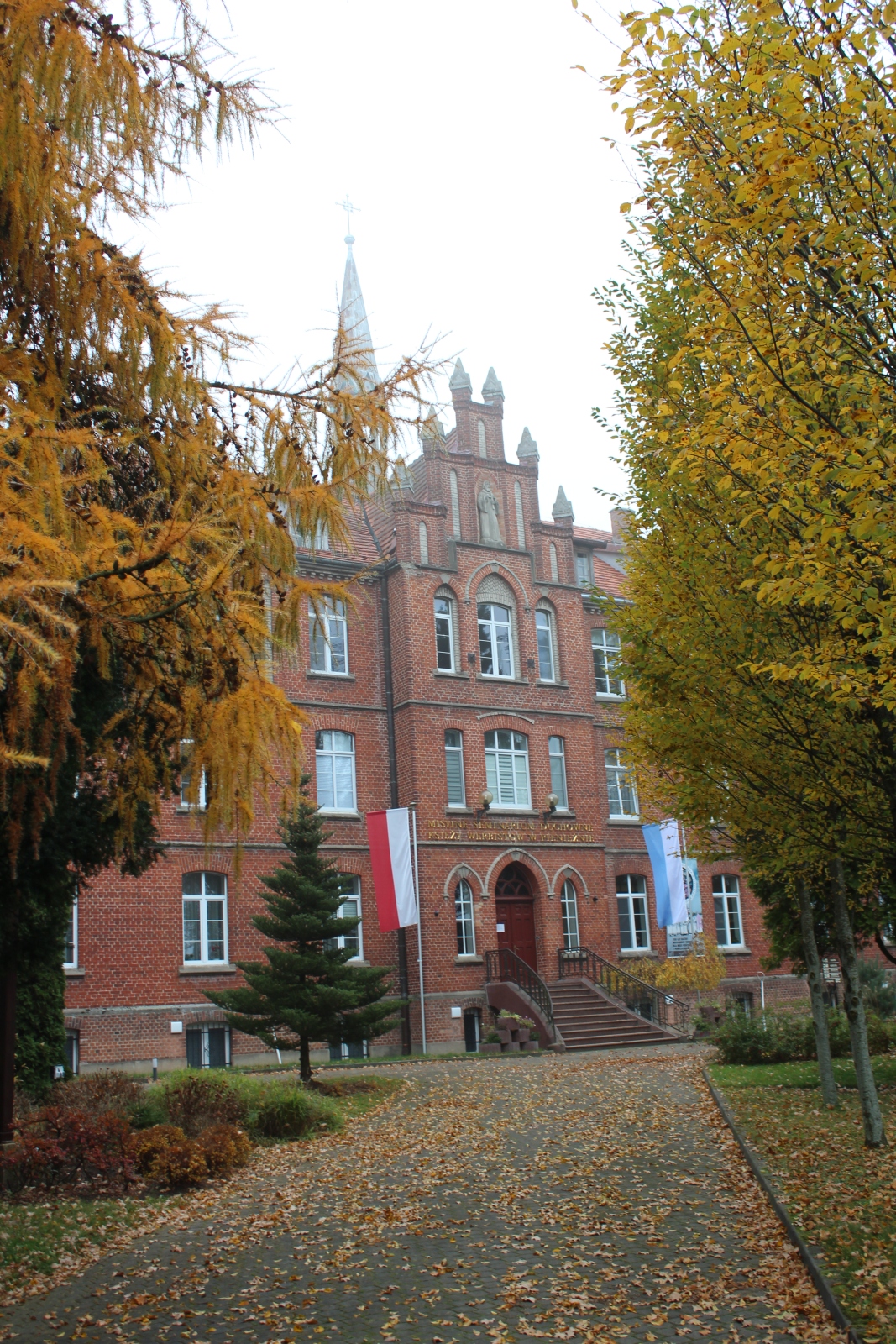
Missionary and Ethnographic Museum of the Verbist Fathers in Pieniężno
General Information
The museum operates in the monastic and seminary building (Major Mission Seminary of the Verbist Fathers in Pieniężno) and possesses the richest and best-developed collection of this type in the country. The permanent exhibition makes it possible to present the richness of the cultures, religions, and traditions of the inhabitants of the countries in which Verbist missionaries work. In 2025 – after several years of renovation – the museum was made accessible in a new form.
Location / Geographical Setting
The museum is located at the address Pieniężno Pierwsze 19 (also Kolonia 19). The monastery and museum are situated outside the compact development of the central part of the town, in the so-called “colony” in the direction of the village of Kajmity. About 1.5 km from the parking area by the monastery there is an entrance to the nature and educational path “Czarci Jar”, leading on one side towards the Chapel of the Nativity, and on the other to the town centre.
History
The Verbist Order was founded by St. Arnold Janssen (1837-1909), who placed particular emphasis on missionary activity and the preparation of young Catholics for it. He considered the lands of Warmia a good place for acquiring candidates; therefore, from as early as 1907 he sought to establish a Verbist institution there. For many years, a suitable place was sought. The estate of the Krüger couple in the locality of Mehlsack proved the most suitable (after the Second World War, the name was changed to Pieniężno, in honour of the Warmian activist Seweryn Pieniężny).
Soon afterwards, the construction of the monastery began. It was built in stages over a period of 10 years: in 1921, the southern wing was erected; in 1924–1925, the eastern wing together with the corner parts of the remaining wings; in 1927–1928, the northern wing; and in 1930–1931, the church together with the adjoining fragments of the building. The patron of the house became St. Adalbert, whose statue is placed at the entrance to the monastery. From the beginning, this place fulfilled a dual role: it supported diocesan clergy and prepared young Catholics for missionary work. After the Second World War, the building was taken over by Polish Verbists. The buildings were seriously damaged and therefore required gradual reconstruction. Until 1948, a minor seminary operated here; then – by decision of the authorities of the order – from the autumn of that same year, Pieniężno became the seat of the Major Seminary of the Verbists.
One of the characteristic elements of Verbist monasteries from the very beginning were small museums or even display cases presenting objects originating from missionary countries. Their aim was to broaden knowledge about distant cultures and arouse interest in missions. Today’s Missionary and Ethnographic Museum in Pieniężno refers to collecting traditions that developed in Polish lands even before the Second World War. In 1930, missionaries opened the first museum in Rybnik, and in the years 1931–1933 another collection was created in Górna Grupa in Pomerania.
During the occupation and post-war period, many exhibits were destroyed or lost. Only in 1964 was it possible to reorganize museum work. The collections were supplemented with surviving objects from Rybnik, Górna Grupa, and Nysa, as well as numerous gifts originating from the private collections of Verbists. The greatest influence on the expansion of the museum, however, came from shipments sent by missionaries working on various continents.
In 1980, the institution received the name Missionary and Ethnographic Museum. Four years later, a space in the monastery’s underground level was opened, where a large permanent ethnographic exhibition was arranged, enriched with natural history exhibits and objects connected with missionary work. After several years of thorough renovation, the museum was reopened in July 2025, presenting its collections in a new form, consistent with the concept of a modern narrative museum.
Collections / Present Condition and Educational Function
Collections
The collections of the Missionary and Ethnographic Museum of the Verbist Fathers in Pieniężno include objects connected with the culture, religion, and Christianity of the countries in which the missionaries of this congregation work. Presented here are both the spiritual and material achievements of the inhabitants of China, Japan, the Philippines, India, Indonesia, Papua New Guinea, as well as various countries of Africa and Latin America. It is the most extensive and best-organized missionary and ethnographic collection in the country.
Among the exhibits are objects connected with everyday life and festivals, as well as elements of traditional rituals and contemporary ethnic art. One may also view objects that have been withdrawn from use due to cultural changes, damage, destruction, or because they served only one-time rituals.
The museum possesses more than 9 thousand processed and catalogued exhibits, which makes it the largest and best-documented collection of this type in Poland. Visitors may see, among other things, working tools, weapons, musical instruments, masks used in ritual dances, as well as historic chasubles and liturgical paraments made of Chinese silk. Among the exceptional objects there are also representations of Christ and Mary shown in ethnic types characteristic of particular regions of the world.
In 2025, a new permanent exhibition was opened, consisting of two complementary displays reflecting the mission and character of the museum. The first, “To Be a Missionary”, has a historical character and presents the origins and ideas of the Verbists, that is, the Society of the Divine Word (SVD). It shows the path travelled by candidates for missions – their formation, preparation, and first experiences in missionary territories. It also presents the most important achievements of the Verbists in fields such as education, formative activity, and medical care. The second, “The Same in a World of Cultural Diversity”, is a permanent ethnographic exhibition showing objects originating from different parts of the world and different cultures. Its principal idea is to emphasize the universal needs and experiences of people which – despite geographical and cultural differences – manifest themselves in similar forms. The exhibition presents objects from different epochs and continents, showing the richness and diversity of human traditions.
Bibliography
- Hiacynta Lorenc, Collections of the Missionary and Ethnographic Museum of the Verbist Fathers in Pieniężno – 50 Years of Activity (Zbiory Muzeum Misyjno-Etnograficznego Księży Werbistów w Pieniężnie – 50 lat działalności), https://werbisci.pl/index.php/czytelnia/zbiory-muzeum-misyjno-etnograficznego-ksiezy-werbistow-w-pienieznie-50-lat-dzialalnosci, [accessed: 15.06.2025].
- Andrzej Miotk, Establishment of the Mission House of St. Adalbert and Its Activity until 1945 (Założenie Domu Misyjnego św. Wojciecha i jego działalność do 1945 r.), “Nurt SVD”, 2020, no. 2, pp. 27–46.
- Missionary and Ethnographic Museum in Pieniężno (Muzeum Misyjno-Etnograficzne w Pieniężnie), https://www.muzeumpieniezno.pl/, [accessed: 15.06.2025].
- Jerzy Skrabania, History of the Mission House of St. Adalbert in Pieniężno until 1945, with Special Consideration of the Period of the Third Reich (Historia Domu Misyjnego św. Wojciecha w Pieniężnie do 1945 r. ze szczególnym uwzględnieniem okresu Trzeciej Rzeszy), “NURT SVD”, 2010, issue 2, pp. 9–48.