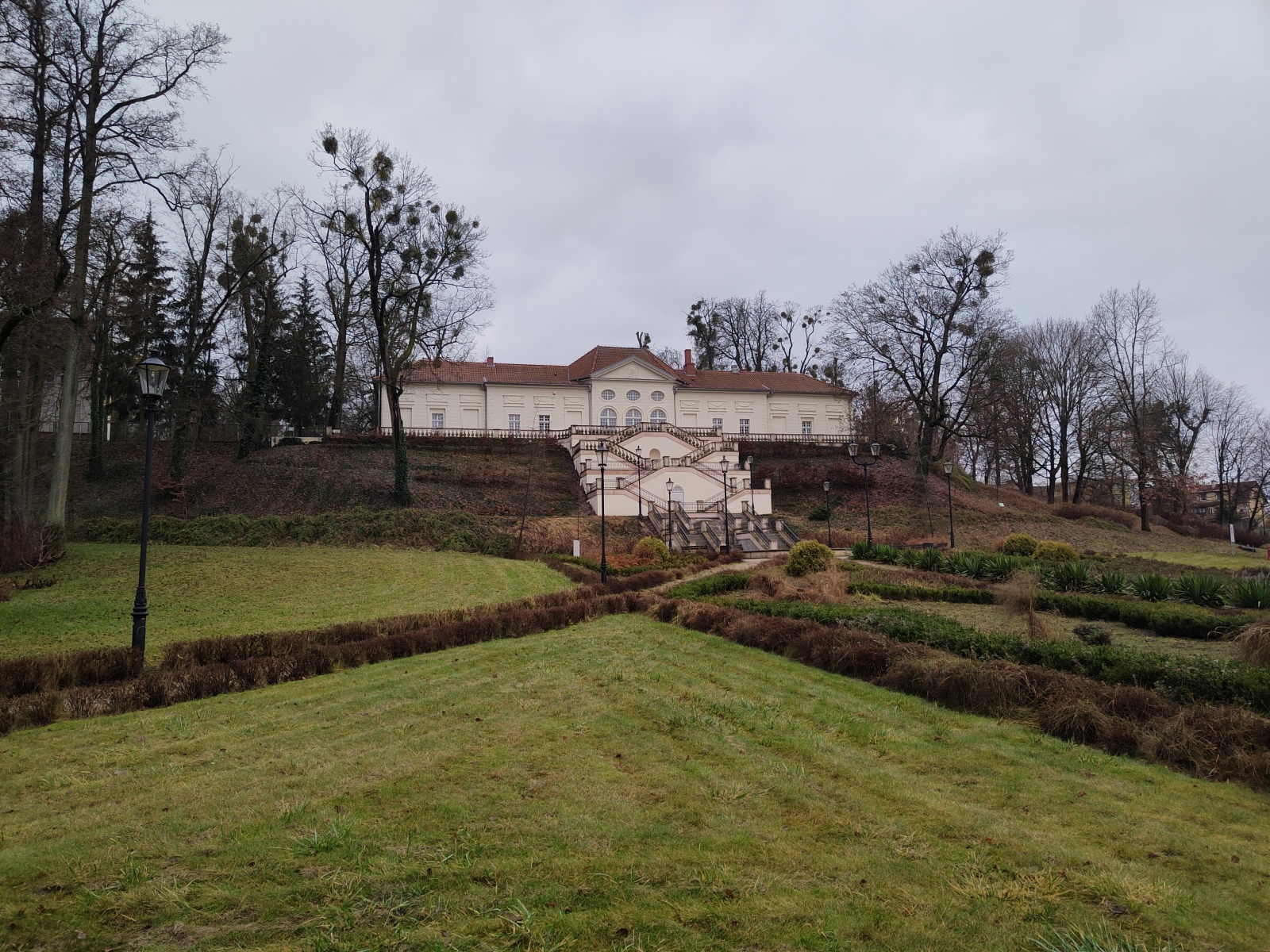
Orangery of Culture in Lidzbark Warmiński
General Information
The Orangery of Culture is a historic garden pavilion – formerly an episcopal orangery, presently fulfilling cultural and educational functions. The building is also known as Krasicki’s Orangery and commemorates one of the former owners of the pavilion.
Location / Geographical Setting
The building is located at 2 Ignacego Krasickiego Street. The orangery stands on the grounds of the former episcopal garden, which extended on the right bank of the Łyna River.
History
The castle gardens of Lidzbark began to be created as early as the fifteenth century and extended by its walls, in the outer bailey, and along the banks of the Łyna. In the first half of the seventeenth century, Bishop Mikołaj Szyszkowski (c. 1590-1643) built a garden leisure pavilion by Lidzbark Castle. A new structure was built by Bishop Jan Stanisław Zbąski (1629-1697), but it was burned and plundered by the Swedes during the Great Northern War in 1704 or 1705. After the end of the Great Northern War in 1721, Bishop Teodor Potocki (1664-1738) erected on a high hill at a distance from the castle a pavilion called an orangery. When Adam Stanisław Grabowski (1698-1766) became bishop, he began work on arranging once again the garden around the castle, into which he brought ornamental plants and trees. Grabowski’s garden did not please the most famous Bishop of Warmia, Ignacy Krasicki (1735-1801), who began great works of ordering it: demolishing and building, planting shrubs, trees, and flowers. Krasicki also marked out paths, planned where fountains should stand, where a stream would run, where secluded arbours would be built, and above all what should be planted in the garden. Lidzbark’s park was adorned with fountains, statues, cascades, ponds, walking alleys, and charming corners for conversation and rest. In the bishop’s greenhouses and orangeries oranges ripened, and in January people feasted on asparagus, plums, and cherries!
Around 1770, Krasicki ordered the expansion of the former orangery. At that time the end rooms were added, oval windows were made in the main hall, and the exterior elevation was unified. The small palace was incorporated into the episcopal garden, surrounded by greenery, cascading stairs, and viewing terraces. After the fall of the Polish-Lithuanian Commonwealth in 1795 and the departure of Bishop Krasicki, Lidzbark Castle and the orangery stood empty and decayed for a long time. In 1859, Bishop Ambroży Geritz (1783-1867) established an orphanage in the castle, while in the orangery partition walls were introduced which disturbed the space. Today, the grounds of the former episcopal gardens extending from the castle to beyond the orangery have been cut through by a broad street, which makes it difficult to imagine their compositional wholeness.
In the post-war period, the building underwent gradual degradation, since the main efforts were focused on rebuilding the ruined town. However, the value of the former garden pavilion was noticed by conservators, and on 17 December 1957 it was entered, together with the surrounding park, in the register of monuments. This made it possible to undertake conservation works in the 1960s, including replacement of the roof, repair of the gutters, and securing of the windows. A thorough revitalization was then carried out in the years 2012–2015. At that time, the layout of the former episcopal garden was recreated, the body of the small palace was restored, the stairs leading to the orangery were reconstructed, and fragments of wall paintings in the central hall were uncovered.
On 12 September 2015, the ceremonious opening of the restored orangery as a place of culture took place. The building fulfils the role of a library (Municipal Pedagogical Library) and a centre of culture, where exhibitions, meetings, and cultural events are held.
Architecture / Architecture and Spatial Layout
Architecture and Furnishings
The garden pavilion, today called the “Orangery of Culture”, was built in the Baroque style, but has been preserved into the present day in a Classical style characteristic of the Stanisław August era. The original arrangement contained a central hall and cabinets on the eastern and western sides. After the expansion in the second half of the eighteenth century, symmetrical orangery rooms were added and the external elevation was changed. In the interiors, in the central hall, there is an uncovered fragment of a wall painting from the time of Bishop Ignacy Krasicki, presenting an allegory of the seasons.
Bibliography
- Roman Doktór, Ignacy Krasicki in the Garden ("Ignacy Krasicki w ogrodzie"), “Prace Filologiczne. Literaturoznawstwo”, 2011, vol. 61, pp. 177-190.
- "History of Lidzbark Warmiński" ("Historia Lidzbarka Warmińskiego"), vol. 1, ed. Krzysztof Mikulski, Eugeniusz Borodij, Lidzbark Warmiński 2008.
- Izabela Lewandowska, Sylwia Szkamruk, "Natural and Cultural Values and Landscape Engineering in Palace and Park Layouts in Warmia and Masuria" ("Walory przyrodniczo-kulturowe i inżynieria krajobrazu przy założeniach pałacowo-parkowych na Warmii i Mazurach"), Olsztyn 2018.
- Krasicki’s Orangery in Lidzbark Warmiński ("Oranżeria Krasickiego w Lidzbarku Warmińskim"), https://funduszfilmowy.warmia.mazury.pl/lokacje-filmowe/oranzeria-krasickiego-w-lidzbarku-warminskim/, [accessed: 22.06.2025].
- Orangery in Lidzbark Warmiński ("Oranżeria w Lidzbarku Warmińskim"), http://leksykonkultury.ceik.eu/index.php/Oran%C5%BCeria_w_Lidzbarku_Warmi%C5%84skim, [accessed: 22.06.2025].
- Joanna Wańkowska-Sobiesiak, Wojciech Krzysztof Szalkiewicz, "On the Trail of Holy Warmia. A Cultural Traveller" ("Na szlaku Świętej Warmii. Podróżnik kulturalny"), Olsztyn 2022.
- From the History of the Orangery ("Z historii Oranżerii"), http://oranzeria.lidzbarkw.pl/historia_oranzeria.html, [accessed: 22.06.2025].