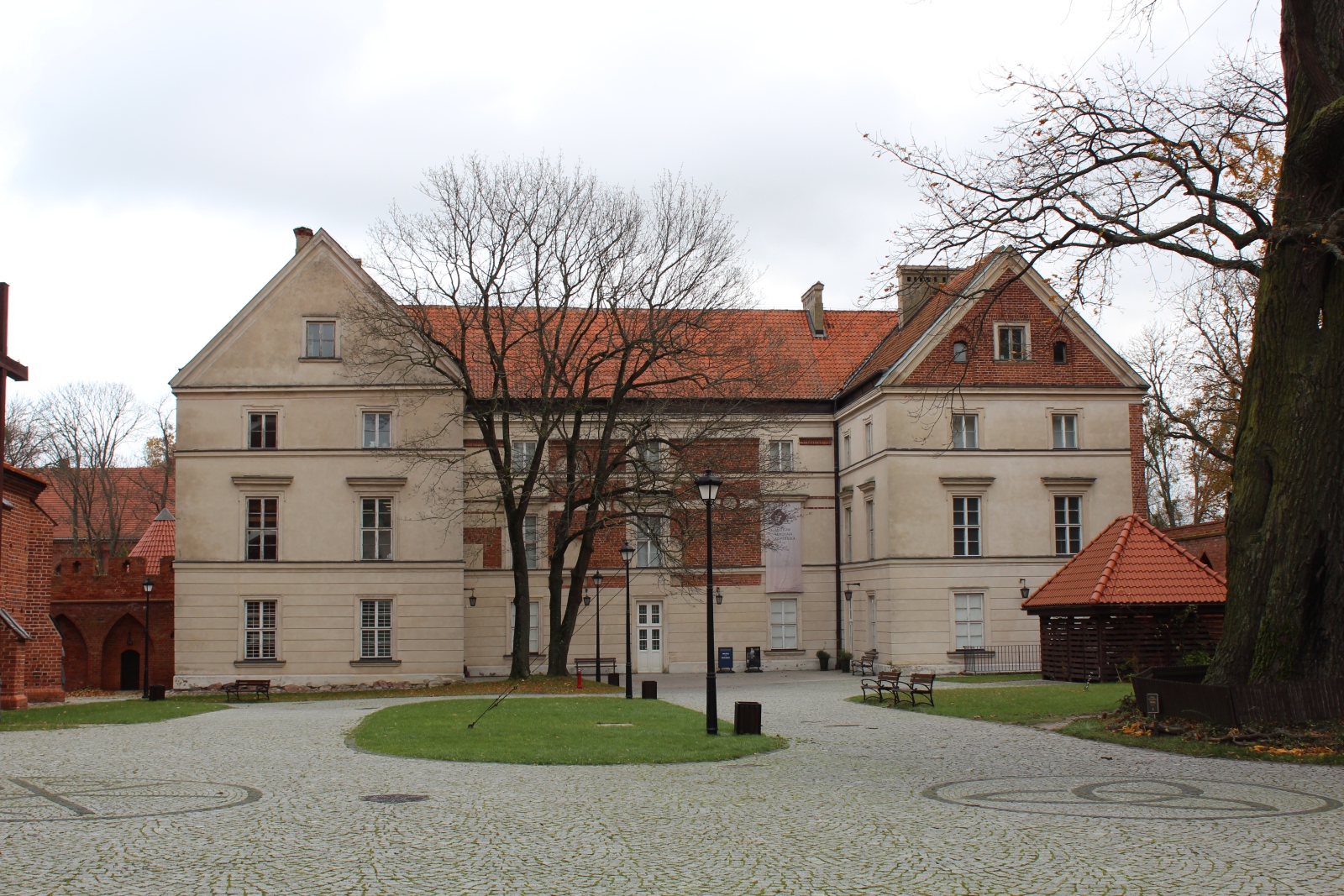
Bishop’s Palace in Frombork
General Information
The Bishop’s Palace in Frombork is one of the representative elements of the fortified Cathedral Hill – an architectural complex unique on a European scale. For centuries this building served as the residence and workplace of the bishops of Warmia. Although it underwent numerous reconstructions, fires, and wartime devastation, the edifice has survived to the present day as a monument of history. Today it houses the Nicolaus Copernicus Museum, serving as a guardian of the memory of the great astronomer, who spent nearly thirty years of his life on Frombork’s hill.
Location
The monument rises in the south-eastern part of Cathedral Hill, picturesquely situated on the shore of the Vistula Lagoon. The palace is an integral part of the Frombork stronghold, directly adjoining the monumental Archcathedral Basilica of the Assumption of the Blessed Virgin Mary and St Andrew the Apostle. Due to its elevated position, the windows and terraces of the palace offer views of the town, the waters of the lagoon, and the Vistula Spit.
History
The beginnings of the episcopal residence in Frombork date back to the mid-fourteenth century. Originally it was a building of the cathedral school, erected at that time as the south-eastern corner tower of the defensive walls, which was destroyed during the Thirteen Years’ War (1454-1466). The structure initially had a defensive character, adapted to the realities of a troubled Middle Ages. At the end of the fifteenth century it served as the dean’s house, which was extended westwards. From 1498 the building functioned as the temporary residence of Bishop Łukasz Watzenrode (1447-1512). On the initiative of Bishop Maurycy Ferber (1471-1537), from 1526 it became the residence of the bishops of Warmia. During the seventeenth-century wars with Sweden, the palace was devastated and plundered by Swedish troops, and in 1630 it was consumed by fire. Bishop Jan Stefan Wydżga (1610-1685) rebuilt it in 1666. In the following decades the palace was expanded. The building underwent its greatest transformation in the eighteenth century. In the years 1727-1728, on the initiative of Bishop Krzysztof Andrzej Szembek (1680-1740), the palace was enlarged by adding the north-western risalit on the site of the former kitchen and the interior was rebuilt. Further reconstructions and renovations took place in the years 1767-1795 and in 1841-1842. In 1850 the palace was adapted for the offices of the diocesan curia.
In 1945, during the Red Army offensive, the palace shared the tragic fate of the whole of Frombork – it was completely burnt out, and of the powerful residence only bare, blackened perimeter walls remained, which were secured in 1956. The great, meticulous reconstruction carried out in the years 1965–1969 restored the building to its former splendour, adapting it into the main exhibition halls of the dynamically developing Nicolaus Copernicus Museum.
Architecture
The architecture of the palace is a multi-layered collage of styles – from medieval Gothic through mature Baroque to nineteenth-century Neo-Gothic with modern interiors. It is a three-storey, basemented building, with the front elevation facing west, built of red brick and covered with a high ceramic gable roof. The body of the palace is asymmetrical, revealing its multi-phase building process. As a result of post-war conservation works, the elevations are not uniform. The front elevation is decorated with large, rhythmically arranged windows and decorative cornices. Of particular note is the eastern part of the building, which displays clear features of Gothic defensive walls. Former defensive towers are incorporated into the structure of the palace.
As a result of the post-war reconstruction, the interiors acquired a modern exhibition character, yet the architects managed to preserve and expose former structural divisions, massive pillars, and fragments of former vaults, creating a unique dialogue between modern museology and the spirit of former centuries. It is worth adding that in the southern part of the basement a fragment of the central heating furnace from the end of the fifteenth century has been preserved.
Furnishings
The original luxurious interior furnishings were completely destroyed or looted in 1945. Today the furnishings of the palace consist of the valuable collections of the Nicolaus Copernicus Museum, displayed in permanent and temporary exhibitions. In the palace halls one may admire unique historical astronomical instruments, including replicas of the instruments used by Copernicus: compasses, quadrant, and astrolabe, as well as early, rare editions of the work "De revolutionibus..." Rich permanent exhibitions have also been arranged in the building, presenting old sculpture and sacral painting of Warmia, artistic craftsmanship, stained glass, and a rich numismatic collection.
Curiosities
Although the building is called the Bishop’s Palace, Nicolaus Copernicus, as a trusted diplomat and physician, was a frequent guest in the palace.
The final opening of the Bishop’s Palace, reconstructed from ruins, for museum use took place in 1973. This date was not accidental – it coincided with the grand international celebrations of the 500th anniversary of the birth of Nicolaus Copernicus, the so-called Copernican Year.
Bibliography
- Former Bishop’s Palace, https://www.frombork.pl/main/pl/artykul/dawny-palac-biskupi, [accessed: 25.08.2025].
- History of the museum, https://muzeumkopernika.pl/historia-muzeum/, [accessed: 25.08.2025].
- "Katalog zabytków sztuki w Polsce. Seria nowa, t. 2: Województwo elbląskie, z. 1: Braniewo, Frombork, Orneta i okolice", prepared by Marian Arszyński and Marian Kutzner, ed. Jerzy Z. Łoziński, Barbara Wolff-Łozińska, Warszawa 1980, pp. 89-91.
- Nicolaus Copernicus Museum in Frombork, http://leksykonkultury.ceik.eu/index.php/Muzeum_Miko%C5%82aja_Kopernika_we_Fromborku, [accessed: 25.08.2025].
- Ferber Palace, https://zabytek.pl/pl/obiekty/g-228496, [accessed: 25.08.2025].
- Piaskowski Tadeusz, Szkop Henryk, "Monuments of Frombork", Frombork 2003, pp. 24-26.