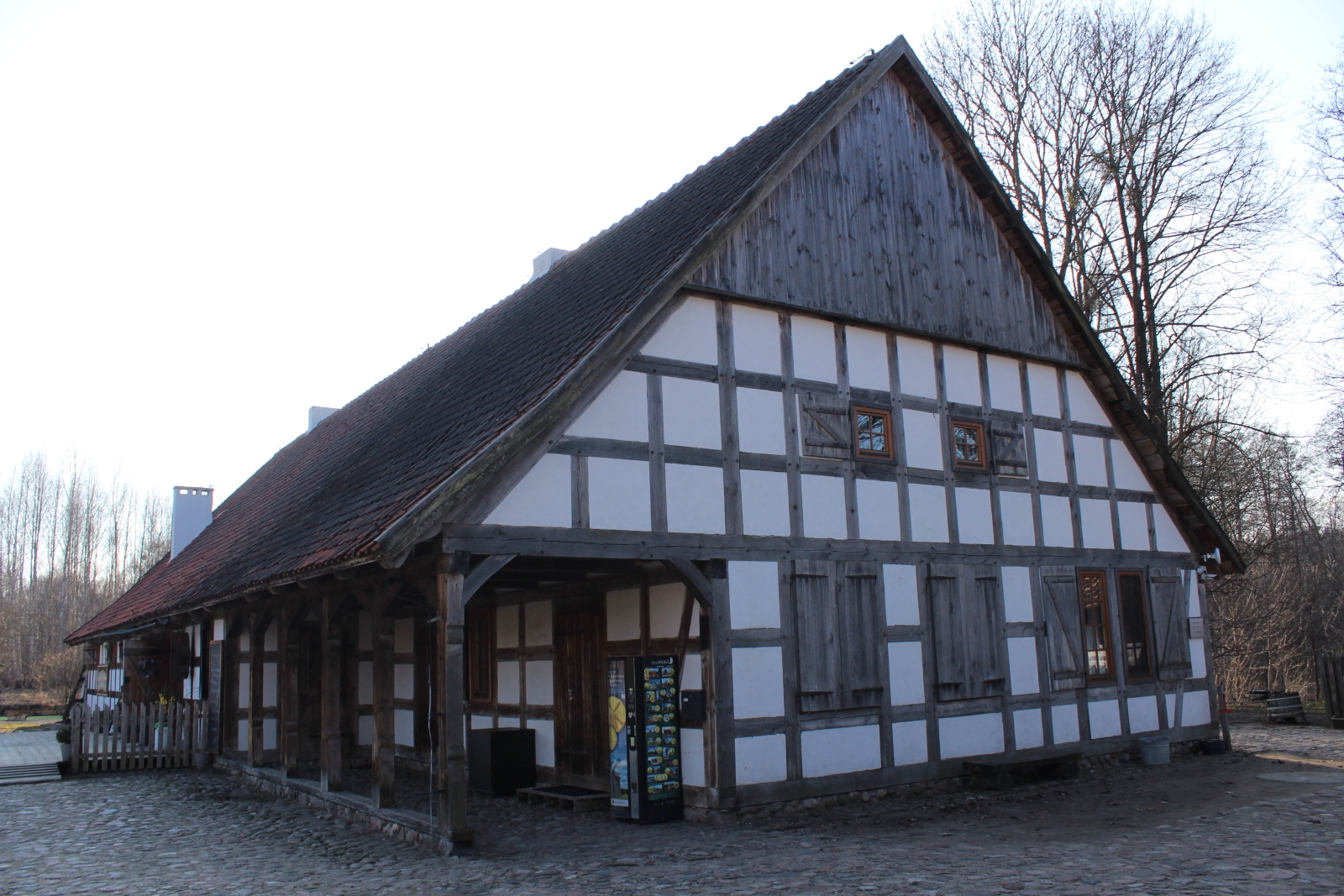
Museum of Folk Architecture – Ethnographic Park in Olsztynek
General Information
The Museum of Folk Architecture – Ethnographic Park in Olsztynek is one of the oldest open-air museums in Poland, presenting the traditional folk architecture of Warmia, Masuria, and Powiśle. It was established at the beginning of the twentieth century in Königsberg as an open-air museum. Numerous objects are gathered within the park, including cottages, barns, windmills, churches, and farm buildings, transferred from various places in the region and illustrating the former life of the countryside. As a cultural institution of the Self-Government of the Warmian-Masurian Voivodeship, the open-air museum performs educational and tourist functions, organising exhibitions, workshops, and folkloristic events.
Geographical Location
The Ethnographic Park of the Museum of Folk Architecture in Olsztynek is located at 23 Leśna Street.
History
The origins of the Museum of Folk Architecture date back to the beginning of the twentieth century. On 24 October 1907 or 1909, a meeting was held in Königsberg attended, among others, by the general conservator of the province of East Prussia, Richard Dethlefsen (1864-1944), and the director of the Prussia-Museum in Königsberg, Adalbert Bezzenberger (1851-1922). A decision was then taken to establish a museum of rural architecture intended to present the building traditions and folk culture of the area of East Prussia. Originally, the objects were planned to be placed on the outskirts of the zoological garden in Königsberg. In the years 1911-1913, 26 replicas of residential, sacral, farm, and industrial buildings were erected there, referring to the traditional architecture of the regions comprising East Prussia. The museum, named Ostpreußisches Heimatmusem, was opened in 1913, and its first director was Richard Dethlefsen. In the 1930s, the name was changed to Freiluftmuseum der Proviz Ostpreußen. The collections of the museum were constantly expanding, and due to the limited space in the Königsberg zoo, a decision was taken in 1937 to move the collection to Olsztynek, where an area of 30 ha was obtained. This place was considered attractive because of the proximity of the Hindenburg Mausoleum, which attracted numerous tourists. The process of transferring the buildings lasted from 1938 to 1942, although not all planned buildings were successfully moved. By 1943, 17 objects had been reconstructed. In contrast to Olsztynek, which suffered serious war damage at the beginning of 1945, the museum survived this period without major losses. In the mid-1950s, the securing of the collected objects began under the supervision of the Voivodeship Conservator of Monuments in Olsztyn. At the end of the 1950s, the gradual expansion of the museum began.
In 1962, the institution was transformed into an Ethnographic Park, functioning as a branch of the Museum of Warmia and Mazury in Olsztyn, and in 1969 it obtained the status of an independent institution as the Museum of Folk Architecture – Ethnographic Park. In 1985, two urban institutions were incorporated into the structure of the open-air museum: an exhibition hall in the former Evangelical church and the tower of the defensive walls, in which an exhibition devoted to Krzysztof Celestyn Mrongowiusz is presented.
In 1998, the museum became a cultural institution of the Self-Government of the Warmian-Masurian Voivodeship, and in 2008 it was entered into the State Register of Museums maintained by the Minister of Culture and National Heritage, which confirmed its significance as one of the most important institutions presenting the folk heritage of the region.
Site
Today the open-air museum occupies an area of 35 ha, on which 76 historic objects from Warmia, Masuria, Powiśle, and Lithuania Minor have been assembled. They form an extensive ethnographic park with rich collections of material folk culture (11 thousand movable museum objects), and the institution also conducts exhibition and educational activities and organises open-air events popularising the traditions of the former countryside.
On 25 August 2001, the Festival of the International Camp “Rainbow Bridge” was organised in the Olsztynek open-air museum under the patronage of Jolanta Kwaśniewska. Distinguished guests took part in the event, including the President of Poland Aleksander Kwaśniewski, the Brazilian writer Paulo Coelho, and the Israeli politician Shimon Peres.
Bibliography
- Bałdowski Jan, "Warmia, Mazury, Suwalszczyzna. Przewodnik", Warszawa 1996, pp. 67-71.
- Cygański Janusz, "Muzeum Budownictwa Ludowego. Park Etnograficzny w Olsztynku", Olsztynek 1987.
- Darmochwał Tomasz, Rumiński Marek Jacek, "Warmia, Mazury. Przewodnik", Warszawa 2003, pp. 26-31.
- [Dudzik Marian], "Olsztynek i okolice", Warszawa 1976, pp. 2-14.
- Gruszkiewicz Ryszard, Kuźniewski Bogumił, "Olsztynek w fotografii", Olsztynek 1999.
- Klonowski Franciszek, "Park Etnograficzny w Olsztynku", Olsztyn 1966.
- Kuźniewski Bogumił, "Olsztynek. Miasto i gmina", Olsztynek 2007, pp. 51-120, 172-186.
- Kuźniewski Bogumił, "650 lat Olsztynka", Olsztynek 2009.
- Museum of Folk Architecture – Ethnographic Park in Olsztynek, https://muzeumolsztynek.pl/, [accessed: 31.08.2025].
- "Muzeum Budownictwa Ludowego Park Etnograficzny w Olsztynku", [ed. Ewa Wrochna], Olsztynek 2015.
- Orłowicz Mieczysław, "Ilustrowany przewodnik po Mazurach Pruskich i Warmji", Lwów-Warszawa 1923, pp. 181-182.
- "Śladami Mikołaja Kopernika/In the Footsteps of Nicolaus Copernicus/Auf den Spuren von Nicolaus Copernicus", introduction by Jerzy Sikorski, Lidzbark Warmiński 2022, p. 29.
- Töppen Max, "Historia okręgu i miasta Olsztynka", trans. Magdalena Sacha, prepared by Grzegorz Białuński and Grzegorz Jasiński, Dąbrówno 2004, pp. 18-122.
- "Warmia i Mazury. Przewodnik", prepared by Szymon Drej, Jarosław Swajdo, Olszanica 2008, pp. 91-96.
- [Wieczerzak Jadwiga, Wroniszewska Maria], "Historia Muzeum w różnych odsłonach, 1913-2013. Katalog wystawy", Olsztynek 2013.