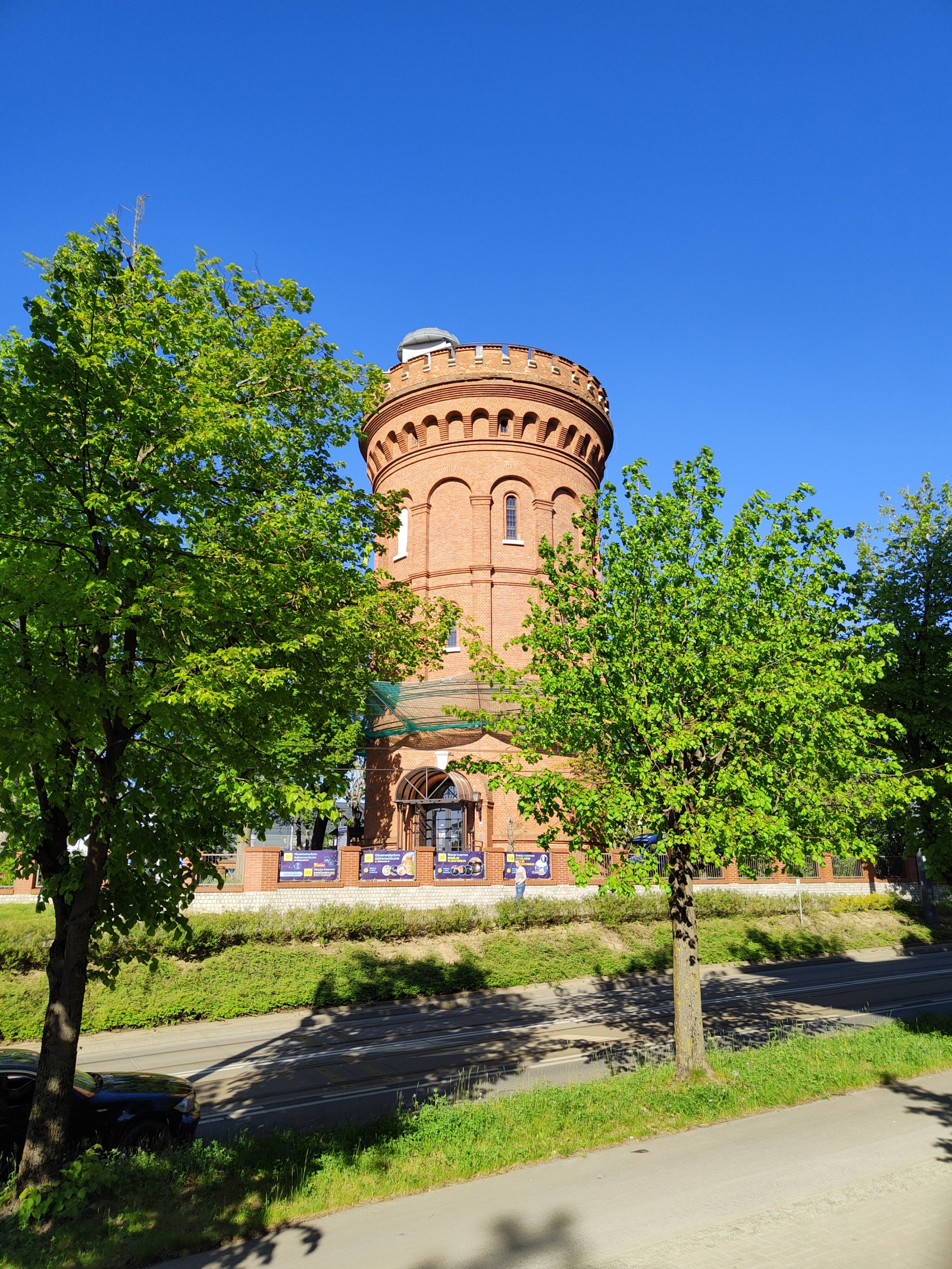
Astronomical Observatory in Olsztyn
General Information
The Astronomical Observatory is one of the most important scientific and educational institutions in the region. Together with the nearby planetarium, it forms a unique complex. The observatory serves both astronomers, who conduct professional observations of celestial bodies and track satellites, and the public, who during night-sky shows can admire the beauty of the universe. The water tower in which the observatory is housed is a valuable monument of industrial and engineering architecture entered in the register of monuments.
Location
The observatory is located at 13 Żołnierska Street, rising on the highest natural elevation of old Olsztyn – the so-called St Andrew’s Hill (approx. 143 m above sea level). At the beginning of the twentieth century, such a location had a dual justification – for hydrotechnical reasons it allowed the city to be supplied with water by gravity, while from the point of view of modern astronomy it ensured excellent observation conditions, raising the telescopes above the roofs of the city buildings.
History
The history of the Olsztyn observatory is an example of the successful adaptation of former municipal architecture to modern scientific and popularising purposes. The building was originally constructed as a municipal water tower, erected in the years 1897–1899 as part of the construction of the modern Olsztyn water supply system. For several decades its interior contained a gigantic water tank with a capacity of about five hundred cubic metres. With time, together with the expansion of the city, the tower lost its technological significance and was taken out of use.
The city authorities – thanks to the efforts of Zbigniew Gałecki, an employee of the then Planetarium of Space Flights – decided to save the monument by giving it a new function. The adaptation works were completed with the ceremonial opening of the Astronomical Observatory on 13 October 1979. In the following decades, the building was systematically equipped with modern optical instruments and computers enabling the automation of observations and the inclusion of the institution in international research programmes, including the monitoring of artificial Earth satellites.
After renovation in 2008, the building became a laureate of the Zabytek Zadbany competition announced by the Minister of Culture and National Heritage, and in the following year it was included on the list of 36 nominated objects in the regional plebiscite “Perły w Koronie” of the Warmian-Masurian Voivodeship.
Architecture
The observatory building is a work of engineering architecture with distinct Neo-Gothic elements. The tower was erected on a circular plan and takes the form of a soaring brick cylinder crowned with decorative battlements. The elevation of red clinker brick is richly decorated. Particularly noteworthy are the regularly arranged narrow windows and ornamental arcaded friezes.
The tower is 23 m high (from the ground to the viewing terrace) and has a diameter of about 8 m at the base. Its walls up to the first floor are more than 1.5 m thick, and from the second floor to the top about 90 cm thick. This difference was dictated by the greater pressure exerted on the lower part by the weight of the water collected in the tank.
During the modernisation in the 1970s, the old riveted water tank was removed from the interior and replaced with several usable storeys. The most important architectural change took place at the very top of the tower – the former conical roof was replaced with a rotating metal observation dome with a diameter of 4 m, allowing the telescopes to be directed in any direction of the world. In order to reach the tower, one must climb 138 stairs.
Furnishings
The transformation of the tower into a scientific institution required the installation of precise astronomical instruments, which over the years were systematically modernised. Under the dome of the observatory there is a modern computer-controlled Schmidt-Cassegrain telescope (Meade LX200) with a diameter of 25 cm, complemented by a refractor with specialist H-alpha filters for safe, direct observations of sunspots and solar flares.
The institution has a smaller radio telescope that makes it possible to listen to and record radio noise coming from the Milky Way and solar activity, regardless of weather conditions and cloud cover.
On the lower storeys of the tower, exhibition rooms have been arranged. One of the most valuable elements of the exhibition equipment is a unique and rich collection of meteorites. Visitors can see authentic fragments of cosmic rocks.
The observatory also opens its laboratories to visitors, such as the time service and cosmic radiation laboratory, where one can closely examine the instruments used in astronomy. Among them is the Shortt clock, the most accurate mechanical timekeeper ever constructed, as well as a radio clock that receives solar time signals.
Curiosities
Apart from astronomical observations, the tower offers one of the best viewpoints in Olsztyn. From the external gallery encircling the top of the tower, just below the dome, in good weather one can admire a breathtaking panorama of the entire city, its numerous lakes, and the surrounding forest complexes.
Bibliography
- Biała Jadwiga, "Meteorites in the Olsztyn Planetarium and Astronomical Observatory", “Postępy Astronomii”, 1995, vol. 43, no. 1, pp. 30-32.
- Biała Jadwiga, "Olsztyn Planetarium and Astronomical Observatory", Olsztyn 1995.
- Astronomical Observatory, https://visit.olsztyn.eu/place/220/obserwatorium-astronomiczne, [accessed: 12.07.2025].
- Olsztyn Planetarium and Astronomical Observatory, http://leksykonkultury.ceik.eu/index.php/Olszty%C5%84skie_Planetarium_i_Obserwatorium_Astronomiczne, [accessed: 12.07.2025].
- Planetarium and Astronomical Observatory, https://olsztyn.eu/kultura/instytucje-miejsca-pelne-kultury/planetarium-i-obserwatorium-astronomiczne.html, [accessed: 12.07.2025].
- Water Tower in Olsztyn, http://leksykonkultury.ceik.eu/index.php/Wie%C5%BCa_Ci%C5%9Bnie%C5%84_w_Olsztynie, [accessed: 12.07.2025].
- Visiting the laboratories, https://planetarium.olsztyn.pl/o-obserwatorium, [accessed: 12.07.2025].