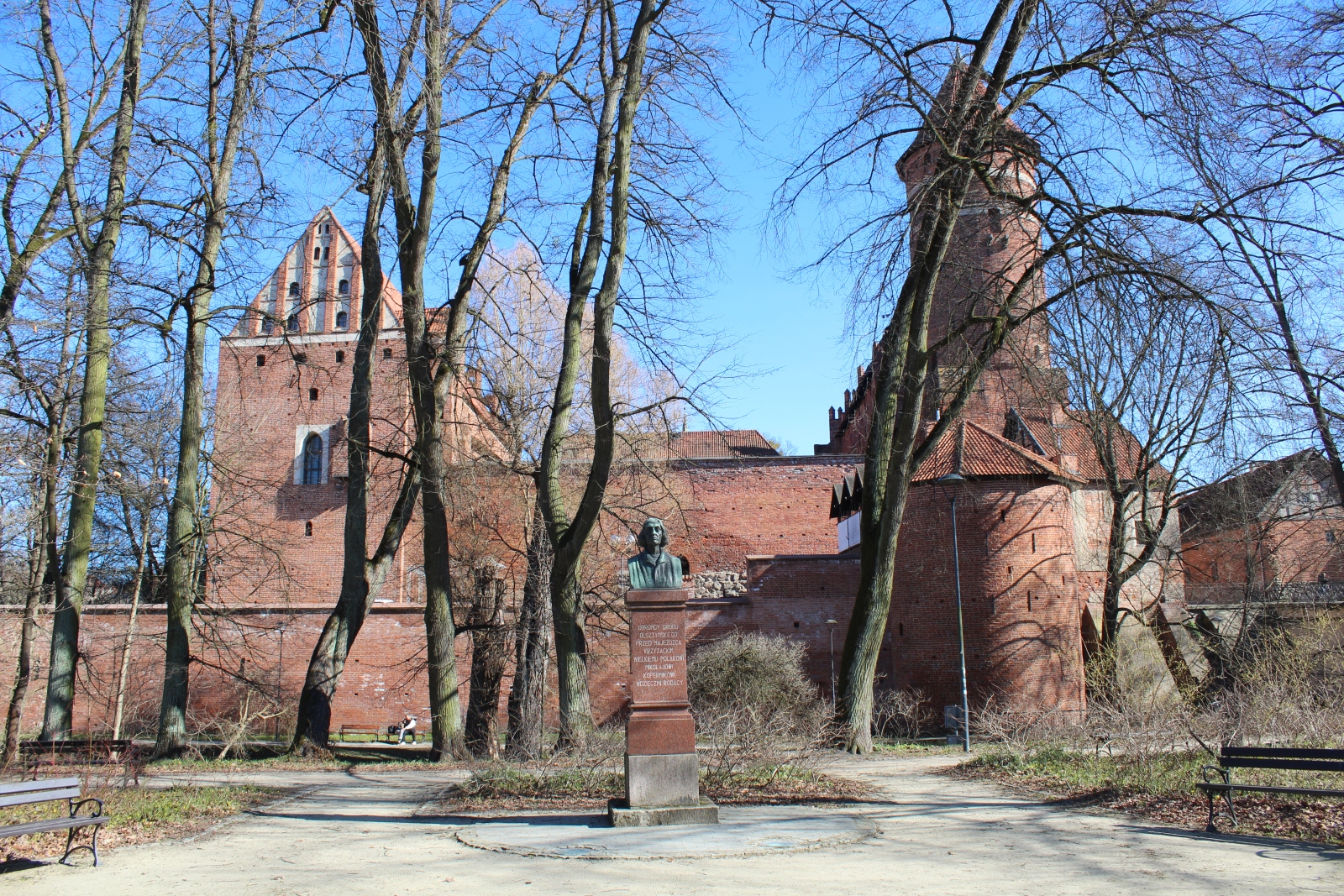
Nicolaus Copernicus Monument in Olszyn
General Information
The bust of Nicolaus Copernicus in Podzamcze Park in Olsztyn is the oldest surviving Olsztyn monument dedicated to the astronomer and one of the most important elements of the city’s Copernican landscape of memory. The author of the sculpture was Johannes Götz (1865-1934), a Berlin sculptor active at the turn of the nineteenth and twentieth centuries. The monument takes the form of a bronze bust set on a granite pedestal; originally, it formed part of a more elaborate architectural composition with a canopy supported on pillars. The object was entered into the register of monuments in 1997, which confirms its artistic, historical, and landscape value.
Location / Geographical Setting
The bust is located in Podzamcze Park on the Łyna River, in the immediate vicinity of the Castle of the Warmian Chapter. The present-day location is described as the area in front of the castle, by the bridge over the Łyna, on a riverside square opposite the building at 5 Zamkowa Street.
History
The initiative to erect the monument came from the Olsztyn City Council during the period when the city belonged to East Prussia. The decision to build it was taken in 1913, on the 440th anniversary of the astronomer’s birth. The official conservation note of the city states that the bust was unveiled on 9 November 1916. The author of the bust was Johannes Götz – a German sculptor associated with the representative art of the German Empire. He was not a local artist, but a creator functioning within the sphere of official German art, thus the commissioning of the bust from him by the city authorities indicates that they intended to commemorate Copernicus in a representative and artistically prestigious form.
Originally, the bronze bust stood before the castle embankment, on a pedestal sheltered by an architectural canopy supported on pillars. Such a solution gave the monument a more representative character and situated it by one of the important approaches to the castle. The monument thus formed a kind of gate of memory leading towards the place where Copernicus lived and worked as administrator of the estates of the Warmian Chapter.
Before the entry of the Red Army into Olsztyn in January 1945, the bust was dismantled and transferred to the castle. After the Second World War, together with the change in the state affiliation of Warmia and Olsztyn, the monument was moved to the western side of the castle, to Podzamcze Park (1946). Its pedestal was also changed and given a new inscription in Polish: “To the defender of the stronghold of Olsztyn against the Teutonic invader. To the great Pole Nicolaus Copernicus, grateful Poles.” The post-war change of location and inscription had significant symbolic importance. The pre-war monument, instead of being removed as an element of the German urban space, was incorporated into a new historical narrative. Copernicus was presented here not only as an astronomer, but also as the defender of Olsztyn and a figure connected with the Polish tradition of Warmia. Thanks to this, the monument became an example of the transformation of earlier material heritage through the assignment of new meanings to it.
In the second half of the twentieth century, the bust became established as one of the principal points in the Copernican topography of Olsztyn. Its significance was reinforced by the neighbouring castle, in which Copernicus’s astronomical table has been preserved and where museum exhibitions devoted to the astronomer were developed. Its entry in the register of monuments in 1997 sanctioned the rank of the monument as a historic object of municipal and regional significance.
In 2021, the bust was damaged as a result of vandalism – it was thrown down from its pedestal in Podzamcze Park. After the event, the sculpture underwent conservation work: its surface was cleaned, corroded mounting elements were removed, and new mounting protections were made. After the completion of renovation, the monument returned to its pedestal in August 2021.
At present, the bust of Nicolaus Copernicus is an object layered with meanings. As a sculptural work, it represents the academic tradition of monumental portraiture of the early twentieth century; as an urban monument, it documents the pre-war culture of memory in Olsztyn; as a monument with a post-war inscription, it testifies to the reinterpretation of the heritage of Warmia after 1945.
Description
The bust was cast in bronze and set on a high, four-sided pedestal made of red granite with a matte texture. The artist depicted the scholar in mature age, with characteristic long hair. Copernicus’s face has an expression of deep concentration and gravity, and his gaze is directed slightly upward – towards the sky, which directly symbolizes his astronomical passion.
On the front of the granite pedestal, the commemorative inscription was carved: Defender of the stronghold of Olsztyn against the Teutonic invader. To the great Pole Nicolaus Copernicus, grateful compatriots.
Bibliography
- Johannes Gottfried Götz, "Bust of Nicolaus Copernicus, bronze, granite pedestal, 1914/1916, Podzamcze Park in Olsztyn, entry into the register of monuments 1997" ("Popiersie Mikołaja Kopernika, brąz, postument granitowy, 1914/1916, Park Podzamcze w Olsztynie, wpis do rejestru zabytków 1997").
- Joanna Kiewisz-Wojciechowska, The Oldest Monument to Nicolaus Copernicus in Olsztyn Returned to Podzamcze Park ("Najstarszy pomnik Mikołaja Kopernika w Olsztynie wrócił do Parku Podzamcze"), https://dzieje.pl/dziedzictwo-kulturowe/najstarszy-pomnik-mikolaja-kopernika-w-olsztynie-wrocil-do-parku-podzamcze, [accessed: 12.10.2025].
- Izabela Lewandowska, Warmia and Masuria as a Palimpsest, or on Taming the Former German Space after the Second World War ("Warmia i Mazury jako palimpsest, czyli o oswajaniu poniemieckiej przestrzeni po drugiej wojnie światowej"), “Studia z Geografii Politycznej i Historycznej”, 2018, vol. 7, pp. 189–206.
- Barbara Ohm, "Johannes Götz 1865–1934. Bildhauer in Fürth und Berlin", Fürth 2008.
- "Olsztyn. Sculptures and Monuments. The Old Town and Its Surroundings" ("Olsztyn. Rzeźby i pomniki. Stare Miasto i okolice"), Olsztyn 2021/2022.
- Bust of Nicolaus Copernicus in Olsztyn ("Popiersie Mikołaja Kopernika w Olsztynie"), http://leksykonkultury.ceik.eu/index.php/Popiersie_Miko%C5%82aja_Kopernika_w_Olsztynie, [accessed: 12.10.2025].
- Emilia Sukertowa-Biedrawina, The Copernican Exhibition in Olsztyn in 1946 ("Wystawa Kopernikowska w Olsztynie w 1946 r."), “Komunikaty Mazursko-Warmińskie” 1966, no. 1, pp. 172–177.