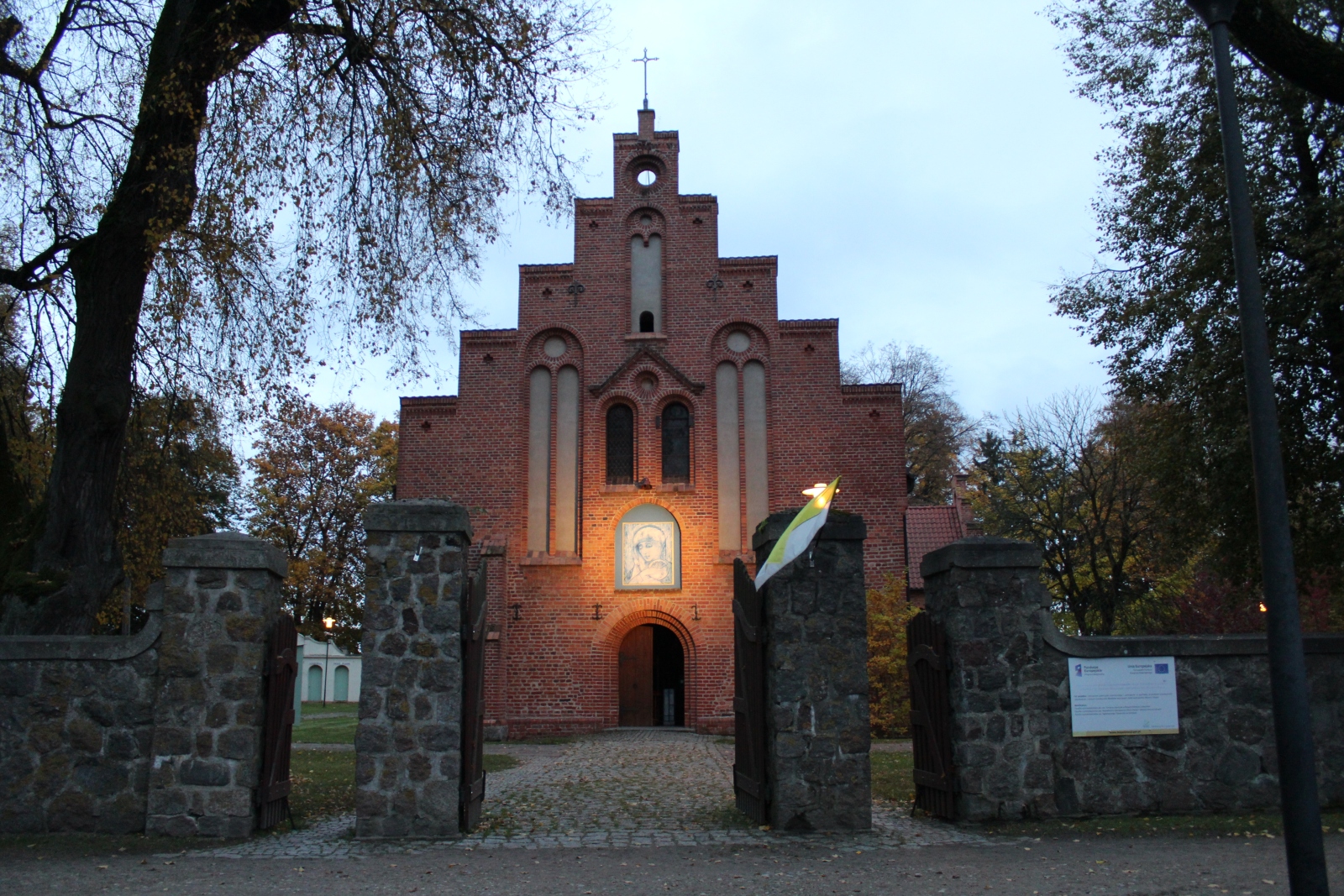
Sanctuary of Our Lady of Lipsk in Lipy
General Information
The Sanctuary of Our Lady of Lipsk in Lipy is one of the oldest and most important Marian pilgrimage sites in the Diocese of Toruń, whose traditions reach back to the thirteenth century. The history of the sanctuary is based on the symbiosis of two places – the Neo-Gothic church in Lipy and the parish church of the Visitation of the Blessed Virgin Mary and Saint Anne in nearby Lubawa.
Location / Geographical Setting
The sanctuary is situated less than 3 km east of the centre of Lubawa.
History
As researchers of the history of the region report, in a beautiful pagan linden grove, in pre-Teutonic times, but also in the later Middle Ages, the Prussians offered sacrifices, held feasts, and celebrated pagan games. In a legend preserved in oral tradition, it was recalled that during the preaching of the Gospel to the Sasins by the missionary Bishop Christian of Prussia, the Mother of God appeared in the holy pagan grove in Lipy, standing over a stream. Others report that a strange brightness appeared around the crown of an old linden tree regarded as sacred. Afterwards, a figurine of Mary with the Child Jesus in her arm was found there. After the conversion to Christianity of a Prussian prince (or magnate) named Surwabuno, with the support of Bishop Christian, this holy figurine was transferred to the parish church in Lubawa, but it miraculously returned to Lipy. This miracle was repeated several times. Then the sacred grove was cut down and a small chapel was built there for the miraculous figurine, while the figurine itself was placed in the church in Lubawa, out of fear of its destruction in the remote grove. It was then promised that each year the figurine would be carried to Lipy and venerated in the chapel built for it.
A nineteenth-century teacher and local historian recorded this in the Lubawa chronicle: “The Mother of God in Lipy seemed to support especially the rural population. She gave good weather, refreshing rain, and protected against storms, hail, and other misfortunes. Even the water in the little river flowing through Lubawa was attributed to the great goodness of Mary. In sickness the Blessed Virgin was the best helper. To her went all the blind, the deaf, and the crippled.”
For several centuries the faithful could not afford to build a brick chapel in Lipy. Only in 1620 (others state 1656) was it founded by the Mortęski sisters. The chapel was surrounded by a fence, possessed three altars and a small organ. After it was set on fire by a dissenter in 1861, a Neo-Gothic church was erected in 1870 and given the invocation of the Visitation of the Blessed Virgin Mary, and it remains a pilgrimage site to this day. Several years later (1883), a bronze plaque commemorating the relief of Vienna by John III Sobieski was built into the northern wall of the church.
After the Second World War, on 1-2 July 1945, the first post-war indulgence of the Visitation of the Blessed Virgin Mary took place in Lipy with the participation of numerous faithful (as evidenced by the distribution of 4000 Holy Communions). Two years later, megaphones were used for the first time during the indulgence in Lipy, and in 1948 a bell from 1737 weighing 320 kg was installed in the church tower.
In 1952, an open-air altar was built on the grounds of the sanctuary, and on 2 July 1969 the image of Our Lady of Lipsk was crowned on the feast of the Visitation of the Blessed Virgin Mary. The coronation was performed by Cardinal Stefan Wyszyński (1901-1981), concelebrating with more than a dozen bishops. In 2009, a large illuminated cross and a gate with a mosaic depicting the Mother of God with the Child were made in Lipy.
At present, the Renaissance figurine, 30 cm in height, which was a gift of the Bishop of Chełmno Piotr Kostka (d. 1595), is kept in the Church of the Visitation of the Blessed Virgin Mary and St. Anne in Lubawa, in the Mortęski Chapel. Every year on 1 and 2 July the figurine is carried to the sanctuary in Lipy on the feast of the Visitation of the Blessed Virgin Mary. The figurine is displayed on the altar during the service for pilgrims. It is carried around the altar with candles lit in hand, just as was done in former centuries during wars and natural disasters. The figure of the Mother of God and the Child is covered with silver-gilt metal robes which conceal the whole sculpture. The Madonna is turned with her face towards the Child looking at her. Numerous votive offerings of thanksgiving for graces and miraculous healings in Lipy confirm faith in the intercession of the Mother of God. The oldest votive offerings date from the sixteenth century; they are made of silver and gold, in various shapes and forms. They testify to the graces received in the sanctuary.
Architecture / Architecture and Spatial Layout
The Church of the Visitation of the Blessed Virgin Mary was built in the Neo-Gothic style, referring to the traditional Pomeranian brick architecture. It is an oriented, single-nave structure with a distinct chancel. The church is picturesquely set within an extensive landscape park with an old stand of linden trees, which directly refers to the name and genesis of the sanctuary. The décor of the church itself is rather modest – in the high altar attention is drawn to a revealed painting presenting the scene of the Visitation of St. Elizabeth, behind which there is, surrounded by votive offerings, an image of Our Lady of Lipsk by Krystyna Szalewska of Toruń.
The spatial concept in Lipy is an expression of a certain relation between the cubic mass of the church and its surroundings. The architecture of the church, as it were, “opens” to the outside – to the geometrically composed courtyard stretching around the church and to the processional avenues planted with ancient lindens. The building constitutes an architectural dominant for the large open-air altar and the stations of the rosary way, creating together with them an integrated landscape-sacral complex adapted to the celebration of liturgy for thousands of people at one time.
Bibliography
- Dawid Galanciak, Jubilee of the 50th Anniversary of the Coronation of the Figure of Our Lady of Lipsk in Lubawa ("Jubileusz 50-lecia koronacji figury Matki Bożej Lipskiej w Lubawie"), “Sympozjum”, 2019, vol. 23, no. 1 (36), pp. 263-283.
- Kazimierz Grążawski, "The Lubawa Land on the Slavic-Prussian Borderland in the 8th-13th Centuries. A Study of the Development of Settlement" ("Ziemia lubawska na pograniczu słowiańsko-pruskim w VIII-XIII w. Studium nad rozwojem osadnictwa"), Olsztyn 2009, pp. 120-121.
- Andrzej Korecki, "The Lubawa Land. A Guide to Monuments" ("Ziemia lubawska. Przewodnik po zabytkach"), [Rybno 2015], pp. 54-55.
- Gustav Liek, "The Town of Lubawa in West Prussia with Consideration of the Lubawa Land" ("Miasto Lubawa w Prusach Zachodnich z uwzględnieniem Ziemi Lubawskiej"), trans. Liliana Lewandowska, Lubawa 2016, pp. 297-304.
- "Lubawa. History of the Town and the Region" ("Lubawa. Dzieje miasta i regionu"), ed. Kazimierz Grążawski, Lubawa 2016, pp. 342-344, 352.
- Mieczysław Rozmarynowicz, A. Żurek, "Sanctuary of Our Lady of Lipsk. Chronicle 1969-2016" ("Sanktuarium Matki Boskiej Lipskiej. Kronika 1969-2016"), Lipy 2016.
- Krzysztof Rynkowski, "Sanctuary of Our Lady of Lipsk in Lipy near Lubawa" ("Sanktuarium Matki Boskiej Lipskiej w Lipach k. Lubawy"), Pelplin 2000.
- Sanctuary of Our Lady of Lipsk in Lubawa ("Sanktuarium Matki Bożej Lipskiej w Lubawie"), https://www.diecezja-torun.pl/artykuly/view/922/sanktuarium-matki-bozej-lipskiej-w-lubawie, [accessed: 10.09.2025].