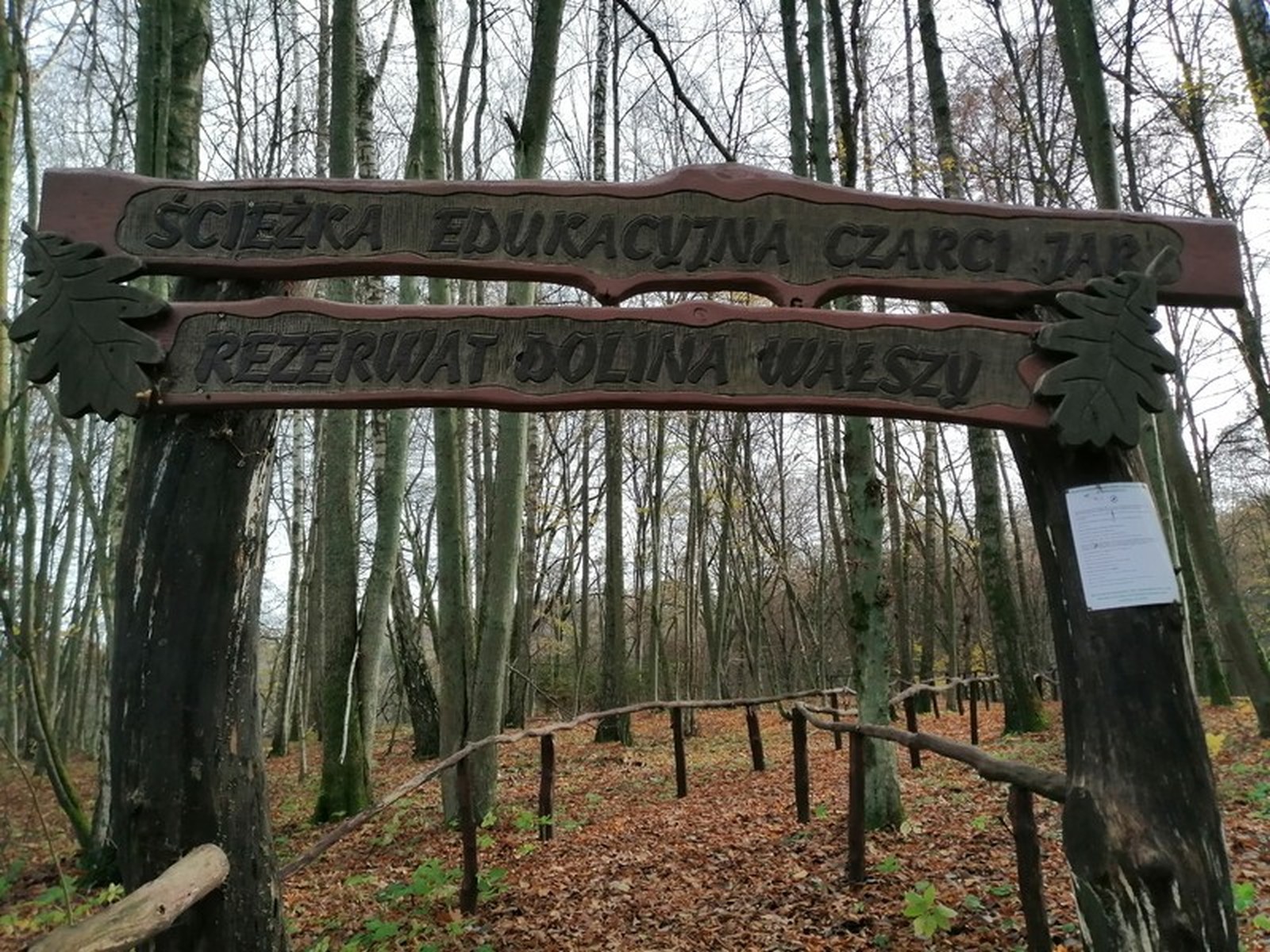
“Wałsza River Valley” Nature Reserve in Pieniężno
General Information
The landscape nature reserve “Wałsza River Valley,” with an area of over 200 hectares, was formally established on 30 April 1957. It is covered by active and landscape protection. The lands of the reserve are administered by the Orneta Forest District.
Location / Geographical Setting
The reserve encompasses the gorge section of the Wałsza River valley (a tributary of the Pasłęka) in the municipality of Pieniężno. The boundaries of the reserve include forests, waters, marshes, and agricultural land indicated in the ordinance of the Regional Director for Environmental Protection. The beginning of the educational trail starts in the area of the ruins of the castle in Pieniężno.
History / History and Cultural Heritage
The Wałsza Valley was described as early as the beginning of the twentieth century, among others by naturalists from the pre-war period. This area was regarded as a reserve before the First World War, as evidenced by its description made in 1907 by Hugo Conwentz (1855-1922), a pioneer of nature conservation in Prussia. In 1949, this information was reported by Professor Roman Kobendza (1886-1955) in the monthly journal “Chrońmy Przyrodę Ojczystą.” It is therefore one of the oldest reserves in the Masurian Lakeland area. After the Second World War, the statutory recognition of the reserve took place in 1957.
Within the area and in its vicinity there are historical traces of settlement. Archaeologists discovered traces of an early medieval Prussian stronghold dated to the eleventh and twelfth centuries. Situated on a gentle elevation and surrounded on all sides by natural watercourses, it fulfilled defensive and observational functions. The most visible cultural feature from the fourteenth century, located right at the boundary of the reserve, is the ruins of the castle in Pieniężno, from where one can descend directly to the nature trail beginning here.
About 3 km downstream from Pieniężno (on the left-hand side) there is the “miraculous spring.” The water flowing there contains large quantities of iron sulphide, which gives it a characteristic smell of hydrogen sulphide. At the spring, the Chapel of the Nativity was built, founded in 1826 by the widow of a local baker, identified in the inscription as “Witwe Germann” (sometimes rendered in Polish studies as Gehrman). Initially, the founder herself took care of the chapel. After her, the care was assumed by a relative of the family, also a baker, surnamed Müller. He possessed the keys to the chapel and was responsible for collecting donations placed in the alms box. The collected offerings were allocated to charitable purposes. During this period, the shrine was maintained in excellent condition. Around 1910, in accordance with an earlier ordinance of Bishop Andreas Thiel (1826–1908), the administration of the chapel was entrusted to the dean of Pieniężno. His duties included taking care of the appearance of the building, its interior, and the surroundings of the chapel. He also had the right to manage the offerings made there.
In 1938, the interior of the chapel was decorated with a painting depicting the Birth of Christ (stolen in the 1980s). In addition to it, there were two sculptures, the most important of which was a figure of the Immaculate Virgin Mary. Mary was shown in a crown of stars, standing on the Moon and the globe. According to accounts, this sculpture was made by a local peasant, and one of the girls from Pieniężno served him as the model.
The present appearance of the chapel differs significantly from the former one. During renovation works, the building lost its original Classicist appearance, and the characteristic rusticated façade was replaced with uniform plaster. Inside, apart from the altar mensa, little of the original furnishings has survived. A contemporary mosaic copy of the former Nativity painting has been hung on the exterior wall. After the war, the chapel was cared for by monks from the nearby Society of the Divine Word Missionaries, and today by the Orneta Forest District. Unfortunately, the chapel, situated in a secluded place, is sometimes exposed to damage and acts of profanation.
Natural and Landscape Values
The Wałsza is a small river with a relatively “mountain-like” character in its gorge section. This is evidenced by the trough-like and narrow fragments of the valley, where steep slopes and meanders create a picturesque, at times austere landscape. The walls of the ravine reach heights of 50–60 m; the river forms, among other features, rapids, boulder debris, and a swift current reminiscent of mountain rivers.
In the valley there are natural forest communities and riparian plants characteristic of riparian forests and oak-hornbeam forests. The reserve serves as a refuge for local fauna (water and marsh birds, small mammals, and invertebrates associated with wet habitats). The flora consists of around 300 plant species, including many protected ones, for example clubmoss, red helleborine, lesser butterfly-orchid, northern monkshood, giant horsetail, and mezereum. Plants that can be encountered in the forest floor include mezereum, wood sorrel, many-flowered stitchwort, evergreen wood-rush, yellow archangel, wood anemone, European wild ginger, ground elder, and hollowroot. Permanent inhabitants of the reserve include wild boar, roe deer, hare, badger, hedgehog, marten, squirrel, polecat, and raccoon dog. Red deer and moose periodically occur in the forests of the reserve. The Wałsza gorge is inhabited by numerous bird species: tits, woodpeckers, finches, jays, magpies, buzzards, treecreepers, kingfishers, dippers, ravens, crows, and blackbirds. Animals under strict protection include the beaver, otter, kingfisher, lesser spotted eagle, black stork, great crested newt, fire-bellied toad, brook lamprey, and European bullhead. The white stork, by contrast, is under partial protection.
The reserve is covered by active and landscape protection. As part of active protection, the following are undertaken, among other things: maintenance measures in ecosystems, habitat restoration, measures supporting species, regulation of tourist traffic, and various technical works intended to prevent environmental degradation. The aim of landscape protection, in turn, is to preserve the character, appearance, and aesthetic-natural values of a given area. It encompasses both natural and cultural elements, which together form the landscape.
In 2011, a multi-year project entitled “Construction of a model educational trail and reconstruction of the historic footbridge in the ‘Wałsza River Valley’ reserve” was completed in the reserve. This trail, as a prepared and marked tourist-educational route, was named “Czarci Jar.” As part of it, a parking area and route for people with disabilities were prepared, footpaths and footbridges were built, the historic bridge over the river was reconstructed, the observation tower was renovated, and the educational trail was modernized.
Bibliography
- Wałsza Valley ("Dolina Wałszy"), https://cudownezrodelka.pl/miejsce/dolina-walszy/, [accessed: 20.09.2025].
- "Kapelle am Heilbrunnen", https://de.wikipedia.org/wiki/Kapelle_am_Heilbrunnen, [accessed: 20.09.2025].
- "Catalogue of Strongholds of Warmia and Mazury" ("Katalog grodzisk Warmii i Mazur"), vol. 4, ed. Rafał Solecki, Warszawa 2024, pp. 207–231.
- Stanisław Kuprjaniuk, "Small Sacred Architecture in Warmia up to 1945, with Particular Emphasis on Wayside Shrines" ("Mała architektura sakralna na Warmii do 1945 r. ze szczególnym uwzględnieniem kapliczek"), Olsztyn 2016, p. 312.
- Reserve “Wałsza River Valley” ("Rezerwat „Dolina Rzeki Wałszy”"), https://bip.pieniezno.pl/artykul/73/68/rezerwat, [accessed: 20.09.2025].
- Wałsza River Valley Reserve ("Rezerwat Dolina Rzeki Wałszy"), https://encyklopedia.warmia.mazury.pl/index.php/Rezerwat_Dolina_Rzeki_Wa%C5%82szy, [accessed: 20.09.2025].
- Nature Reserve “Wałsza River Valley” ("Rezerwat przyrody „Dolina Rzeki Wałszy”"), https://pieniezno.pl/artykul/137/1892/rezerwat-przyrody-dolina-rzeki-walszy, [accessed: 20.09.2025].
- Ordinance No. 68 of the Regional Director for Environmental Protection in Olsztyn of 2 November 2010 concerning the nature reserve “Wałsza River Valley” ("Zarządzenie nr 68 Regionalnego Dyrektora Ochrony Środowiska w Olsztynie z dnia 2 listopada 2010 r. w sprawie rezerwatu przyrody „Dolina Rzeki Wałszy”"), „Official Journal of the Warmian-Masurian Voivodeship No. 182, item 2312” ("Dziennik Urzędowy Województwa Warmińsko-Mazurskiego Nr 182, poz. 2312").