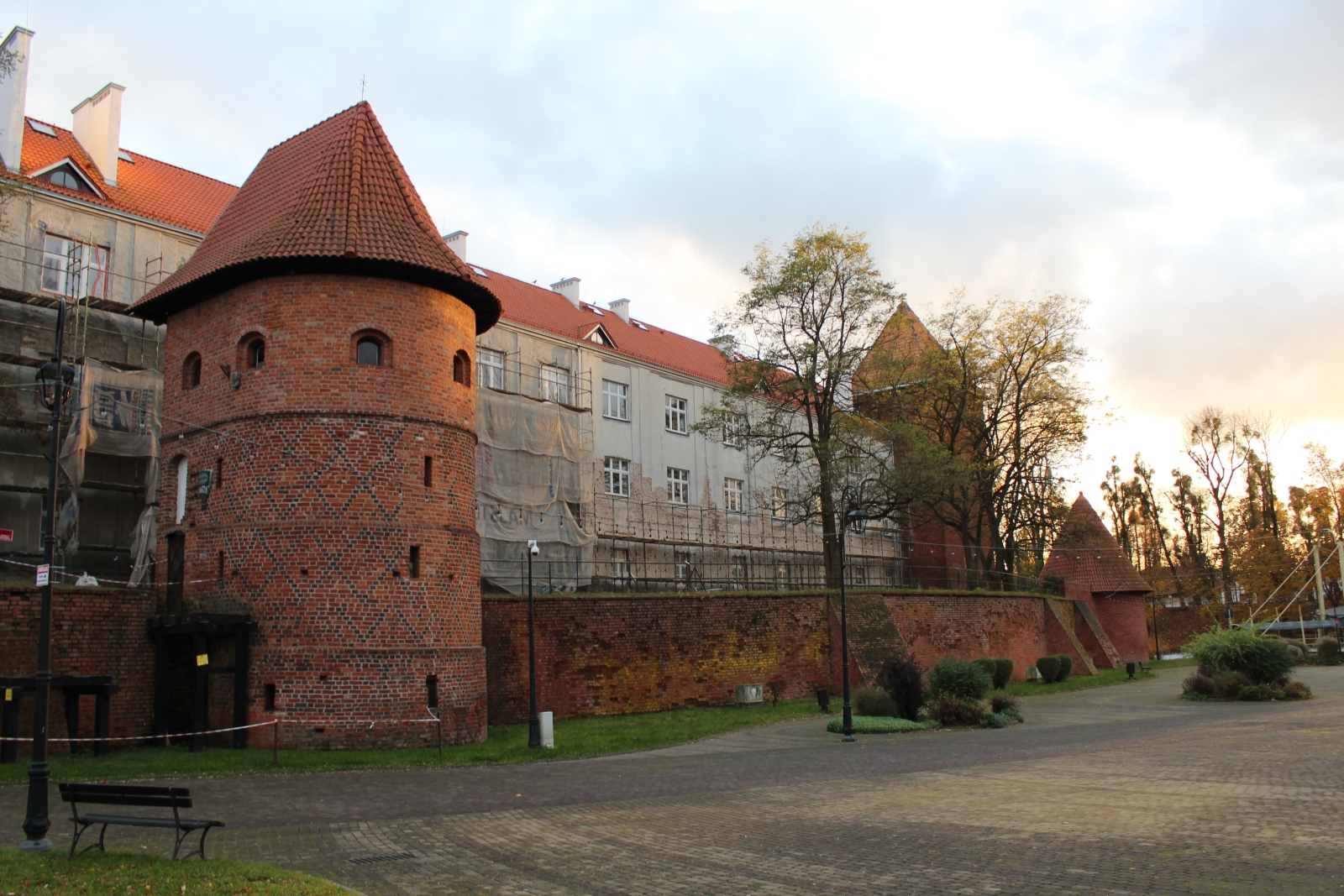
Museum of the Braniewo Region – the former Collegium Hosianum in Braniewo
General Information
The Hosianum Lyceum, more precisely the Hosianum Alumnate and Theological Seminary in Braniewo, was one of the most important and monumental educational centres in the history of Central and Eastern Europe. Founded in the sixteenth century by Cardinal Stanislaus Hosius (1504-1579), it constituted a bastion of the Counter-Reformation and a forge of intellectual elites for the Polish-Lithuanian Commonwealth, the Scandinavian countries, and Livonia. Over the centuries, the institution evolved from a Jesuit college, through an academy, to a State Academy in the nineteenth and twentieth centuries. Although the turbulent events of the Second World War reduced the town to ruins, the surviving wing of the former monastic and seminary complex now constitutes a priceless monument, within whose walls the Museum of the Braniewo Region has operated since 2016.
Location
The monument is located at 19 Gdańska Street. The complex is situated within the area of the former Old Town, not far from the Pasłęka River. The Museum of the Braniewo Region, which currently takes care of this space and has its seat there, presents relics of the former splendour of the region within authentic historic interiors.
History
The history of the Hosianum began in 1565, when the Bishop of Warmia, Stanislaus Hosius, brought the Jesuit order to Braniewo and founded a college. In 1567, Pope Pius V (1504-1572) approved here one of the first papal theological seminaries in the world (Alumnatus Pontificius), which in 1578 was transformed into a papal missionary seminary. The mission of the Braniewo Jesuits was to educate missionaries who were to return to countries dominated by Protestantism, such as Sweden or the German principalities, in order to re-Catholicise the North.
After the suppression of the Jesuit order in 1773, the Prussian authorities transformed the institution into an Academic Gymnasium, and in 1818 into the Hosianum Lyceum with academic status. During the Kulturkampf, the school was closed (1876-1886). In 1912, it was renamed Royal, and after 1918 State Academy. Outstanding humanists, theologians, and scholars studied there.
Over the centuries the school experienced periods of spectacular flourishing as well as wartime destruction, including during the Swedish Deluge. The present building was erected in the years 1743-1771, with an interruption from 1758 caused by a construction disaster, on the site of the former buildings of the Franciscan monastery. In the nineteenth century and in the 1930s the complex was rebuilt many times, partially losing its historic features. It is worth mentioning that in 1904 a western bay was added and the defensive tower known as Klesza was incorporated. The end of the splendour of the powerful Neo-Baroque and Baroque complex came at the beginning of 1945, when Braniewo was almost completely destroyed by the Red Army. From the former complex there survived only the south-western Baroque wing, which in 1956 was subjected to demolition. The reconstruction of the complex took place in the years 1960-1973; it served educational purposes, and today it houses the Jan Liszewski Vocational School Complex, while at present it also serves museum purposes.
Architecture
The building is a late Baroque wing of the former college, erected on the plan of an elongated rectangle. The monument is characterised by the monumental harmony and symmetry typical of the Baroque. The outer walls are plastered, and the façade is decorated with lesenes, flat vertical strips that give the building a monumental character and visually elongate it. Inside, the traditional three-storey layout with wide vaulted corridors has been preserved. The most valuable architectural elements of the interior are the original massive barrel vaults with lunettes and the groin vaults on the ground floor and first floor, which survived the fires and bombardments of 1945. They give the exhibition rooms of the Museum a unique monastic atmosphere. The whole is covered with a gable roof.
Furnishings
The original rich furnishings of the Jesuit college, including the splendid altar, sculptures, liturgical paraments, and the priceless Hosianum Library numbering thousands of volumes, were dispersed, plundered, or destroyed, with part of the unique books now located in Sweden and Olsztyn. Today, thanks to the activity of the Museum of the Braniewo Region, the interiors of the former seminary have been furnished with rich historical collections, works of sacral art, and artistic craftsmanship. In the rooms of the former Hosianum one may admire unique location documents, old maps of Warmia, militaria, and craft memorabilia. A special place is occupied by surviving sacral artefacts from Braniewo churches and school memorabilia documenting the multinational academic past of this building.
Curiosities
Because of the extraordinarily high level of education in theology, philosophy, mathematics, and classical and oriental languages, sixteenth- and seventeenth-century Braniewo was called in Europe the “Athens of the North”.
During the Polish-Swedish war of 1626-1629, the Swedes plundered the library and took the book collection to Sweden. These spoils became the foundation of the newly established university library in Uppsala, where they remain to this day.
Within the walls of the Braniewo seminary many statesmen and scholars studied, including St Andrew Bobola, a Jesuit and martyr, and the outstanding Polish Baroque composer Jacek Różycki.
Bibliography
- Achremczyk Stanisław, Szorc Alojzy, "Braniewo", Olsztyn 1995, p. 163 ff.
- Chorostian Bogusława, Braniewo, in: "Braniewo. Z dziejów miasta i powiatu", ed. Jerzy Chojnowski et al., Olsztyn 1973, p. 134.
- Collegium Hosianum, https://zszbraniewo.pl/index.php/pl/o-szkole/2014-06-25-09-39-35, [accessed: 10.10.2025].
- Former Braniewo Academy, the so-called Hosianum Lyceum, https://zabytek.pl/pl/obiekty/braniewo-d-akademia-braniewska-tzw-liceum-hosionum, [accessed: 10.10.2025].
- Former Jesuit College, https://www.it.braniewo.pl/index.php/warto-zobaczyc/dawne-kolegium-jezuickie, [accessed: 10.10.2025].
- The building of the Jesuit college in Braniewo, http://leksykonkultury.ceik.eu/index.php/Gmach_kolegium_jezuickiego_w_Braniewie, [accessed: 10.10.2025].
- "Katalog zabytków sztuki w Polsce. Seria nowa, t. 2: Województwo elbląskie, z. 1: Braniewo, Frombork, Orneta i okolice", prepared by Marian Arszyński and Marian Kutzner, ed. Jerzy Z. Łoziński, Barbara Wolff-Łozińska, Warszawa 1980, pp. 27-29.
- Szorc Alojzy, "Kolegium jezuickie w Braniewie i jego księgozbiór 1565-1626", Olsztyn 1998.
- Ceremonial opening of the Museum of the Braniewo Region, https://gazetaolsztynska.pl/artykul/uroczyste-otwarcie-muzeum-n1927945, [accessed: 10.10.2025].