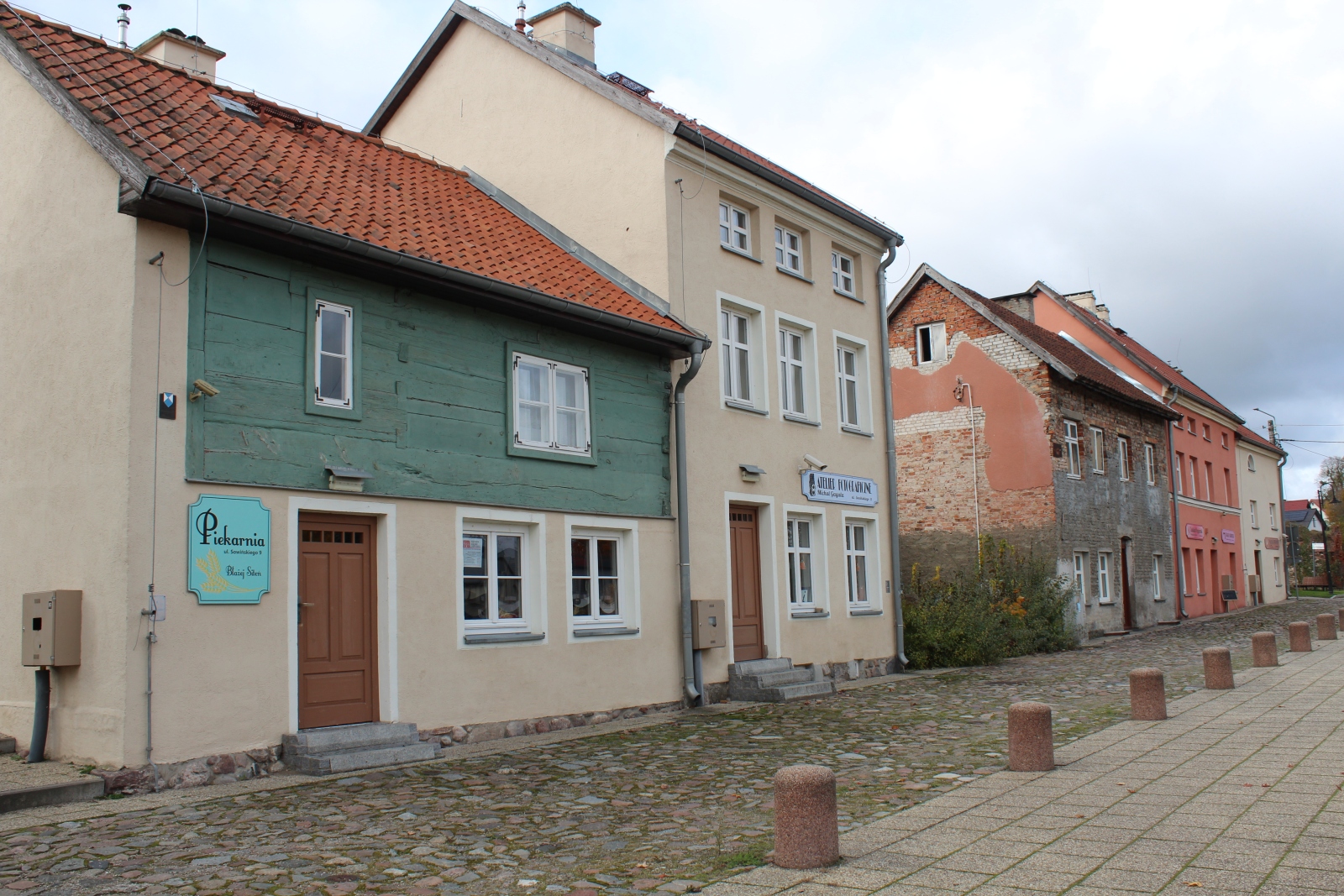
Municipal Open-Air Museum in Dobre Miasto
General Information
The Municipal Open-Air Museum in Dobre Miasto is a complex of historic burgher tenement houses transformed into an in situ museum of crafts and everyday life in a small Warmian town. The exhibitions, operating under the title "Traditional Crafts in a Warmian Town", reconstruct the interiors of workshops and dwellings of craftsmen from the turn of the 19th and 20th centuries, using original equipment, tools, and furnishings. In this way, they create a narrative about the material and social background of former urban culture.
The open-air museum constitutes one of the key cultural and tourist attractions of Dobre Miasto and fits into the concept of an “urban open-air museum” as a specific form of open-air museum practice. This model is not based on the relocation of monuments, but on the preservation and interpretation of authentic historic buildings within their original urban context.
Location
The Municipal Open-Air Museum is located in the very centre of Dobre Miasto in Warmia, in the Warmian-Masurian Voivodeship, approximately 25 kilometres north-west of Olsztyn, in the Łyna River valley. The complex of tenement houses at Józefa Sowińskiego Street, situated directly at the foot of the medieval Stork Tower and the former town defensive walls, forms a fragment of the historic frontage in the area of a former trade route and market facilities of the chartered town.
At present, the complex includes tenement houses numbered 5, 7, 9, 11, 15, and 17, recognised in municipal documentation as an important element of the historic urban layout of Dobre Miasto.
History
The origin of the Municipal Open-Air Museum is inseparably connected with the development of craftsmanship and urban architecture in Dobre Miasto from the late Baroque period to the 19th century. The tenement houses along today’s Sowińskiego Street, erected at the turn of the 17th and 18th centuries as brick, multi-storey buildings on narrow and deep plots, represent a typical model of development found in Warmian towns. Workshops or shops were located on the ground floor, while the upper storeys housed the living quarters of the owners and their families.
The location of these buildings in the vicinity of the town gate and the Stork Tower favoured the establishment of service activities catering both to transit traffic and to the local market. Over the centuries, bakers, shoemakers, tailors, saddlers, barbers, and other craftsmen worked here, forming a dense network of small enterprises characteristic of Warmian small towns.
In the 19th and early 20th centuries, the tenement complex was gradually adapted to the changing needs of a commodity-money economy. Ground floors were rebuilt, shop windows widened, and new installations and functional divisions introduced, while preserving the fundamental structural system and building mass. These changes document the evolution of small-town craftsmanship—from workshops serving almost exclusively the local community to enterprises integrated into broader regional economic networks.
After 1945, the tenement houses, nationalised and used in various ways, gradually deteriorated technically. Some were converted into low-standard municipal housing, while others were left in an advanced state of degradation. War damage, lack of systematic renovation, and changing functions led to a situation in which, despite formal conservation protection, the complex was considered at the beginning of the 21st century to be one of the most endangered fragments of the historic fabric of Dobre Miasto.
A breakthrough came with the process of revitalisation of the old town, carried out by the municipal authorities using national and European Union funds, and in cooperation with institutions involved in cultural heritage protection. As part of a broader programme aimed at restoring the historical value of the urban fabric, a decision was made to assign the tenement houses at Sowińskiego Street to museum and educational purposes, using their authentic substance as a medium for telling the story of urban life and craftsmanship.
The adaptation initially focused on tenement houses numbered 11, 15, and 17, which are listed in the register of monuments. Comprehensive structural and conservation works were carried out, restoring historical interior divisions and the legibility of the original building structure. The interiors were then furnished according to the concept of permanent exhibitions developed in cooperation with the Museum of Folk Architecture – Ethnographic Park in Olsztynek.
A key moment in the history of the site was the ceremonial opening of the Municipal Open-Air Museum on 5 July 2014, marking the completion of several years of construction and exhibition work. As a result, a series of exhibitions reconstructing historical workshops and living spaces was created, including a shoemaker’s workshop combined with a saddler’s workshop, a bakery with the baker’s dwelling, a photographic studio, and tailoring and barber workshops. These interiors illustrate the diversity of workspaces and everyday life of petty-bourgeois families.
The furnishings consist of authentic furniture, tools, and small household items from the late 19th and early 20th centuries, as well as from the interwar period, obtained from museum collections and donations from local residents. This gives the exhibitions the character of a local archive of memory. In museological literature, it has been emphasised that the solutions adopted in Dobre Miasto—from the fidelity of reconstruction to the composition of exhibition narratives—place the museum within the current of modern heritage interpretation, which focuses on the experience of space and the everyday life of “ordinary” town inhabitants, rather than exclusively on representative monuments of art.
In subsequent years, the museum complex was functionally expanded to include neighbouring tenement houses, as documented in municipal reports. According to data for 2024, the Municipal Open-Air Museum comprises buildings at Sowińskiego Street 5, 7, 9, 11, 15, and 17, which perform both exhibition and educational functions.
Tenement house no. 17 houses a reconstructed shoemaker’s workshop on the ground floor, while the upper floors contain historical exhibitions devoted to the Napoleonic Wars in the municipality and to the history of Dobre Miasto. Tenement house no. 15 includes reconstructed interiors of a tailor’s workshop, barber’s shop, and photographic studio. Due to the rental of part of the premises in building no. 11, it also accommodates a ceramics workshop and a guide’s office.
Tenement house no. 9 combines a reconstructed bakery on the ground floor with the baker’s living quarters on the upper floor, while buildings no. 5 and 7—although included in the museum’s premises—have been temporarily excluded from use due to the need for renovation following a heating system failure in 2022.
This functional arrangement means that the open-air museum combines features of a traditional interior museum with those of a living cultural institution, using part of its space for workshops, meetings, and community activities. In this way, the site reflects broader trends in treating heritage as a developmental resource within the strategies of Cittaslow municipalities.
Today, the Municipal Open-Air Museum in Dobre Miasto fulfils a triple role: it serves as a repository of authentic historic fabric, a tool for education about the history of the town and Warmian craftsmanship, and a laboratory of local heritage policy, in which forms of engaging residents in the protection and interpretation of their immediate surroundings are tested.
Bibliography
- "Cultural Heritage in Research. Local Development and Strategic Management Based on Cultural Heritage" (Dziedzictwo kulturowe w badaniach. Rozwój lokalny i strategiczne zarządzanie rozwojem gminy w oparciu o dziedzictwo kulturowe), ed. Aleksandra Chabiera, Adam Dąbrowski, Anna Kozioł, Piotr Nowak, Bartosz Skaldawski, Kraków–Warsaw 2021.
- "Heritage Next to Me – Inspirations for Local Actions" (Dziedzictwo obok mnie – inspiracje do działań lokalnych), ed. Aleksandra Chabiera, National Heritage Institute, Warsaw 2016.
- "Report on the State of the Municipality of Dobre Miasto for 2024" (Raport o stanie Gminy Dobre Miasto za rok 2024), Dobre Miasto 2024.
- Suchenek Zygmunt, "Dobre Miasto. A Fragment of Charming Warmia" (Dobre Miasto. Skrawek uroczej Warmii), Gdańsk 2011.
- Wieczerzak Jadwiga, "“Traditional Crafts in a Warmian Town”. Permanent Exhibitions in Tenement Houses in Dobre Miasto" („Dawne rzemiosło w warmińskim miasteczku”. Wystawy stałe w kamienicach w Dobrym Mieście), “Scientific Journal of the Museum of Folk Architecture – Ethnographic Park in Olsztynek”, 2014, vol. 5, pp. 93–105.