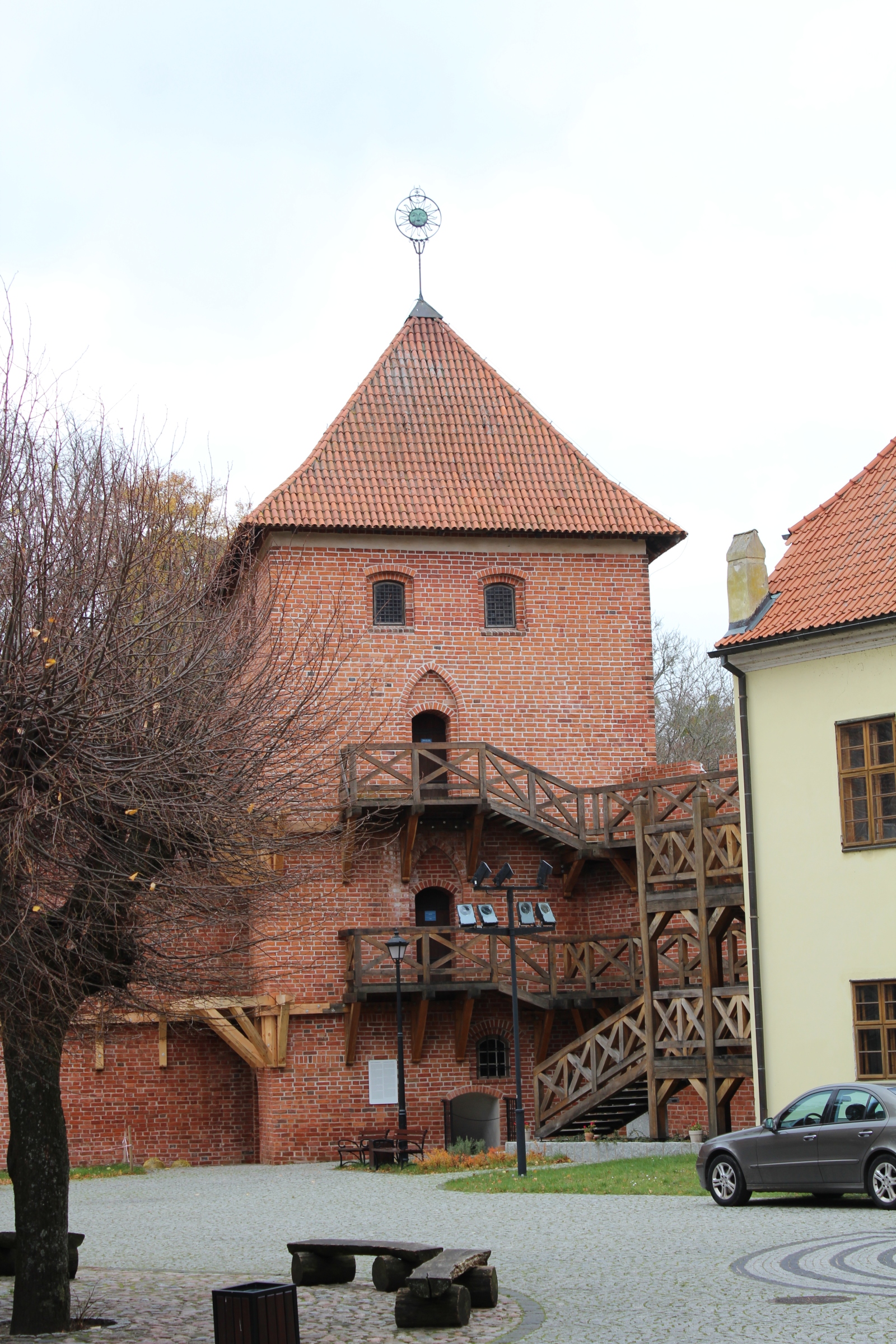
Copernicus Tower in Frombork
General Information
Copernicus Tower is an element of medieval defensive-residential architecture, being part of the fortified Cathedral Hill. This monument possesses the highest class of historical authenticity and is entered on the list of Historic Monuments. Its common name, functioning since the seventeenth century, is owed to Nicolaus Copernicus, who was its owner and user in the first half of the sixteenth century. Today the building constitutes one of the branches of the Nicolaus Copernicus Museum in Frombork.
Location
The structure is situated in the north-western corner of the fortifications of Cathedral Hill in Frombork, at 8 Katedralna Street. The tower rises on a steep hill towering above the town and the waters of the Vistula Lagoon. Such a strategic location ensured excellent defensive qualities in the Middle Ages and an ideal field of observation.
History
The tower was erected before 1400 and is regarded as the oldest surviving element of the hill’s fortifications. Originally it fulfilled purely defensive functions as a corner bastion, protecting access to the cathedral from the north-western side. Over time, its interiors were adapted for residential purposes.
The statutes of the Warmian chapter imposed on every canon the obligation to possess secure lodgings within the walls in the event of war. In July 1499 the chapter decided to assign bastions to individual clergymen. Nicolaus Copernicus took over this tower as his property and used it, with interruptions, probably from 1504 to 1543. Although the astronomer possessed a more spacious canon’s house outside the town walls, the tower served him as a secure refuge in times of unrest, for example during the wars with the Teutonic Order, and as a place for storing valuable books and manuscripts.
Over the centuries the upper storeys of the tower were repeatedly rebuilt. During the period of the partitions, the Prussian authorities transferred the tower to the Hosianum Gymnasium in Braniewo. The authorities of that institution intended to demolish the tower and sell the bricks to private purchasers. The opposition of the Warmian chapter, supported by the opinion of the provincial conservator Ferdinand von Quast (1807-1877), caused the Royal Ministry of the Interior in 1861 to transfer the tower back to the Warmian chapter.
In 1912, on the initiative of the historian and Warmian canon Eugen Brachvogel (1882-1942), the first memorial chamber dedicated to the astronomer was created in the tower. In 1945 the structure was completely burnt down by the Red Army. Reconstruction works, which restored its original Gothic appearance, were completed in 1965. In recent years the tower has undergone thorough modernisation works as part of the creation of the European Copernicus Centre.
Architecture
The structure is a classic example of medieval brick Gothic of a military character. It is a basemented, four-storey building erected on a square plan. The lower parts of the walls are extremely thick, constructed in Gothic brick bond, with locally visible vitrified headers, strongly fired dark bricks arranged in geometric patterns.
A characteristic architectural feature of the tower is its external wooden defensive galleries, from which the higher storeys were formerly accessed. The interiors of the individual floors, connected by steep wooden stairs, are marked by austerity: the windows have pointed-arch or segmental splays, and the ceilings were made of massive wooden beams. The structure is crowned with a high hipped tent roof covered with ceramic tiles.
Furnishings
The original furniture, instruments, and personal belongings of Nicolaus Copernicus were burnt or lost in the course of wartime conflagrations, mainly in the seventeenth century and in 1945. For this reason, the present museum exhibition inside the tower has the character of a historical arrangement with a popular-scientific profile. One of the exhibitions presents the astronomer’s private world. It has been arranged on three levels and aims at a vivid presentation of the daily life of a canon in the Renaissance era. Here one finds reconstructions of a medieval-Renaissance kitchen on the lowest level, the canon’s bedroom on the second level, and the scholar’s study, a scriptorium with a replica of a working table, an armchair, and a mannequin depicting Copernicus at work on the third level.
The tower contains valuable substitute historical objects: Renaissance and Baroque chest furniture, wardrobes, tables, old writing implements, vessels of everyday use, and copies of the astronomical instruments used by the scholar, including the triquetrum, quadrant, and astrolabe. Some of the exhibits, saved from the devastation of the Second World War, come from the first museum exhibition in Frombork, organised by Eugen Brachvogel.
Curiosities
The greatest and most deeply rooted myth in Polish culture is the belief that Copernicus observed the sky directly from the terrace of this tower. This vision was perpetuated by Jan Matejko (1838-1893) in the famous painting "Astronomer Copernicus, or Conversation with God". In reality, he did not study the sky from there – the steep, high walls and the lack of a stable platform made precise measurements impossible. The astronomer conducted observations in the garden of his external canon’s house, on a specially levelled brick platform called the "pavimentum".
Bibliography
- Pagaczewski Janusz, "A contribution to the reconstruction of Copernicus Tower in Frombork", “Komunikaty Mazursko-Warmińskie”, 1967, no. 4, pp. 571-575.
- Romanowska Ada, "A canon and a householder. Copernicus’s house and tower in Frombork", https://kopernik.warmia.mazury.pl/kanonik-i-gospodarz-dom-i-wieza-kopernika-we-fromborku/, [accessed: 2.09.2025].
- Sikorski Jerzy, "The tower, house, and Frombork observatory of Nicolaus Copernicus and his farms", “Komunikaty Mazursko-Warmińskie”, 1969, no. 4, pp. 619-645.
- Szymański Stanisław, "Copernicus Tower in Frombork", “Ochrona Zabytków”, 1953, no. 6/1 (20), pp. 57-63.
- Copernicus Tower, https://zabytek.pl/pl/obiekty/frombork-wieza-kopernika, [accessed: 2.09.2025].
- Copernicus Tower in Frombork, https://infogdansk.pl/wieza-kopernika-we-fromborku/, [accessed: 2.09.2025].
- Nicolaus Copernicus Tower in Frombork, https://encyklopedia.warmia.mazury.pl/index.php/Wie%C5%BCa_Miko%C5%82aja_Kopernika_we_Fromborku, [accessed: 2.09.2025].