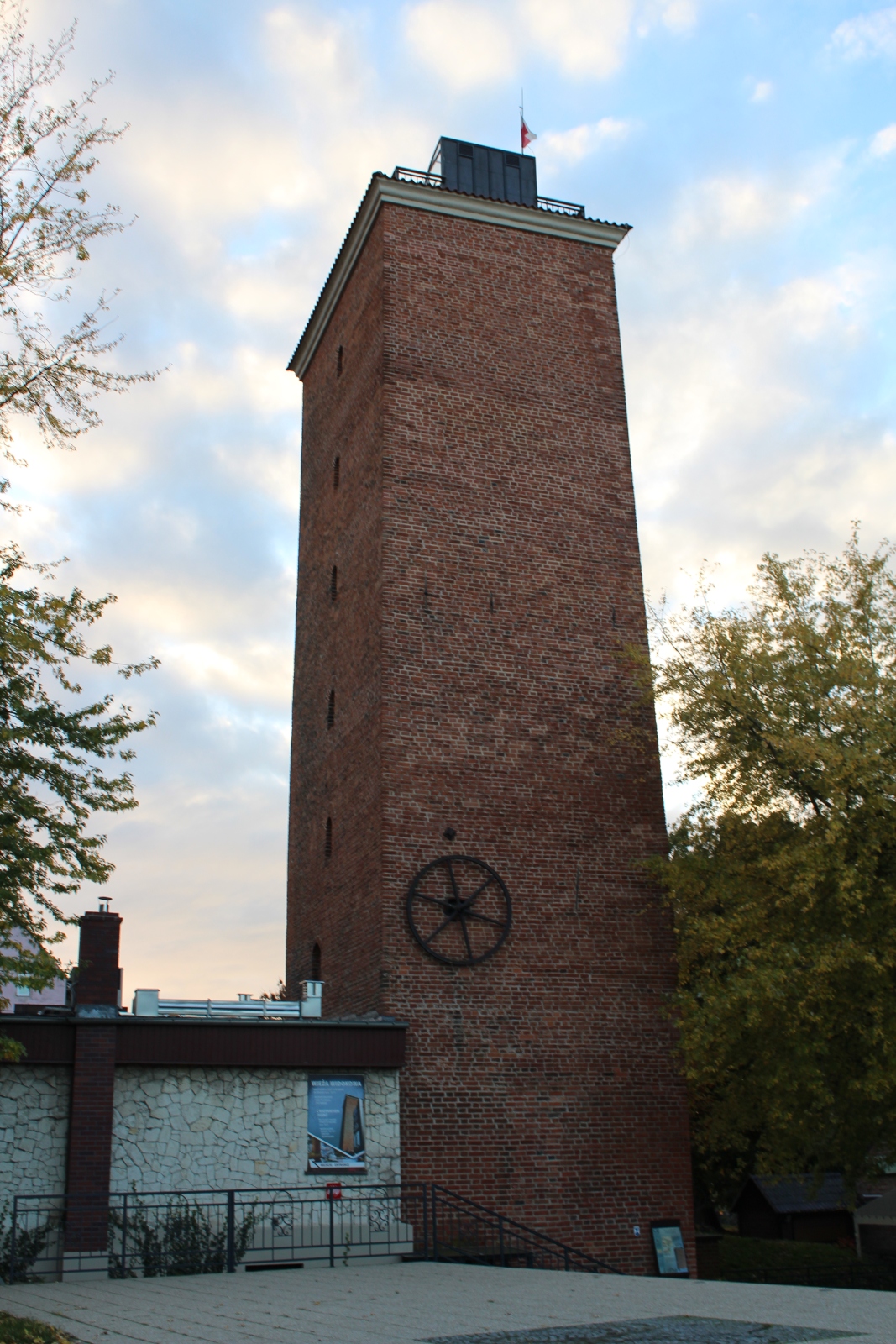
Water Tower in Frombork
General Information
The Water Tower in Frombork is one of the most valuable and most unique monuments of hydraulic engineering on the scale of the whole of Europe. Erected in the Late Gothic-Renaissance style, it constitutes material evidence of the skill of former engineers. It is the oldest preserved water tower in Poland and the second oldest in Europe (after a similar structure in Augsburg).
Location / Geographical Setting
The tower is geographically situated in the north-western part of the town, at the foot of Cathedral Hill, above the canal connecting the Bauda River with the Vistula Lagoon, at 2 Elbląska Street, near road no. 504 leading from Frombork to Braniewo and Elbląg.
History
The history of the water tower is connected with the water mill existing since the first half of the fourteenth century and with the construction, for the needs of the Warmian Chapter, of a water supply system in the second half of the sixteenth century, which was to deliver water to Cathedral Hill. The tower was erected in 1571, probably on the site of an earlier mill. Already in the same year, a novel lifting system began to be installed in it – a water hoist called a paternoster, which was put into operation in 1572. The creator of this mechanism – as evidenced by the preserved contract and accounts from the time of construction – was the Wrocław engineer Walenty Hendel (great-grandfather of the composer George Frideric Handel). It is known that the device was repaired and modernized several times in the second half of the seventeenth century (1637, 1649, 1664, 1680, 1681, 1682, 1684) and at the beginning of the eighteenth century (1720). The water supply system functioned continuously for about two centuries, but after the annexation of Warmia by Prussia in 1772 its repairs were abandoned. The worn wooden and copper devices were devastated at the end of the eighteenth century, and the system was replaced by simpler wells. The remains of the lifting system were dismantled at the beginning of the nineteenth century. Until the end of the Second World War, a mill with a wheel driven by the waters of the canal functioned in the tower. As a result of military operations in 1945, the tower was damaged by fire, and the canal bringing the water was also seriously damaged. The remains of the mill buildings were removed in the 1960s.
In 1964, the water tower was rebuilt, adapting it to the role of a viewing point of the Society of Astronomy Enthusiasts. Structural elements were then altered, among other things new inter-storey divisions, reinforced concrete ceilings or platforms, stairs, and a new roof covering of the building were introduced. Three years later, on the site of the filled-in turbine chamber, a low commercial pavilion was built, which somewhat distorted the body of the structure.
At present, after a comprehensive renovation in 2012, the tower performs museum functions, houses a café, and serves as an excellent viewing point. In 2013, the tower was awarded the title “Well-Kept Monument” in a competition of the Minister of Culture and National Heritage.
Architecture / Architecture and Spatial Layout
The tower was laid out on a rectangular plan (6.20 x 8.30 m), with a vaulted canal running along the transverse axis. It was covered with a new flat concrete roof with a metal riveted barrier, which serves as a viewing terrace. Originally, the tower possessed seven storeys connected by ladder stairs; today only the ground floor is provisionally covered by a ceiling. Three elevations possess six small window openings closed semicircularly; in the western elevation there is an entrance opening closed with a segmental arch and three rectangular former door openings leading to the no longer existing mill building. On the eastern elevation one may discern the relic of a cast-iron belt pulley. Inside there are four usable levels, with contemporary ceilings and reinforced concrete stairs, and on the interior walls the clear levels of the former ceilings are visible. In its lower part, the tower was built of ceramic brick in Gothic bond, whereas in the upper part the bricks were laid less carefully in block bond, which indicates two phases of construction of the monument.
Curiosities
For centuries it was commonly believed that the creator of the Frombork water supply system was Nicolaus Copernicus himself. Although the astronomer was interested in hydraulic engineering, scholarly research has excluded this – Copernicus died in 1543, that is almost 30 years before the construction of the tower. A remembrance of this legend remains, however, in the name of the canal supplying the tower (Copernicus Canal).
Visiting the tower today, one can see a fully functional reconstructed model of the former bucket-lifting mechanism, which illustrates how water was transported uphill without the use of electric energy.
Bibliography
- Wiktoria Głodowska, The Water Tower in Frombork – the Oldest in Poland, the Second in Europe ("Wieża Wodna we Fromborku - najstarsza w Polsce, druga w Europie"), https://www.bryla.pl/wieza-wodna-we-fromborku-najstarsza-w-polsce-druga-w-europie, [accessed: 12.09.2025].
- "Catalogue of Monuments of Art in Poland. New Series", vol. 2: Elbląg Voivodeship, fasc. 1, Braniewo, Frombork, Orneta and Surroundings ("Katalog zabytków sztuki w Polsce. Seria nowa, t. 2: Województwo elbląskie, z. 1, Braniewo, Frombork, Orneta i okolice"), prepared by Marian Arszyński and Marian Kutzner, ed. Jerzy Z. Łoziński, Barbara Wolff-Łozińska, Warszawa 1908, pp. 114-115.
- Iwona Liżewska, Water Tower ("Wieża wodociągowa"), https://zabytek.pl/pl/obiekty/frombork-wieza-wodna, [accessed: 12.09.2025].
- Bolesław Orłowski, Copernicus Did Not Build the Water Supply System in Frombork ("Kopernik nie budował wodociągu we Fromborku"), “Komunikaty Mazursko-Warmińskie”, 1959, no. 2, pp. 121-149.
- Bolesław Orłowski, Legend and Truth about the Pseudo-Copernican Water Supply Systems ("Legenda i prawda o pseudokopernikowskich wodociągach"), https://stalker.udl.pl/private/dokumenty/legenda_i_prawda_o_pseudokopernikowskich_wodociagach.pdf, [accessed: 12.09.2025].
- Tadeusz Piaskowski, Henryk Szkop, "Monuments of Frombork" ("Zabytki Fromborka"), Frombork 2003, pp. 99-100.
- Cezary Wawrzyński, The Frombork Water Tower – a Sixteenth-Century Water Engineering Wonder ("Fromborska Wieża Wodna – wodociągowy cud techniki XVI wieku"), https://www.wiezawodna.pl/, [accessed: 12.09.2025].