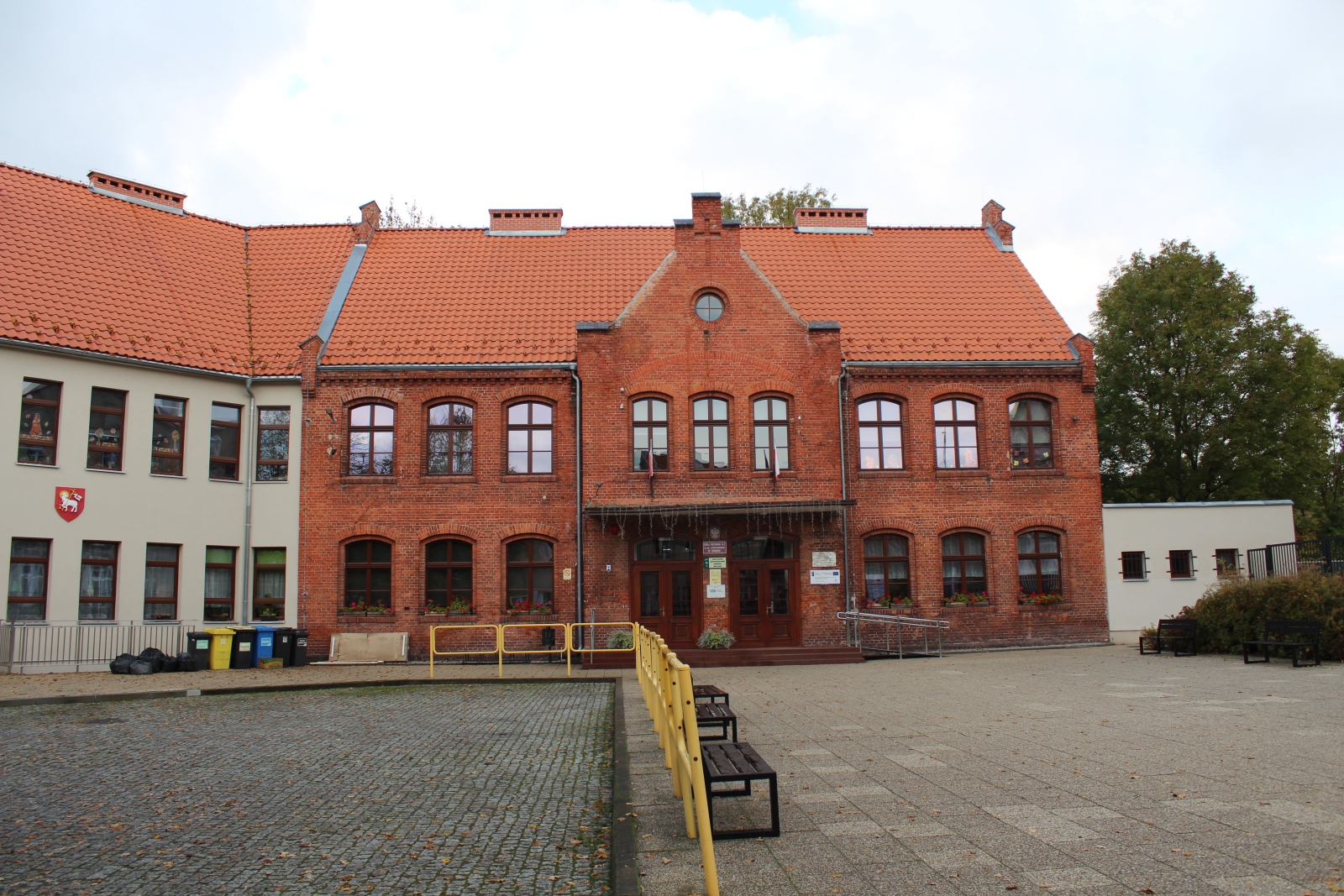
Episcopal Castle (demolished) in Orneta
General Information
The now non-extant castle of the Warmian bishops in Orneta is one of the least known sites on the map of the former Warmian Dominium. It was a medieval defensive-residential stronghold erected in the style of Brick Gothic and heavily Baroquized in later centuries. For centuries it served as the administrative centre of the Orneta chamber district, being a symbol of the ecclesiastical and territorial authority of the bishops in this area. Today, the building of Primary School No. 1 stands on its site.
Location / Geographical Setting
The castle was situated in the north-western part of the medieval urban layout of the town, on an escarpment above the Drwęca Warmińska River. In the Middle Ages, the castle stood on the edge of the town – on one side there was the escarpment and the valley of the Drwęca, on the other urban development. Two key arteries led to the castle courtyard: Zamkowa Street (running from the market square) and Kościelna Street (leading from the Gothic parish church of St. John the Baptist). Today, the building of Primary School No. 1 stands on the castle foundations at 26 Zamkowa Street.
History
The stronghold in Orneta was probably built before 1315 during the time of Bishop Eberhard of Nysa (c. 1250–1326), who was its founder. Around 1340, the castle was expanded and designated as the bishop’s seat. The complex was bounded by the escarpment on the north and by a transit street ending with the Lower Gate (Łazienna Gate) on the south. The perimeter walls were equipped with three towers placed in the western curtain wall. Initially, a single masonry, three-storey castle building with an adjacent tower was located in the courtyard. The most important moment in the history of the building came in the years 1341–1349, when Bishop Herman of Prague (c. 1280-1349) transferred the main capital of the diocese here from Braniewo. For less than a decade, Orneta was the heart of Holy Warmia.
After Bishop Jan of Miśnia (1300-1355) moved the episcopal seat to Lidzbark Warmiński in 1350, the castle served as the seat of the administrator of church estates (the chamberlain). He collected rents and dues from village heads and took care of the condition of the municipal fortifications. Income was also provided by two mills, a sawmill, a fulling mill, and a manor farm located north-west of the town. The townspeople of Orneta were burdened with onerous obligations towards a bishop favourable to the Teutonic Order. These factors became one of the reasons for their joining the Prussian Confederation. It was in Orneta that an assembly of representatives of Warmian towns took place in 1454. The rebellious townspeople then captured and plundered the castle and the episcopal mill. In the following year, during the Polish-Teutonic Thirteen Years’ War, the castle came under the control of the mercenary knights of the Prussian Confederation (aligned with the Polish side), and the forces of the Teutonic Order failed to capture Orneta thanks to its strong municipal fortifications. In 1460, the townspeople handed Orneta over to Bishop Paweł Legendorf (c. 1410–1467), who favoured Poland.
Although after the Second Peace of Thorn (1466) all of Warmia passed under Polish rule, fighting over Orneta continued until 1525. During the period of Warmia’s autonomy within the Polish-Lithuanian Commonwealth, the owners of the castle, namely the Warmian bishops Szymon Rudnicki (1552–1621) and Teodor Andrzej Potocki (1664–1738), carried out the reconstruction of the residence. The latter erected a Baroque house on the western side reaching the south-western round tower. Bishop Jan Krzysztof Szembek (1680–1740) initiated a further Baroque rebuilding of the castle.
After the First Partition of Poland and the annexation of Warmia by Prussia (1772), the castle fell into neglect and the Prussian authorities ultimately decided to demolish it. The first demolition works began around 1806, with the defensive walls being torn down. In the second half of the nineteenth century, the residential wings of the castle were demolished, and a school building was erected on their foundations, which continues to serve this function to the present day.
Today, the only material remains of the castle are cellars with Gothic vaults (barrel and ribbed cross vaults), which are located in the school building and serve the children as cloakrooms. The school building may be seen from the outside – the site is accessible, although the castle survives only in the memory of the inhabitants.
Architecture / Architecture and Spatial Layout
The castle was erected of brick on stone foundations. The layout of the plan was irregular, close to a pentagon or trapezoid, which was dictated by the topography of the site (the escarpment above the Drwęca). On the town side, the castle was surrounded by a defensive wall with a gate, and further on by three towers placed along the western curtain wall; one of the towers was cylindrical and the other two quadrilateral. Within the walls there was a courtyard measuring approximately 29 x 38 metres. In the courtyard stood a masonry, three-storey residential building (the main house) with an adjoining tower. The ground floor housed utility rooms (kitchen, bakery, armoury). The rooms on the upper floor fulfilled representative functions: the apartment of the bishop/burgrave, the chapel, and the refectory (dining hall). The uppermost storey served defensive purposes (there were guard-walks with arrow slits) and storage functions.
Apart from the residence itself, the castle was surrounded by a manor farm, mills, a sawmill, and a cloth-making workshop, which made it a centre not only of defence but also of economic activity. The building was not directly connected with the town fortifications – it had its own, independent defences.
Curiosities
Primary School No. 1, which was built on the ruins of the stronghold, is entered in the register of monuments precisely because of the castle cellars hidden within its foundations.
Bibliography
- Janusz Bieszk, "Castles of the Teutonic State in Poland" ("Zamki państwa krzyżackiego w Polsce"), Warszawa 2010, pp. 219–222.
- Mirosław Garniec, Małgorzata Jackiewicz-Garniec, "Castles of the Teutonic State in Former Prussia: Powiśle, Upper Prussia, Warmia, Mazury" ("Zamki państwa krzyżackiego w dawnych Prusach: Powiśle, Górne Prusy, Warmia, Mazury"), 2nd ed., Olsztyn 2009, pp. 312–317.
- Leszek Kajzer, Stanisław Kołodziejski, Jan Salm, "Lexicon of Castles in Poland" ("Leksykon zamków w Polsce"), Warszawa 2007, p. 359.
- Wojciech Kujawski, "Warmia. Copernicus. Copernicus. Hiking Trail" ("Warmia. Kopernik. Copernicus. Szlak wędrowny"), Olsztyn 2023.
- Orneta, in: "Catalogue of Castles, Palaces and Manor Houses in Poland" ("Katalog zamków, pałaców i dworów w Polsce"), https://www.polskiezabytki.pl/m/obiekt/6917/Orneta/, [accessed: 4.09.2025].
- Orneta. Medieval Episcopal Castle ("Orneta. Średniowieczny zamek biskupi"), https://zamkomania.pl/orneta.php, [accessed: 4.09.2025].
- Orneta – Episcopal Castle ("Orneta – zamek biskupi"), https://medievalheritage.eu/pl/strona-glowna/zabytki/polska/orneta-zamek-biskupi/, [accessed: 4.09.2025].
- Wojciech Wółkowski, "The Beginnings of Warmian Castles – the Problem of the Original Functional and Spatial Layouts of the Castles of the Warmian Dominium up to the Mid-Fourteenth Century" ("Początki zamków warmińskich – problem pierwotnych układów funkcjonalno przestrzennych zamków dominium warmińskiego do połowy XIV wieku"), in: "The Beginnings of Masonry Castles in Poland up to the Mid-Fourteenth Century" ("Początki murowanych zamków w Polsce do połowy XIV wieku"), ed. Agnieszka Bocheńska, Przemysław Mrozowski, Warszawa 2017, pp. 113–126.
- Castle of the Warmian Bishops in Orneta (former) ("Zamek biskupów warmińskich Ornecie (dawny)"), https://polska-org.pl/8979641,Orneta,Zamek_biskupow_warminskich_Ornecie_dawny.html, [accessed: 4.09.2025].
- Castle in Orneta ("Zamek w Ornecie"), http://leksykonkultury.ceik.eu/index.php/Zamek_w_Ornecie, [accessed: 4.09.2025].
- Castle in Orneta ("Zamek w Ornecie"), https://www.zamki.pl/?idzamku=orneta, [accessed: 4.09.2025].
- Castle in Orneta ("Zamek w Ornecie"), https://zamkiobronne.pl/zamek/orneta/, [accessed: 4.09.2025].